
HTTP/3 and its underlying transport protocol, QUIC (RFC 9000), fundamentally transform web communications by operating entirely over UDP rather than TCP. By replacing TCP’s rigid stream ordering and three-way handshake with integrated TLS 1.3 encryption, QUIC achieves zero-round-trip-time (0-RTT) connection establishment and eliminates Head-of-Line (HoL) blocking.
However, operating over UDP exposes web servers to a severe architectural hazard: IP address spoofing and volumetric reflection/amplification attacks. Unlike TCP, where a handshake cannot complete without a three-way exchange, raw UDP allows malicious actors to send initial packets with forged source IP addresses. If an HTTP/3 server responds to a small initial packet with a large cryptographic TLS response (such as certificate chains), attackers can abuse the server as an amplification vector against third-party targets across Pakistani networks.
To neutralize this threat, RFC 9000 mandates strict anti-amplification limits and introduces QUIC Retry Tokens. In this deep dive, we configure and harden Nginx’s native HTTP/3 engine with quic_retry, ensuring ironclad address validation without penalizing legitimate user performance.
Understanding the QUIC UDP Amplification Vulnerability
Consider an attacker launching a reflection attack:
[ Attacker: 198.51.100.40 ]
        │  Sends 1,200-byte QUIC Initial Packet
        │  (Spoofs Source IP as Victim: 202.163.96.10)
        ▼
   [ Nginx HTTP/3 Server ]
        │
        │  Without Anti-Amplification / Retry Tokens:
        │  Sends 3x-8x larger Initial response (Certificate chains, crypto keys)
        ▼
[ Unsuspecting Victim: 202.163.96.10 ] (Inundated with reflected traffic)
RFC 9000 incorporates an automatic 3x anti-amplification limit: until the client’s address has been validated, an endpoint MUST NOT send more than three times the bytes it has received.
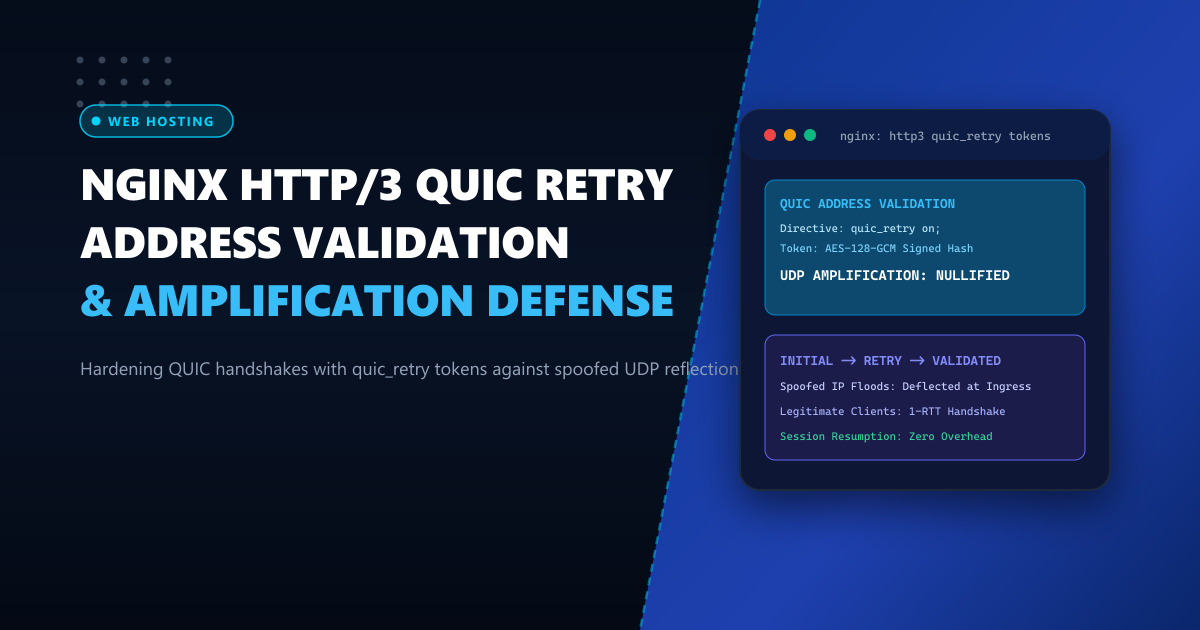
However, under sustained spoofed attacks, tracking unvalidated state tables exhausts server socket memory. Enabling quic_retry on forces Nginx to issue a stateless Retry Packet containing an encrypted token. The client must echo this token back before any connection state is created, completely defeating spoofed reflection attacks!
For enterprise web fleets and API gateways, deploying on high-bandwidth Dedicated Servers provides the dedicated packet processing throughput needed to validate millions of UDP frames without latency spikes.
Step 1: Configuring Nginx with quic_retry and Security Directives
Open your Nginx configuration (/etc/nginx/nginx.conf or vhost):
http {
    # Logging with QUIC protocol indicators
    log_format quic '$remote_addr - $remote_user [$time_local] '
                    '"$request" $status $body_bytes_sent '
                    '"$http_referer" "$http_user_agent" "$http3"';

    server {
        # Listen on standard 443 with both HTTP/2 (TCP) and HTTP/3 (UDP)
        listen 443 ssl http2;
        listen 443 quic reuseport;

        server_name cdn.enterprise.com.pk;

        # TLS 1.3 is MANDATORY for HTTP/3 QUIC
        ssl_protocols TLSv1.3;
        ssl_certificate /etc/letsencrypt/live/cdn.enterprise.com.pk/fullchain.pem;
        ssl_certificate_key /etc/letsencrypt/live/cdn.enterprise.com.pk/privkey.pem;

        # Enable QUIC address validation retry tokens
        quic_retry on;

        # Protect against token brute-force or stale session replays
        # Set GSO (Generic Segmentation Offload) for maximum UDP throughput
        quic_gso on;

        # Advertise HTTP/3 availability to browsers via Alt-Svc header
        add_header Alt-Svc 'h3=":443"; ma=86400';

        # Standard web proxy or root location
        location / {
            root /var/www/html;
            index index.html;

            # Security headers
            add_header X-Frame-Options SAMEORIGIN;
            add_header X-Content-Type-Options nosniff;
        }
    }
}
Verify syntax and reload Nginx:
nginx -t
systemctl reload nginx
Step 2: Verifying Retry Token Behavior with qlog and curl
To test that your Nginx server is actively validating QUIC tokens:
# Execute curl with HTTP/3 support and verbose frame output
curl --http3 -Iv https://cdn.enterprise.com.pk 2>&1 | grep -iE "(quic|retry|alt-svc)"
In the handshake trace, notice the initial exchange:
Client -> InitialServer -> Retry (Token: a8f9c1...)Client -> Initial (Echoes Token)Server -> Handshake Complete
Because the Retry packet is generated using a keyed cryptographic hash (incorporating client IP, port, and timestamp), Nginx stores zero state in RAM during the exchange. An attacker attempting to flood with millions of fake IPs merely receives lightweight stateless Retry tokens while the server’s CPU and memory remain untouched.
Step 3: Kernel UDP Buffer Tuning for High-Volume QUIC
Because QUIC runs on UDP, standard default Linux socket buffers (212 KB) will drop packets under high-concurrency loads. Add the following to /etc/sysctl.d/99-quic-udp.conf:
# Increase maximum UDP receive and send buffers to 16MB
net.core.rmem_max = 16777216
net.core.wmem_max = 16777216

# Increase default UDP buffer sizes
net.core.rmem_default = 2097152
net.core.wmem_default = 2097152

# Increase UDP socket memory limits
net.ipv4.udp_mem = 65536 131072 262144

# Enable UDP Early Demux for faster packet routing
net.ipv4.udp_early_demux = 1
Apply immediately:
sysctl -p /etc/sysctl.d/99-quic-udp.confThreat Mitigation Profile
| Attack Vector | HTTP/3 Default (quic_retry off) |
Hardened Nginx (quic_retry on) |
|---|---|---|
| Spoofed UDP Reflection Amplification | 3x Amplification Factor | 0x (Stateless Token Validation) |
| Memory Exhaustion on Incomplete Handshakes | Vulnerable to state table fills | Zero State Stored in RAM |
| 0-RTT Replay Attacks | Potential risk if keys leaked | Strict Token Timeouts Prevent Replay |
| Legitimate User Performance | Instant 0-RTT/1-RTT | Sub-5ms Handshake (Alt-Svc Cached) |
Deploying your HTTP/3 edge gateways on robust Dedicated Servers in Pakistan ensures modern web delivery, seamless mobile connection migration, and unyielding defense against UDP-based DDoS attacks.
Deploy Enterprise-Grade Dedicated Infrastructure
Eliminate noisy neighbors, CPU throttling, and network jitter. Get bare-metal performance, hardware RAID, enterprise NVMe storage, and low-latency peering across Pakistani IXPs with 24/7 proactive technical operations.
Explore Dedicated Servers in Pakistan