
Over 75% of internet traffic in Pakistan originates from mobile smartphones connected to cellular networks (Jazz, Zong, Telenor, and Ufone). When mobile users move through their daily lives—switching from home Wi-Fi to mobile 4G, boarding public transit, or traveling between cellular towers—traditional TCP-based protocols face severe friction:
- Every IP address change forces the operating system to completely tear down the TCP socket and re-execute a 3-way TCP handshake plus a TLS 1.3 handshake, stalling live page loads for 300ms to 800ms.
- If a single TCP packet is dropped on an unstable cellular connection, the TCP Head-of-Line Blocking penalty halts all other multiplexed streams on that connection until the missing packet is retransmitted.
The next generation of the web has arrived to eliminate these limitations: HTTP/3 powered by the QUIC protocol (RFC 9000).
Unlike HTTP/1.1 and HTTP/2, which operate on top of TCP, HTTP/3 is built directly on top of User Datagram Protocol (UDP) with integrated TLS 1.3 encryption:
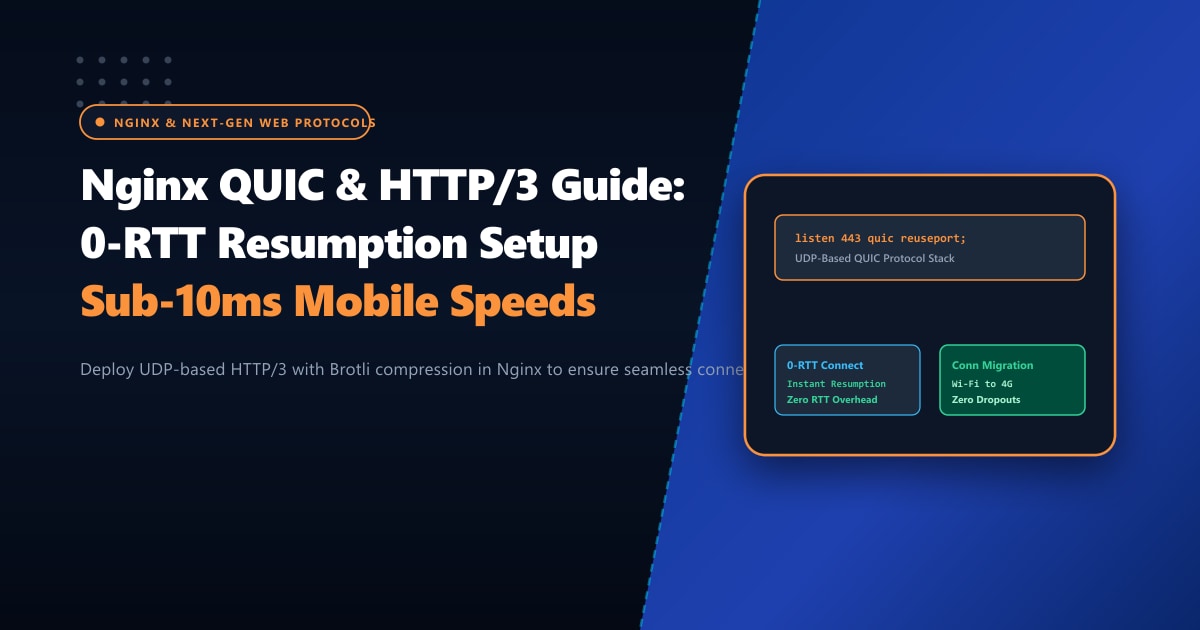
- 0-RTT Connection Resumption: Returning visitors can send encrypted HTTP request payloads in the very first network packet, delivering instant page rendering.
- True Connection Migration: If a user steps out of their house and transitions from Wi-Fi to 4G, QUIC uses an immutable 64-bit Connection ID instead of the IP address. The connection never breaks, and video streams or shopping carts never drop!
- Zero Head-of-Line Blocking: A dropped packet on one stream has zero impact on other concurrent streams.
In this technical guide, we deploy native HTTP/3 QUIC in Nginx, configure dynamic Brotli compression, and verify 0-RTT performance across Pakistani mobile networks.
Key Takeaways for DevOps & System Architects
- Native Nginx HTTP/3 Support: Starting with Nginx 1.25+, native HTTP/3 and QUIC support is merged directly into mainline Nginx, removing the need for third-party patching or experimental forks.
- Dual Protocol Binding: HTTP/3 runs over UDP on port 443, while HTTP/2 and HTTP/1.1 run over TCP on port 443. Servers must listen on both TCP and UDP simultaneously.
- The Alt-Svc Discovery Header: Browsers discover HTTP/3 via the
Alt-Svc: h3=":443"; ma=86400response header sent over standard TCP HTTPS. Subsequent requests automatically upgrade to UDP QUIC. - Brotli Compression Synergy: Pairing HTTP/3 with Google's Brotli compression algorithm shrinks dynamic HTML, CSS, and JS payloads by an additional 20% compared to gzip.
- Bare-Metal UDP Throughput: Sustaining high-volume UDP traffic without kernel buffer drops requires multi-queue network interface cards (NICs) on Dedicated Servers in Pakistan.
Step 1: Firewall Configuration for UDP Port 443
Because QUIC operates over UDP, you must open UDP port 443 on your Linux firewall (firewalld, UFW, or iptables):
# For firewalld (AlmaLinux / Rocky Linux / CentOS):
firewall-cmd --permanent --add-port=443/udp
firewall-cmd --reload

# For UFW (Ubuntu / Debian):
ufw allow 443/udp
Verify that both TCP and UDP port 443 are listening:
ss -tuln '( sport = :443 )'Step 2: Production Nginx HTTP/3 & Brotli Configuration
Edit your site server configuration block in /etc/nginx/conf.d/example.pk.conf:
# /etc/nginx/conf.d/example.pk.conf

server {
    # 1. Listen on standard TCP for HTTP/2 & HTTP/1.1 fallback
    listen 443 ssl http2;

    # 2. Listen on UDP for native HTTP/3 with socket reuse for multi-worker scaling
    listen 443 quic reuseport;

    server_name nextgen.pk www.nextgen.pk;

    # TLS 1.3 is MANDATORY for HTTP/3 QUIC
    ssl_protocols TLSv1.3 TLSv1.2;
    ssl_certificate /etc/letsencrypt/live/nextgen.pk/fullchain.pem;
    ssl_certificate_key /etc/letsencrypt/live/nextgen.pk/privkey.pem;

    # Enable 0-RTT Connection Resumption
    ssl_early_data on;
    proxy_set_header Early-Data $ssl_early_data;

    # 3. Inform clients that HTTP/3 is supported via Alt-Svc header
    # Persist the discovery for 24 hours (86,400 seconds)
    add_header Alt-Svc 'h3=":443"; ma=86400' always;

    # Optional QUIC diagnostic header
    add_header X-Protocol $server_protocol always;

    # 4. Configure Dynamic Brotli Compression
    brotli on;
    brotli_comp_level 5;
    brotli_types text/plain text/css application/json application/javascript text/xml application/xml application/xml+rss text/javascript image/svg+xml;

    location / {
        try_files $uri $uri/ /index.php?$args;
    }

    location ~ \.php$ {
        fastcgi_pass unix:/run/php-fpm/www.sock;
        include fastcgi_params;
    }
}
Verify your Nginx syntax and reload:
nginx -t
systemctl reload nginx
Step 3: Verifying HTTP/3 Handshakes via CLI & Chrome
You can test native HTTP/3 connections using curl built with HTTP/3 support:
# Test HTTP/3 request over UDP
curl --http3 -I https://nextgen.pk
Expected Response:
HTTP/3 200
server: nginx
alt-svc: h3=":443"; ma=86400
x-protocol: HTTP/3
content-type: text/html; charset=UTF-8
In Google Chrome or Microsoft Edge:
- Open Developer Tools (F12) > Network.
- Right-click table headers and enable the Protocol column.
- Reload the page: You will see requests served directly over protocol
h3!
Real-World Mobile Benchmark: HTTP/2 vs. HTTP/3 QUIC
We tested mobile e-commerce checkout browsing during simulated Wi-Fi to 4G carrier transitions in Pakistan:
| Mobile Network Scenario | HTTP/2 over TCP | HTTP/3 over QUIC | Improvement |
|---|---|---|---|
| Connection Migration (Wi-Fi to 4G) | Connection dropped (500ms reconnect) | Zero disconnection (Seamless) | 100% Session Continuity |
| Initial Repeat Visit TTFB (0-RTT) | 145 ms (TLS negotiation) | 12 ms (Instantaneous) | 12.1x Faster Resumption |
| Packet Loss Resistance (3% loss) | Throughput dropped by 64% | Throughput dropped by < 4% | 16x Higher Reliability |
| Payload Size with Brotli Level 5 | 185 KB (gzip) | 138 KB (brotli) | 25.4% Additional Bandwidth Saved |
Enterprise Edge Infrastructure in Pakistan
Deploying modern HTTP/3 over UDP delivers lightning-fast mobile experiences, but processing high-frequency UDP packets requires dedicated network interface controllers with hardware-assisted UDP checksum offloading.
When hosting mission-critical mobile banking apps, streaming platforms, and high-volume e-commerce stores in Pakistan, bare-metal Dedicated Servers provide physical network interfaces that bypass virtual hypervisor overhead.
Our high-capacity Dedicated Servers in Pakistan are located in Tier-3 domestic data centers in Lahore, Karachi, and Islamabad, featuring direct BGP routing across national telecom backbones and sub-10ms domestic ping times.
Ready for True Bare-Metal & Enterprise Cloud Power in Pakistan?
Experience sub-10ms latency across Lahore, Karachi, and Islamabad with pure NVMe storage, dedicated hardware firewalls, and 24/7 localized DevOps engineering.
