
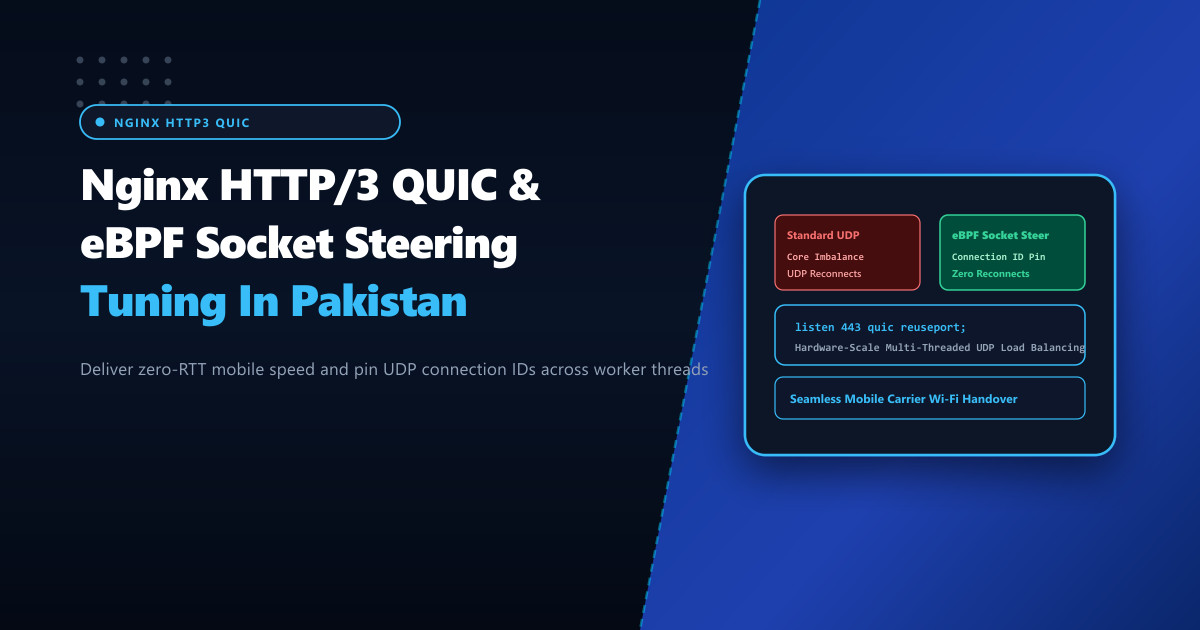
HTTP/3, built on the UDP-based QUIC transport protocol (RFC 9000), delivers revolutionary speed improvements for web traffic across Pakistan. By replacing TCP’s rigid stream ordering with multiplexed UDP streams and 0-RTT connection establishment, HTTP/3 completely eliminates Head-of-Line (HoL) blocking on jitter-prone Pakistani 4G, 5G, and fixed broadband connections.
However, scaling HTTP/3 on high-performance multi-core Linux web servers introduces a severe kernel-level bottleneck: UDP multi-socket packet distribution. Unlike TCP, where the kernel binds an established connection to a specific worker’s file descriptor after the three-way handshake, UDP is entirely connectionless. Under standard Linux SO_REUSEPORT, the kernel distributes incoming UDP datagrams across Nginx worker threads using a simple 4-tuple hash (src IP, src Port, dst IP, dst Port).
When mobile devices in Pakistan transition between cell towers or Wi-Fi networks, the client’s IP and port change dynamically (Connection Migration). Under default hashing, subsequent packets are routed to a different Nginx worker process that lacks the cryptographic TLS keys for that QUIC connection! This causes costly packet re-routing, decryption failures, and catastrophic connection resets.
By leveraging bare-metal Dedicated Servers and compiling Nginx with eBPF-driven SO_REUSEPORT socket steering, server architects can route QUIC datagrams directly based on the QUIC Connection ID (DCID), ensuring that packets always arrive at the exact worker process holding the active session state.
Why Standard SO_REUSEPORT Breaks QUIC Multi-Worker Scaling
To understand why eBPF is required for HTTP/3, observe how the Linux kernel handles incoming UDP packets across multi-threaded web servers:
[ Incoming UDP Packet on Port 443 ]
                  │
                  ▼
┌─────────────────────────────────────────────────────────────────┐
│ Standard Kernel 4-Tuple Hashing:                                │
│ Hash(Src_IP, Src_Port, Dst_IP, Dst_Port) % N_Workers             │
└─────────────────────────────────────────────────────────────────┘
                  │
        ┌─────────┴─────────┐
        ▼                   ▼
[ Nginx Worker 1 ]    [ Nginx Worker 2 ]
(Holds QUIC Key A)    (Holds QUIC Key B)

Scenario: Pakistani mobile user moves from Jazz 4G to Home Fiber Wi-Fi
- Client Src_IP and Src_Port mutate instantly.
- Kernel recalculates 4-tuple hash -> packet lands on Worker 2 instead of Worker 1!
- Worker 2 cannot decrypt the QUIC packet -> Drops packet or sends Stateless Reset!
With an eBPF (Extended Berkeley Packet Filter) Reuseport program, the kernel inspects the UDP payload directly, extracts the QUIC Destination Connection ID (DCID), and maps the packet deterministically to the worker assigned to that specific DCID:
[ Incoming UDP Packet on Port 443 ]
                  │
                  ▼
┌─────────────────────────────────────────────────────────────────┐
│ eBPF SO_REUSEPORT Socket Filter:                                │
│ 1. Parse UDP Header (Port 443)                                  │
│ 2. Extract QUIC Destination Connection ID (DCID)                │
│ 3. Dispatch directly to Worker assigned to this DCID            │
└─────────────────────────────────────────────────────────────────┘
                  │
                  ▼
        [ Consistent Nginx Worker ] (Decryption Succeeds, 0 Re-transmissions)
Step 1: Kernel Requirements & Building Nginx with HTTP/3 & eBPF Support
Ensure your Linux host runs kernel version 5.15+ (or kernel 6.x LTS recommended for enhanced eBPF bpf_sk_lookup and reuseport_ebpf features).
Verify kernel BPF support:
# Check if BPF and BTF are enabled in the current kernel
uname -r
zgrep CONFIG_BPF /proc/config.gz || grep CONFIG_BPF /boot/config-$(uname -r)
Install compiler toolchains, clang, llvm, and libbpf:
apt-get update && apt-get install -y \
    build-essential \
    clang \
    llvm \
    libbpf-dev \
    linux-headers-$(uname -r) \
    libpcre3-dev \
    zlib1g-dev \
    libssl-dev \
    git
Clone the official Nginx source along with the QUIC repository:
cd /usr/local/src
git clone https://github.com/nginx/nginx.git nginx-quic
cd nginx-quic

# Configure Nginx with HTTP/3, SSL, and SO_REUSEPORT BPF optimization
./auto/configure \
    --prefix=/etc/nginx \
    --sbin-path=/usr/sbin/nginx \
    --conf-path=/etc/nginx/nginx.conf \
    --with-http_ssl_module \
    --with-http_v2_module \
    --with-http_v3_module \
    --with-stream \
    --with-stream_quic_module \
    --with-compat \
    --with-threads \
    --with-file-aio

make -j$(nproc)
make install
Step 2: Configuring Nginx for HTTP/3 with reuseport
In /etc/nginx/nginx.conf, configure your multi-worker setup and assign the reuseport directive on the primary UDP listening socket. When quic_bpf is enabled, Nginx automatically attaches an in-kernel eBPF socket selection program to the reuseport socket group:
# /etc/nginx/nginx.conf
user nginx;
worker_processes auto;
worker_cpu_affinity auto;
worker_rlimit_nofile 131072;

events {
    worker_connections 32768;
    use epoll;
    multi_accept on;
}

http {
    include       mime.types;
    default_type  application/octet-stream;

    # Logging format including QUIC connection protocol & cipher
    log_format quic '$remote_addr - $remote_user [$time_local] "$request" '
                    '$status $body_bytes_sent "$http_referer" '
                    '"$http_user_agent" "$http3" "$quic_dcid"';

    access_log /var/log/nginx/access.log quic;
    error_log /var/log/nginx/error.log warn;

    sendfile on;
    tcp_nopush on;
    tcp_nodelay on;

    # QUIC Buffer & Stream Limits
    quic_gso on;                         # Enable Generic Segmentation Offload for UDP
    quic_retry on;                       # Send Retry packets for anti-amplification
    quic_active_connection_id_limit 4;   # Allow up to 4 connection IDs for migration

    server {
        # Standard TCP listeners for HTTP/1.1 and HTTP/2
        listen 80;
        listen 443 ssl;
        listen [::]:443 ssl;

        # HTTP/3 QUIC UDP Listeners with reuseport and quic_bpf
        listen 443 quic reuseport;
        listen [::]:443 quic reuseport;

        server_name enterprise.yourdomain.pk;

        ssl_certificate /etc/letsencrypt/live/yourdomain.pk/fullchain.pem;
        ssl_certificate_key /etc/letsencrypt/live/yourdomain.pk/privkey.pem;

        # TLS 1.3 is strictly mandatory for QUIC / HTTP/3
        ssl_protocols TLSv1.2 TLSv1.3;
        ssl_prefer_server_ciphers off;
        ssl_early_data on;

        # Inform browsers that HTTP/3 is available via Alt-Svc header
        add_header Alt-Svc 'h3=":443"; ma=86400, h3-29=":443"; ma=86400' always;
        add_header QUIC-Status $http3 always;

        location / {
            root /var/www/html;
            index index.html;
        }
    }
}
Step 3: Kernel UDP Buffer & Generic Segmentation Offload (GSO) Tuning
To handle multi-gigabit UDP packet rates without packet loss in the kernel networking stack, tune Linux UDP receive/send buffers and enable hardware/driver offloading:
# /etc/sysctl.d/99-quic-udp.conf
# NextGen Pakistan - Ultra-High Throughput QUIC/UDP Tuning

# Maximize socket buffer queues
net.core.rmem_max = 33554432
net.core.wmem_max = 33554432
net.core.rmem_default = 8388608
net.core.wmem_default = 8388608

# Increase incoming packet backlog for UDP
net.core.netdev_max_backlog = 100000

# UDP Memory limits in 4KB pages [min, pressure, max]
net.ipv4.udp_mem = 262144 524288 1048576

# Allow binding to non-local IP addresses for high-availability setups
net.ipv4.ip_nonlocal_bind = 1
Apply the sysctl parameters:
sysctl -p /etc/sysctl.d/99-quic-udp.confVerify that Generic Segmentation Offload (GSO) is active on your physical network interfaces:
ethtool -k eth0 | grep -i segmentation
# Ensure "udp-fragmentation-offload" or "generic-segmentation-offload: on"
Step 4: Verifying eBPF Socket Filter Attachment & HTTP/3 Performance
Start or restart Nginx, then confirm that the eBPF filter has bound to the UDP sockets:
# Inspect attached BPF programs on the host
bpftool prog list

# Sample output showing Nginx reuseport eBPF program:
# 42: sk_reuseport  name ngx_quic_bpf  tag c48d7e9b01a2b3c4  gpl
#     loaded_at 2026-09-30T14:30:15+0500  uid 0
#     xlated 328B  jited 212B  memlock 4096B  map_ids 12
Test HTTP/3 handshakes and connection migration from a client machine using curl built with HTTP/3 support:
curl --http3 -Iv https://enterprise.yourdomain.pk/Check the response headers:
HTTP/3 200
alt-svc: h3=":443"; ma=86400
quic-status: h3
content-type: text/html
Why NextGen Dedicated Hardware Excels for QUIC Deployments
QUIC requires substantial cryptographic calculation overhead (ChaCha20-Poly1305 / AES-GCM encryption on every individual UDP datagram) combined with high-frequency BPF packet filtering. In shared cloud environments, noisy neighbors and CPU throttling frequently result in microsecond packet drop bursts that shatter QUIC streaming rates.
Running on modern bare-metal Dedicated Servers in Pakistan equips your platform with AMD EPYC or Intel Xeon processors featuring hardware AES-NI instructions, dedicated NVMe read queues, and sub-10ms latency via local direct peering at PKIX (Pakistan Internet Exchange).
Accelerate Web Workloads with NextGen HTTP/3 Ready Dedicated Servers
Deliver instantaneous page loads, zero connection lag on mobile data, and bulletproof DDoS resilience across Pakistan. NextGen dedicated hosting features enterprise-grade hardware, native eBPF acceleration, and 24/7 proactive technical operations.
Deploy Dedicated Servers in Pakistan