
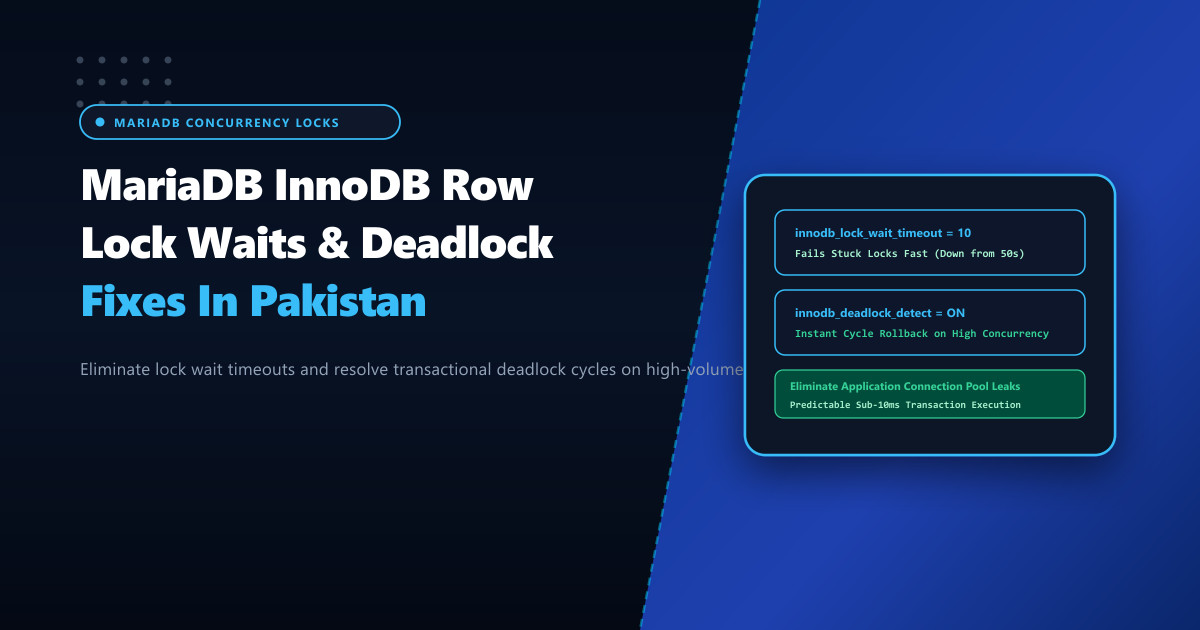
High-throughput transactional databases in Pakistan—powering WooCommerce stores during mega shopping events (11.11, Blessed Friday), financial settlement microservices, and courier booking engines—frequently grind to a halt under sudden transaction spikes. Developers and database administrators suddenly notice catastrophic spikes in application latency accompanied by two dreaded database errors:
ERROR 1205 (HY000): Lock wait timeout exceeded; try restarting transactionERROR 1213 (40011): Deadlock found when trying to get lock; try restarting transaction
When concurrent queries attempt to modify overlapping rows or index gaps, MariaDB’s InnoDB storage engine holds row locks (exclusive X locks or shared S locks) until the owning transaction issues an explicit COMMIT or ROLLBACK. If slow queries, unindexed foreign keys, or long-running application transactions block subsequent writers, incoming requests pile up in the lock wait queue. Within seconds, threads exhaust MariaDB’s connection pool (max_connections), triggering HTTP 504 gateway timeouts across the platform.
Deploying on high-performance bare-metal Dedicated Servers provides unthrottled NVMe storage and compute capacity, but resolving concurrency contention requires deep instrumentation of InnoDB lock monitoring, surgical isolation level tuning (READ COMMITTED vs REPEATABLE READ), and elimination of gap locking.
Understanding Row Locks, Gap Locks, and Deadlock Cycles
In MariaDB InnoDB, locks are placed on index records, not the physical data rows themselves. Contention stems from three primary lock types:
- Record Lock: Locks the specific index entry (e.g.,
WHERE order_id = 45201 FOR UPDATE). - Gap Lock: Locks the empty space between index records (or before the first/after the last). Used in the default
REPEATABLE READisolation level to prevent “phantom reads.” - Next-Key Lock: A combination of a Record Lock on the index record plus a Gap Lock on the gap preceding it. Next-key locks are the #1 root cause of unexpected deadlocks during concurrent
INSERTandUPDATEstatements!
+-----------------------------------------------------------------------------------+
|                        CLASSIC DEADLOCK CYCLE (CYCLE OF 2)                        |
+-----------------------------------------------------------------------------------+
| Transaction A (Thread 101):                                                       |
|   1. Updates Row #10 (Holds X-Lock on Row #10)                                   |
|                                                                                   |
| Transaction B (Thread 102):                                                       |
|   2. Updates Row #20 (Holds X-Lock on Row #20)                                   |
|                                                                                   |
| Conflict Phase:                                                                   |
|   3. Transaction A requests X-Lock on Row #20 -> BLOCKED by Transaction B         |
|   4. Transaction B requests X-Lock on Row #10 -> BLOCKED by Transaction A         |
|                                                                                   |
| Resolution:                                                                       |
|   InnoDB Deadlock Engine detects the circular dependency graph:                   |
|   - Evaluates undo log volume of both transactions.                               |
|   - Elects Transaction B as the "victim" (least modified rows).                   |
|   - Issues ROLLBACK to Transaction B and raises ERROR 1213.                       |
+-----------------------------------------------------------------------------------+
Step 1: Real-Time Diagnostics with sys.innodb_lock_waits & Engine Status
To inspect current lock blockers in real time, query MariaDB’s information_schema or sys schema:
-- Identify which transaction is blocking other threads
SELECT
    r.trx_id AS waiting_trx_id,
    r.trx_mysql_thread_id AS waiting_thread,
    r.trx_query AS waiting_query,
    b.trx_id AS blocking_trx_id,
    b.trx_mysql_thread_id AS blocking_thread,
    b.trx_query AS blocking_query,
    TIMESTAMPDIFF(SECOND, r.trx_wait_started, NOW()) AS wait_age_seconds
FROM information_schema.innodb_lock_waits w
INNER JOIN information_schema.innodb_trx b
    ON b.trx_id = w.blocking_trx_id
INNER JOIN information_schema.innodb_trx r
    ON r.trx_id = w.requesting_trx_id;
To examine the exact SQL queries, locks, and heap allocation of the most recent deadlock:
SHOW ENGINE INNODB STATUS\GLocate the ------------------------ LATEST DETECTED DEADLOCK ------------------------ section. Pay close attention to:
- The lock mode (
lock_mode X waiting,lock_mode S, orgap). - The index name being traversed (
PRIMARY,idx_customer_id, etc.). - The hex value of the physical record heap.
Step 2: Optimizing Server Configuration in /etc/my.cnf.d/server.cnf
To mitigate lock wait timeouts and log every single deadlock incident for historical auditing, apply the following production parameters in /etc/my.cnf.d/server.cnf:
[mariadb]
# /etc/my.cnf.d/server.cnf
# NextGen Pakistan - High-Concurrency InnoDB Lock Management Profile

# 1. Lock Wait Timeout (seconds)
# Default is 50 seconds; under web concurrency, 50s is an eternity.
# Lower to 10 or 15 seconds to fail fast and release connection threads.
innodb_lock_wait_timeout = 15

# 2. Comprehensive Deadlock Logging
# Automatically prints every deadlock to MariaDB's standard error log
innodb_print_all_deadlocks = ON

# 3. Transaction Isolation Level Optimization
# Change from default REPEATABLE READ to READ COMMITTED.
# READ COMMITTED completely disables InnoDB GAP LOCKS for non-unique scans,
# drastically reducing deadlock frequency in e-commerce and API backends!
transaction_isolation = READ-COMMITTED

# 4. Binary Log Format (Mandatory for READ COMMITTED)
# READ COMMITTED requires ROW-based replication to prevent replication drift
binlog_format = ROW

# 5. Row Lock Wait Rollback Policy
# By default, a lock wait timeout only rolls back the single failed statement.
# Enabling this rolls back the ENTIRE transaction, preventing partial data writes.
innodb_rollback_on_timeout = ON

# 6. Deadlock Detection Engine
# Keep ON for normal workloads so InnoDB detects cycles immediately.
innodb_deadlock_detect = ON
Restart MariaDB or apply the non-static variables dynamically:
SET GLOBAL innodb_lock_wait_timeout = 15;
SET GLOBAL innodb_print_all_deadlocks = ON;
SET GLOBAL transaction_isolation = 'READ-COMMITTED';
Step 3: Application Code Architecture & Retry Patterns
Database tuning alone cannot prevent deadlocks if application transactions execute updates in arbitrary order. Follow these structural best practices:
1. Deterministic Lock Ordering
Always acquire row locks in consistent sequential order across all application endpoints:
-- BAD: Thread 1 updates A then B; Thread 2 updates B then A
-- GOOD: Always sort IDs before updating!
UPDATE accounts SET balance = balance - 500 WHERE account_id = 1204;
UPDATE accounts SET balance = balance + 500 WHERE account_id = 3409;
2. Implement Exponential Backoff Retries in PHP / Python / Node.js
Because deadlocks are a natural consequence of high concurrency, applications must be engineered to catch 1213 errors and retry the transaction gracefully:
import time
import mysql.connector
from mysql.connector import errorcode

def execute_transaction_with_retry(cursor, db_conn, max_retries=3):
    attempt = 0
    while attempt < max_retries:
        try:
            cursor.execute("START TRANSACTION;")

            # Execute business logic queries
            cursor.execute("UPDATE inventory SET stock = stock - 1 WHERE product_id = 8901 AND stock > 0;")
            cursor.execute("INSERT INTO orders (product_id, status) VALUES (8901, 'CONFIRMED');")

            db_conn.commit()
            return True

        except mysql.connector.Error as err:
            if err.errno == errorcode.ER_LOCK_DEADLOCK or err.errno == errorcode.ER_LOCK_WAIT_TIMEOUT:
                attempt += 1
                db_conn.rollback()
                # Exponential backoff with jitter (50ms, 150ms, 350ms)
                sleep_time = (0.05 * (2 ** attempt))
                time.sleep(sleep_time)
                if attempt >= max_retries:
                    raise Exception(f"Transaction failed after {max_retries} attempts: {err}")
            else:
                db_conn.rollback()
                raise err
Step 4: Indexing Strategies to Eliminate Table-Wide Row Locks
When MariaDB executes an UPDATE or DELETE query without a precise index, InnoDB cannot place selective record locks. Instead, it scans and locks every single row and gap in the entire table, instantly paralyzing all other writers!
-- DANGEROUS: If 'status' is unindexed, this locks the entire 'shipments' table!
UPDATE shipments SET courier_assigned = 'TCS' WHERE status = 'PENDING' AND city = 'Lahore';

-- SOLUTION: Add a composite index covering the WHERE clause
ALTER TABLE shipments ADD INDEX idx_status_city (status, city);
Verify index usage with EXPLAIN:
EXPLAIN UPDATE shipments SET courier_assigned = 'TCS' WHERE status = 'PENDING' AND city = 'Lahore';Ensure the type is ref or range, and key reflects idx_status_city, guaranteeing that locks are confined solely to targeted rows.
Enterprise Database Performance on NextGen Hardware
Heavy transaction volumes and lock evaluation routines require low-latency disk writes for redo log flushing (innodb_flush_log_at_trx_commit = 1). On multi-tenant cloud platforms, storage I/O jitter slows down transaction commit times, artificially lengthening the duration each lock is held and triggering exponential deadlock cascades.
Hosting your database clusters on bare-metal Dedicated Servers in Pakistan guarantees dedicated PCIe 4.0/5.0 NVMe drives capable of 1,000,000+ IOPS with sub-100 microsecond commit latencies. Combined with local data residency compliance and 24/7 database engineering support, your applications stay lightning-fast during peak Pakistani shopping seasons.
Conquer Database Contention with NextGen High-IOPS Dedicated Servers
Eliminate lock wait timeouts, minimize deadlock cascades, and scale MariaDB throughput to tens of thousands of queries per second. NextGen bare-metal servers feature enterprise NVMe storage, dedicated memory pools, and sub-millisecond local network response.
Deploy Dedicated Servers in Pakistan