
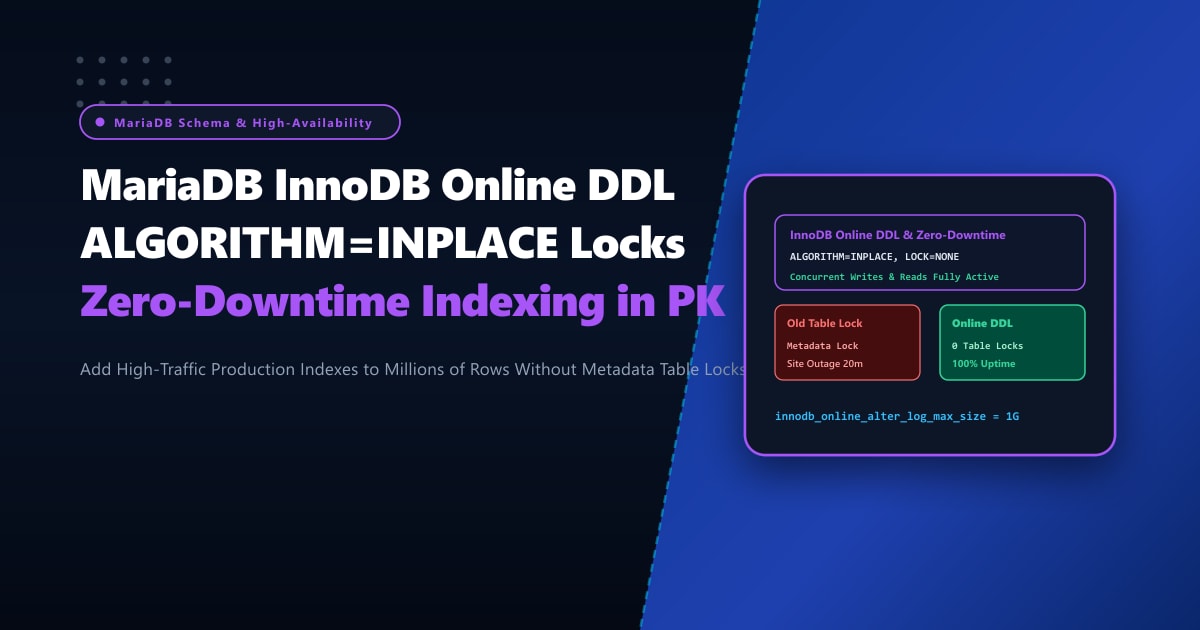
Operating mission-critical relational databases in Pakistan—supporting 24/7 fintech wallets, nationwide courier dispatch databases, and fast-growing WooCommerce storefronts—demands continuous schema optimization. When slow query logs indicate that a table with 10 million rows is missing a critical composite index, database administrators naturally want to execute an ALTER TABLE ... ADD INDEX command.
However, in default or unmanaged environments, running an ALTER TABLE statement triggers a catastrophic production freeze:
- MariaDB acquires an exclusive Metadata Lock (MDL) on the target table.
- All incoming application writes (
INSERT,UPDATE,DELETE) are queued behind the lock. - If index creation takes 15 minutes, application connection pools are exhausted within 20 seconds, triggering cascading
HTTP 504 Gateway Timeouterrors and halting all user checkout operations.
In modern MariaDB versions, the InnoDB storage engine features Online DDL (Data Definition Language). By explicitly specifying ALGORITHM=INPLACE and LOCK=NONE, administrators can build secondary indexes in the background while concurrent application threads continue reading and writing to the table without interruption!
By deploying on high-IOPS bare-metal Dedicated Servers and properly sizing the innodb_online_alter_log_max_size buffer, engineering teams can execute zero-downtime index migrations on multi-gigabyte tables during normal business hours.
The Architecture: Legacy Copy Table vs. InnoDB Online DDL
Understanding why legacy index creation locks databases:
+-----------------------------------------------------------------------------------+
|                        LEGACY COPY vs INNODB ONLINE DDL                           |
+-----------------------------------------------------------------------------------+
| 1. Legacy Copy Method (ALGORITHM=COPY / Default in older engines):                |
|    - Creates an empty hidden temporary table with the new index.                  |
|    - Locks the original table against all incoming WRITES!                       |
|    - Copies all 10,000,000 rows one by one.                                       |
|    - Renames temporary table to replace original table.                           |
|    - Writes blocked for 15+ minutes! Total business outage!                       |
|                                                                                   |
| 2. InnoDB Online DDL (ALGORITHM=INPLACE, LOCK=NONE):                              |
|    - Phase 1 (Brief Preparation): Takes a microscopic MDL lock (<5ms).            |
|    - Phase 2 (Execution): Scans existing clustered index and builds B-tree        |
|      in the background. Concurrent READS and WRITES are 100% permitted!           |
|    - Phase 3 (Row Log Replay): Incoming modifications made during index creation  |
|      are stored in memory (innodb_online_alter_log) and merged at commit.         |
|    - Phase 4 (Commit): Brief metadata lock (<5ms) to finalize index dictionary.   |
|    - Downtime: EXACTLY ZERO SECONDS! All checkout transactions succeed!           |
+-----------------------------------------------------------------------------------+
Step 1: Pre-Flight Capacity Checks for Online Alter Operations
During an Online DDL operation with concurrent writes, MariaDB records all incoming data modifications in a temporary in-memory buffer called the Online Alter Log.
If write volume is exceptionally heavy and the Online Alter Log runs out of allocated memory, the operation aborts with a fatal error:
ERROR 1799 (HY000): Creating index 'idx_name' required more than 'innodb_online_alter_log_max_size' bytes of modification log.To prevent this failure on busy production databases in Pakistan, inspect and increase innodb_online_alter_log_max_size:
-- Check current online alter buffer limit (default is usually 128MB)
SHOW GLOBAL VARIABLES LIKE 'innodb_online_alter_log_max_size';

-- Dynamically increase to 1GB or 2GB on dedicated database servers
SET GLOBAL innodb_online_alter_log_max_size = 1073741824; -- 1 GB
Ensure the configuration is persisted in /etc/my.cnf.d/server.cnf:
[mariadb]
# /etc/my.cnf.d/server.cnf
# NextGen Pakistan - High-Concurrency Online DDL Profile
innodb_online_alter_log_max_size = 1G
innodb_sort_buffer_size = 64M
Step 2: Executing Zero-Downtime Index Creation with Explicit Clauses
Never execute a bare ALTER TABLE without explicitly declaring the algorithm and lock level. Explicitly specifying ALGORITHM=INPLACE and LOCK=NONE ensures that if MariaDB cannot execute the DDL online, it will fail immediately rather than silently falling back to a table-locking copy!
-- Safe Online Index Creation: Permits concurrent SELECT, INSERT, UPDATE, DELETE!
ALTER TABLE orders
    ADD INDEX idx_customer_created (customer_id, created_at),
    ALGORITHM=INPLACE,
    LOCK=NONE;
Supported Online DDL Operations in MariaDB InnoDB:
- Adding a secondary index:
ALGORITHM=INPLACE, LOCK=NONE(Fully Online) - Dropping a secondary index:
ALGORITHM=INPLACE, LOCK=NONE(Fully Online) - Adding a column (at the end):
ALGORITHM=INPLACE, LOCK=NONE(Instant in modern versions) - Renaming a column or index:
ALGORITHM=INPLACE, LOCK=NONE(Instant metadata change) - Changing a column default:
ALGORITHM=INPLACE, LOCK=NONE(Instant)
Step 3: Monitoring Active Online DDL Progress via information_schema
Do not guess how long an index build will take. MariaDB provides real-time stage tracking through the Performance Schema:
-- Enable stage instrumentation if not already active
UPDATE performance_schema.setup_instruments
SET ENABLED = 'YES', TIMED = 'YES'
WHERE NAME LIKE 'stage/innodb/alter%';

-- Monitor live index building percentage
SELECT
    EVENT_NAME,
    WORK_COMPLETED,
    WORK_ESTIMATED,
    ROUND((WORK_COMPLETED / WORK_ESTIMATED) * 100, 2) AS pct_complete
FROM performance_schema.events_stages_current
WHERE EVENT_NAME LIKE 'stage/innodb/alter%';
Sample output:
+------------------------------------+----------------+----------------+--------------+
| EVENT_NAME                         | WORK_COMPLETED | WORK_ESTIMATED | pct_complete |
+------------------------------------+----------------+----------------+--------------+
| stage/innodb/alter table (log apply)| 842010         | 1000000        | 84.20        |
+------------------------------------+----------------+----------------+--------------+
You can watch the progress bar reach 100% while seeing incoming customer orders process in real time without a millisecond of lock delay.
Step 4: Mitigating Metadata Lock (MDL) Hangs Before Starting DDL
Although LOCK=NONE allows concurrent queries during index creation, MariaDB still requires a split-second Exclusive Metadata Lock at the start and end of the DDL to update the internal data dictionary.
If an abandoned read query (such as an unclosed report in phpMyAdmin) is active, the DDL will wait for it to finish, and all subsequent queries will queue behind the DDL!
To prevent this queue pile-up, configure a short metadata lock wait timeout:
-- Set DDL lock wait timeout to 10 seconds (fails fast instead of freezing queue)
SET SESSION lock_wait_timeout = 10;

-- Now execute the online index creation
ALTER TABLE shipments
    ADD INDEX idx_status_tracking (status, tracking_code),
    ALGORITHM=INPLACE,
    LOCK=NONE;
If a blocking query exists, the statement fails harmlessly after 10 seconds:
ERROR 1205 (HY000): Lock wait timeout exceeded; try restarting transactionYour production applications remain 100% online and unblocked!
Dedicated Bare-Metal Database Infrastructure in Pakistan
Building secondary B-tree indexes across tables containing millions of rows generates substantial temporary disk read/write bandwidth. In multi-tenant cloud hosting, shared SSD storage controllers throttle I/O during heavy DDL rebuilds, lengthening index creation time from minutes to hours.
Deploying on bare-metal Dedicated Servers in Pakistan equips your database cluster with dedicated PCIe 4.0/5.0 NVMe storage capable of sequential reads exceeding 7,000 MB/s, multi-channel ECC DDR5 RAM, and dedicated physical CPU cores, ensuring that schema modifications complete with blazing speed and zero downtime.
Scale Your Database Infrastructure with NextGen Dedicated Servers
Eliminate database lock freezes, execute zero-downtime schema migrations, and achieve sub-millisecond query performance across Pakistan. NextGen bare-metal infrastructure provides enterprise NVMe storage arrays, custom MariaDB tuning, and 99.99% operational uptime.
Deploy Dedicated Servers in Pakistan