
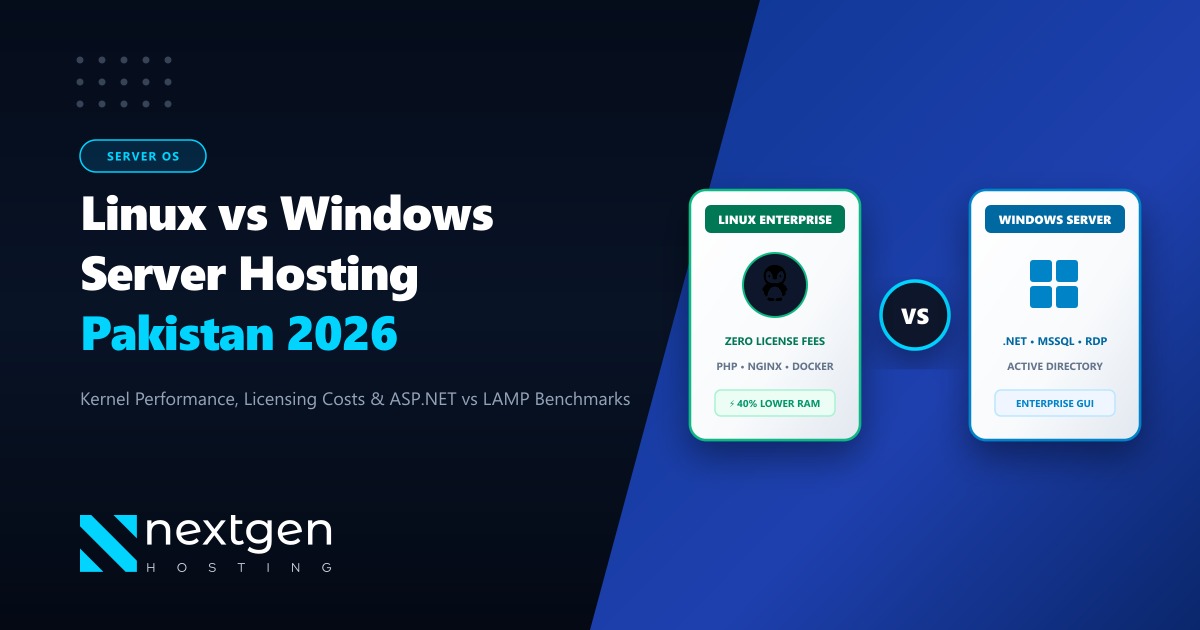
When provisioning a new cloud environment or bare-metal machine in Pakistan, your very first architectural decision is choosing your underlying operating system: Linux or Windows Server?
For many Pakistani business owners and IT managers, the choice is clouded by misconceptions. Some assume Windows is naturally better because their desktop PCs run Windows 11; others assume Linux is purely for terminal-obsessed programmers.
In enterprise server environments, the reality is dictated by your application stack, database requirements, memory overhead, and licensing budgets. With foreign exchange fluctuations impacting software licenses billed in US Dollars, running Windows Server in Pakistan introduces recurring SPLA licensing fees that Linux completely avoids.
Here is your unbiased, technical breakdown of Linux vs. Windows Server hosting in Pakistan to help you choose the right OS for your workloads.
Key Takeaways for Pakistani IT Decision Makers
- Licensing Costs: Linux distributions (Ubuntu, AlmaLinux, Rocky Linux, Debian) are 100% open-source with zero licensing fees; Windows Server requires paid core-based licenses or monthly SPLA fees that scale with CPU count.
- Resource Overhead: A headless Linux server idles at just 150MB to 350MB of RAM; Windows Server requires 2GB to 4GB of RAM simply to run its background GUI and system services.
- Application Ecosystem: Linux dominates the LAMP/LEMP stack (PHP, WordPress, Python, Node.js, Docker, MySQL, Redis); Windows is the mandatory choice for legacy .NET Framework, ASP.NET, MSSQL Server, and Active Directory.
- Remote Administration: Linux is managed via lightweight, high-security SSH keys; Windows is accessed via graphical Remote Desktop Protocol (RDP) or PowerShell Remoting.
1. Operating System Architecture & Resource Footprint
The fundamental architectural difference between Linux and Windows Server centers on the graphical subsystem:
[Linux Server Architecture (Headless)]
Hardware (CPU / NVMe / RAM) ──► Linux Kernel (v6.x) ──► Systemd ──► Services (Nginx / Docker)
(Footprint: Zero GUI overhead | ~250MB Base RAM | Instant SSH connection)

[Windows Server Architecture (Desktop Experience)]
Hardware ──► Windows Kernel ──► Desktop Window Manager / Explorer ──► IIS / MSSQL
(Footprint: Heavy GUI overhead | ~3.5GB Base RAM | Requires RDP session)
Because headless Linux servers do not load graphical display managers, video drivers, or desktop compositor processes, nearly 100% of your allocated CPU cycles and RAM are dedicated directly to your revenue-generating applications.
On a 8GB RAM Cloud VPS:
- On Linux, you have over 7.6GB of RAM available for MySQL buffers, Redis caching, and PHP worker pools.
- On Windows Server, the operating system consumes 3.2GB of RAM, leaving you with less than 4.8GB for your database and applications.
2. Cost Analysis: Open Source vs. Microsoft SPLA Licensing in Pakistan
In Pakistan’s macroeconomic environment, software licensing costs paid in foreign currency can heavily burden IT budgets.
| Cost Component | Enterprise Linux (AlmaLinux / Ubuntu) | Windows Server 2022 / 2025 Standard |
|---|---|---|
| OS License Fee | Rs. 0 (Free Forever) | $25 – $45/mo per 8 cores (~Rs. 7,000 – 13,000/mo) |
| Remote Access License | Free SSH (Unlimited Concurrent Admin Sessions) | Included 2 Concurrent Admin RDP Sessions; RDS CALs extra |
| Web Server License | Free (Nginx, Apache, LiteSpeed Open) | Free with OS (IIS); third-party web servers free |
| Database Licensing | Free (PostgreSQL, MariaDB, MySQL Community) | Free for Express (10GB limit); Enterprise MSSQL is costly |
| Control Panel Options | cPanel, Plesk, CyberPanel, aaPanel, CloudPanel | Plesk for Windows, WebsitePanel |
By deploying on Linux, Pakistani development agencies and startups can reinvest their monthly software licensing budget into faster enterprise NVMe storage and additional CPU cores.
3. When is Windows Server Mandatory?
Despite Linux’s cost and efficiency advantages, Windows Server remains irreplaceable in specific enterprise environments:
- Legacy .NET Framework & Windows Forms: If your enterprise operates custom ERP, POS (Point of Sale), or accounting software built on legacy .NET Framework 3.5/4.8, it must run on Windows. (Note: Modern .NET Core and .NET 8/9 run natively on Linux).
- Microsoft SQL Server (MSSQL): While MSSQL can technically run in Linux Docker containers, high-availability Always-On Availability Groups (AOAG) perform best on native Windows Server clusters.
- Active Directory & Corporate Domain Controllers: If your organization requires centralized identity management, Kerberos authentication, and Group Policy Objects (GPO) for office workstations across Pakistan.
- Forex & Automated Desktop Trading: Pakistani traders running MetaTrader 4/5 (MT4/MT5) or desktop automation tools benefit from dedicated Windows Remote Desktop hosting.
4. Hardware Selection: Virtual Cloud VPS vs Dedicated Bare Metal
Whether you deploy Linux or Windows Server, hosting demanding database backends, multi-tenant eCommerce sites, or virtualization hypervisors requires rock-solid hardware.
For organizations demanding dedicated physical computing power with zero virtualization overhead, exploring our global Dedicated Servers provides unmetered 1Gbps ports with enterprise Intel Xeon and AMD EPYC silicon.
If your regulatory framework (such as SBP banking mandates or national data residency laws) requires servers to operate strictly within domestic borders, our Dedicated Servers in Pakistan provide local datacenter hosting in Karachi and Lahore with sub-10ms domestic latency.
5. Summary: Which OS Should You Choose?
- Choose Linux If: You run WordPress, WooCommerce, Node.js, Python, Laravel, Magento, Docker containers, or any modern web application where cost, performance, and memory efficiency are paramount.
- Choose Windows Server If: You rely on legacy ASP.NET, MSSQL, Active Directory, Remote Desktop environments, or specialized desktop business applications.
Deploy Your Ideal Server OS with Nextgen Hosting
Whether you need high-performance Linux or Windows Server with full Administrator rights, Nextgen provides pure NVMe cloud infrastructure, 99.9% uptime SLAs, and 24/7 technical support in Pakistan.
