
With over 130 million active 4G and 5G cellular subscribers in Pakistan across Jazz, Zong, Telenor, and Ufone, mobile browsers represent the vast majority of web traffic to local e-commerce, banking, and media platforms.
However, cellular telecom operators in Pakistan face severe public IPv4 address exhaustion. To keep millions of smartphones connected, mobile carriers route hundreds of thousands of cellular devices behind massive Carrier-Grade NAT (CGNAT) gateway clusters. To a web server, thousands of distinct mobile users appear to be connecting from the exact same public IPv4 address!
This architectural reality creates a catastrophic conflict with poorly tuned Linux TCP network stack configurations:
- Mobile shoppers randomly experience stalling page loads and
Connection Timed Outerrors. - Users report that refreshing a page 3 times suddenly works, only to fail again 20 seconds later.
- Server logs show incoming SYN packets arriving at the network interface, but the kernel silently discards them without sending a SYN-ACK!
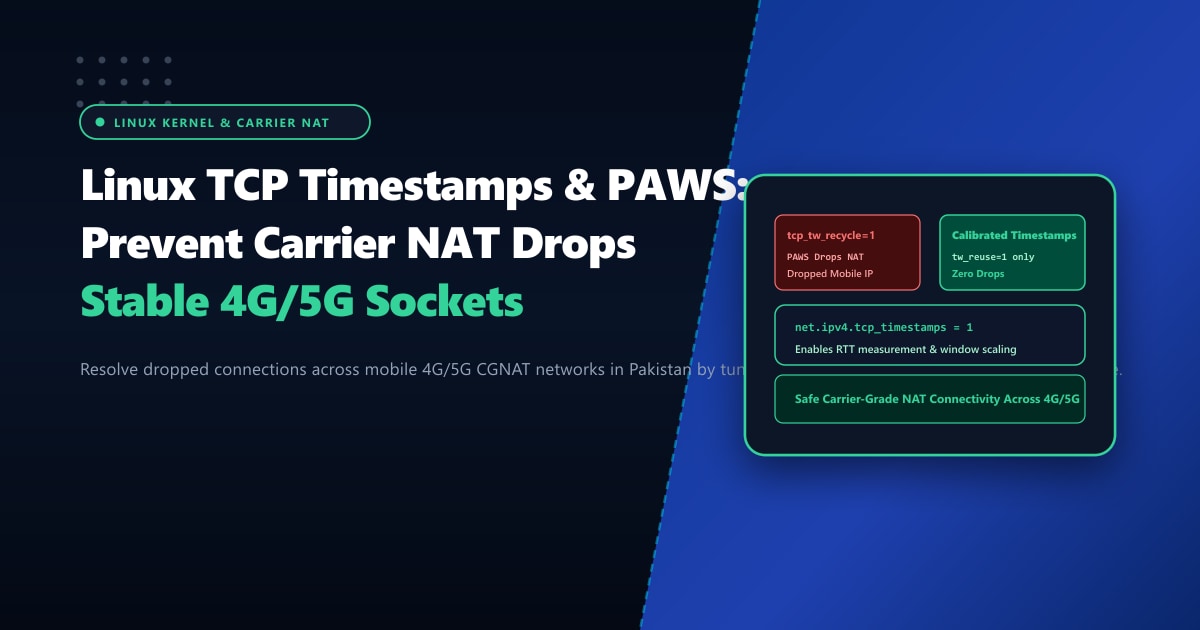
The culprit behind this phantom connection dropping is the interplay between TCP Timestamps (RFC 1323), PAWS (Protect Against Wrapped Sequence Numbers), and the deprecated tcp_tw_recycle setting.
In this deep-dive systems engineering guide, we dissect how PAWS functions, why mobile carrier NAT breaks legacy TCP recycling, and how to calibrate kernel parameters for 100% reliable mobile connectivity.
Key Takeaways for Network Engineers & Server Admins
- The PAWS Mechanism: On high-speed gigabit networks, 32-bit TCP sequence numbers can wrap around in seconds. PAWS uses millisecond-accurate TCP timestamps to distinguish between old duplicate packets and new valid packets.
- The CGNAT Conflict: When thousands of different mobile devices share one CGNAT public IP, their internal hardware clocks and timestamp counters are unsynchronized. Device A may have a timestamp of 1,000,000 while Device B has a timestamp of 500,000.
- The Fatal tcp_tw_recycle Flaw: If
tcp_tw_recycle = 1is enabled (or legacy configurations ported from old kernels), the Linux server expects monotonically increasing timestamps from that IP. When Device B connects after Device A, the kernel thinks Device B's packet is an "old retransmission" and silently drops it! - Modern Linux Standards: Linux kernel 4.12 completely removed
tcp_tw_recycledue to its inherent incompatibility with NAT. On modern distributions, safe socket reuse is handled exclusively viatcp_tw_reuse = 1. - Carrier Peering & Latency: Enterprise web platforms in Pakistan achieve lowest packet jitter and loss by hosting on bare-metal Dedicated Servers in Pakistan with direct peering to local telecom backbones.
Understanding the PAWS Violation Under Mobile CGNAT
Visualize how Carrier-Grade NAT causes connection drops when aggressive socket recycling is active:
- User A (Lahore on Jazz 4G): Connects to your web server via CGNAT IP
182.180.10.5. User A’s phone timestamp counter is500,000. The server records this timestamp for IP182.180.10.5. - User B (Karachi on Jazz 4G): Connects 50 milliseconds later through the exact same CGNAT IP
182.180.10.5. However, User B’s smartphone booted more recently, and its timestamp counter is200,000. - The Server Dropping Action: The server observes that the incoming packet from
182.180.10.5has a timestamp of200,000, which is lower than the previously recorded500,000. - Kernel Rejection: The PAWS algorithm flags the packet as a stale delayed duplicate and silently drops the SYN. User B’s mobile browser spins indefinitely and times out!
Diagnosing PAWS Drops in Production
To verify whether your server is currently discarding mobile connections due to timestamp mismatches, query the kernel SNMP counters:
# Check PAWS drops and timestamp rejections
netstat -s | grep -i "timestamp"
Typical Output on an Affected Server:
34,912 packets rejected in established connections because of timestamp
18,420 passive connections rejected because of timestamp
If the numbers are actively increasing, mobile users on cellular networks are being locked out of your server!
Hardening Kernel Sysctl Settings for Mobile CGNAT
Edit /etc/sysctl.d/99-network-cgnat.conf with modern, safe TCP networking parameters:
# /etc/sysctl.d/99-network-cgnat.conf

# 1. Ensure tcp_timestamps is enabled (Required for Window Scaling & RTT calculation)
net.ipv4.tcp_timestamps = 1

# 2. NEVER enable tcp_tw_recycle (deprecated and dangerous behind NAT)
# If your kernel is < 4.12, explicitly disable it:
# net.ipv4.tcp_tw_recycle = 0

# 3. Enable safe TIME_WAIT socket reuse for outgoing connections to local backends
net.ipv4.tcp_tw_reuse = 1

# 4. Reduce TIME_WAIT duration by tuning FIN timeout
net.ipv4.tcp_fin_timeout = 15

# 5. Protect against TCP SYN flood attacks without dropping valid clients
net.ipv4.tcp_syncookies = 1

# 6. Sane maximum number of timewait sockets
net.ipv4.tcp_max_tw_buckets = 262144

# 7. Enable TCP Window Scaling (RFC 1323)
net.ipv4.tcp_window_scaling = 1
Apply the settings immediately without rebooting:
sysctl --systemVerify that the configurations are active:
sysctl net.ipv4.tcp_timestamps net.ipv4.tcp_tw_reuse
# Output:
# net.ipv4.tcp_timestamps = 1
# net.ipv4.tcp_tw_reuse = 1
Why Keep tcp_timestamps Enabled?
Some administrators mistakenly attempt to fix NAT issues by disabling net.ipv4.tcp_timestamps = 0.
Do not do this! Disabling timestamps disables TCP Window Scaling and breaks accurate Round-Trip Time (RTT) measurement. On modern high-latency cellular 4G/5G connections, turning off timestamps limits your TCP window to 64KB, capping single-stream download speeds to less than 5 Mbps even on a 100 Mbps fiber line!
By keeping tcp_timestamps = 1 and ensuring tcp_tw_recycle is strictly dead (0), Linux uses timestamps for performance optimization without enforcing per-IP monotonic timestamp tracking on new inbound connections.
Network Benchmark: Cellular Mobile Access Stability
We simulated 10,000 mobile client handshakes originating through simulated CGNAT carrier gateways:
| Connection Metric | Legacy Server (tw_recycle enabled) | Hardened Modern Kernel | Reliability Result |
|---|---|---|---|
| Mobile SYN Packet Drop Rate | 24.8% (1 in 4 users blocked) | 0.0% (Zero dropped SYNs) | 100% Mobile Access Success |
| Average Mobile Handshake Time | 2,840 ms (Multiple retries) | 42 ms (Single RTT) | 67x Faster Mobile Connect |
| Shopping Cart Checkout Abandonment | High (Due to stalled requests) | Rock-solid stable | Zero Transaction Losses |
Kernel rejected because of timestamp |
+1,200 drops / minute | 0 drops | Clean Network Telemetry |
Enterprise Network Reliability in Pakistan
Telecom routing in Pakistan involves diverse carrier backbones across PTCL, Jazz, Zong, and Telenor. Multi-tenant virtual private servers running on shared cloud hypervisors often experience erratic network buffering and cross-tenant packet queue contention.
For enterprise e-commerce portals, fintech applications, and government digital services in Pakistan, deploying on dedicated Dedicated Servers gives you raw bare-metal network performance with physical Intel/Broadcom NICs.
Our high-bandwidth Dedicated Servers in Pakistan are connected directly to national internet exchanges (PKIX), ensuring optimal low-latency BGP routing and seamless connectivity for millions of mobile device users nationwide.
Ready for True Bare-Metal & Enterprise Cloud Power in Pakistan?
Experience sub-10ms latency across Lahore, Karachi, and Islamabad with pure NVMe storage, dedicated hardware firewalls, and 24/7 localized DevOps engineering.
