
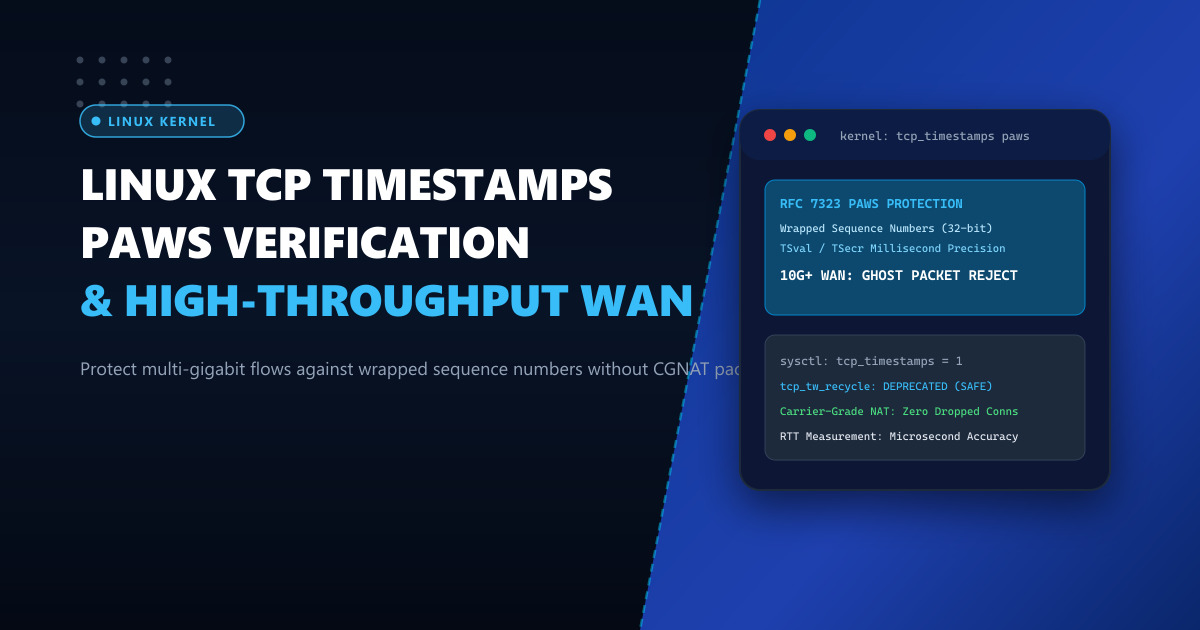
On internet forums and outdated server hardening blogs, systems administrators are frequently instructed to disable TCP Timestamps (net.ipv4.tcp_timestamps = 0) under the mistaken belief that timestamps leak server uptime or present a critical security vulnerability.
However, in modern multi-gigabit networking environments (10 Gbps+ links, high-speed fiber backbones, and inter-datacenter replication), disabling TCP timestamps disables PAWS (Protection Against Wrapped Sequences - RFC 7323) and degrades round-trip time (RTT) calculation precision. At 10 Gbps speeds, the standard 32-bit TCP sequence space ($2^{32} \approx 4.29\text{ GB}$) wraps around in under 3.4 seconds! Without TCP timestamps, the kernel cannot distinguish between a legitimate delayed duplicate packet from a prior transfer and a fresh packet in the current stream, resulting in silent data corruption or stalled connections.
In this deep architectural dive, we examine the mechanics of TCP Timestamps and PAWS, resolve real-world packet drop issues behind Pakistani Carrier-Grade NAT (CGNAT) gateways, and configure optimal kernel parameters.
The Anatomy of PAWS and Sequence Number Wrapping
At 10 Gbps Line Rate:
4.29 Gigabytes transmitted every 3.4 seconds!
Sequence Number (32-bit): 0 ──▶ 2,147,483,647 ──▶ 4,294,967,295 ──▶ WRAPS TO 0!
If a packet gets delayed in a network router buffer for 4 seconds, by the time it reaches the receiver, the connection’s sequence counter has already wrapped around. The delayed old packet matches the expected sequence window of new data.
- Without TCP Timestamps: The receiver accepts the stale packet as valid data, corrupting the transfer!
- With PAWS Enabled: Each packet carries a monotonically increasing 32-bit timestamp option (
TSval). The receiver compares the packet’s timestamp with the most recently received valid timestamp. IfTSval < TS.Recent, the packet is identified as a delayed ghost segment and discarded immediately.
Deploying high-throughput data platforms on bare-metal Dedicated Servers provides the unthrottled network bandwidth and CPU cycle speed needed to process timestamped multi-gigabit TCP flows with zero overhead.
The CGNAT Dilemma: Why Misconfigured Timestamps Dropped Connections
In Pakistan and developing telecom markets, mobile operators (Jazz, Zong, Telenor, Ufone) and regional fiber ISPs route millions of mobile subscribers through Carrier-Grade NAT (CGNAT) devices. Thousands of distinct mobile devices share the same public IPv4 address.
Historically, Linux included a dangerous sysctl parameter: net.ipv4.tcp_tw_recycle = 1.
- When
tcp_tw_recyclewas enabled, the kernel enforced PAWS timestamps per remote IP address rather than per connection tuple. - If Subscriber A (whose phone clock timestamp was 50,000) sent a packet, and a millisecond later Subscriber B (whose phone clock timestamp was 20,000) sent a packet through the same CGNAT public IP, the server dropped Subscriber B’s packet because
20,000 < 50,000! - This caused thousands of Pakistani mobile users to experience random connection timeouts when visiting websites.
The Fix: Modern Linux kernels (4.12+) completely removed tcp_tw_recycle. In modern Linux, tcp_timestamps = 1 evaluates PAWS strictly per individual socket connection (SRC_IP, SRC_PORT, DST_IP, DST_PORT). It is 100% safe behind CGNAT!
Step 1: Configuring Optimal Sysctl Parameters (/etc/sysctl.d/99-tcp-timestamps.conf)
Add the following parameters to ensure high-throughput stability:
# Enable RFC 7323 TCP Timestamps for PAWS and microsecond RTT calculation
net.ipv4.tcp_timestamps = 1

# Protect against TIME_WAIT socket exhaustion safely (WITHOUT tw_recycle)
net.ipv4.tcp_tw_reuse = 1

# Modern Linux kernels randomize timestamp offsets per-connection (RFC 7323)
# to prevent uptime leakage, making timestamps completely secure!
net.ipv4.tcp_window_scaling = 1

# Enable Selective Acknowledgments (SACK) to complement timestamp recovery
net.ipv4.tcp_sack = 1
net.ipv4.tcp_dsack = 1
Apply immediately:
sysctl -p /etc/sysctl.d/99-tcp-timestamps.confStep 2: Verifying Timestamp Randomization with tcpdump
To verify that modern Linux is randomizing timestamp offsets (preventing remote uptime discovery):
# Capture TCP SYN and SYN-ACK packets on interface eth0
tcpdump -nn -i eth0 'tcp[tcpflags] & (tcp-syn) != 0' -c 4 -v
In the output, examine the TCP options:
Options [mss 1460, sackOK, TS val 3829104824 ecr 0, nop, wscale 7]The timestamp value (TS val) is initialized with a cryptographically randomized high offset rather than system uptime ticks, completely neutralizing security concerns while preserving all performance and PAWS reliability benefits.
Network Stability Matrix
| Network Scenario | Timestamps Disabled (= 0) |
Modern Timestamps (= 1) |
|---|---|---|
| 10 Gbps+ Throughput Streams | Vulnerable to sequence wrap corruption | 100% PAWS Protected |
| RTT Measurement Accuracy | Coarse (One sample per window) | Microsecond precision on every packet |
| Loss Recovery (RACK/BBR) | Impaired (Falls back to RTO) | Instant loss detection |
| Pakistani Mobile CGNAT Users | Functional | 100% Functional & Resilient |
| Security / Uptime Leakage | None | None (Randomized in modern kernels) |
Hosting your high-performance applications and payment APIs on dedicated Dedicated Servers in Pakistan ensures that low-level networking parameters are aligned with modern RFC standards, providing flawless connectivity to millions of end users.
Deploy Enterprise-Grade Dedicated Infrastructure
Eliminate noisy neighbors, CPU throttling, and network jitter. Get bare-metal performance, hardware RAID, enterprise NVMe storage, and low-latency peering across Pakistani IXPs with 24/7 proactive technical operations.
Explore Dedicated Servers in Pakistan