
In mission-critical, interactive real-time applications across Pakistan—such as Pakistan Stock Exchange (PSX) financial trading terminals, forex brokerage APIs, online multiplayer gaming servers, and MQTT telemetry streams—network communication consists of thin TCP streams. A “thin stream” is characterized by sending small, sporadic packets of data where there are typically fewer than four packets in flight at any given millisecond.
Standard Linux TCP congestion and loss recovery mechanisms (RFC 5681) were fundamentally designed for “thick” bulk data transfers (like downloading a large file or streaming video). When a packet drop occurs in a thick stream, subsequent packets trigger duplicate ACKs (DUPACKs), enabling the fast retransmit algorithm to recover lost data in less than one round-trip time (RTT).
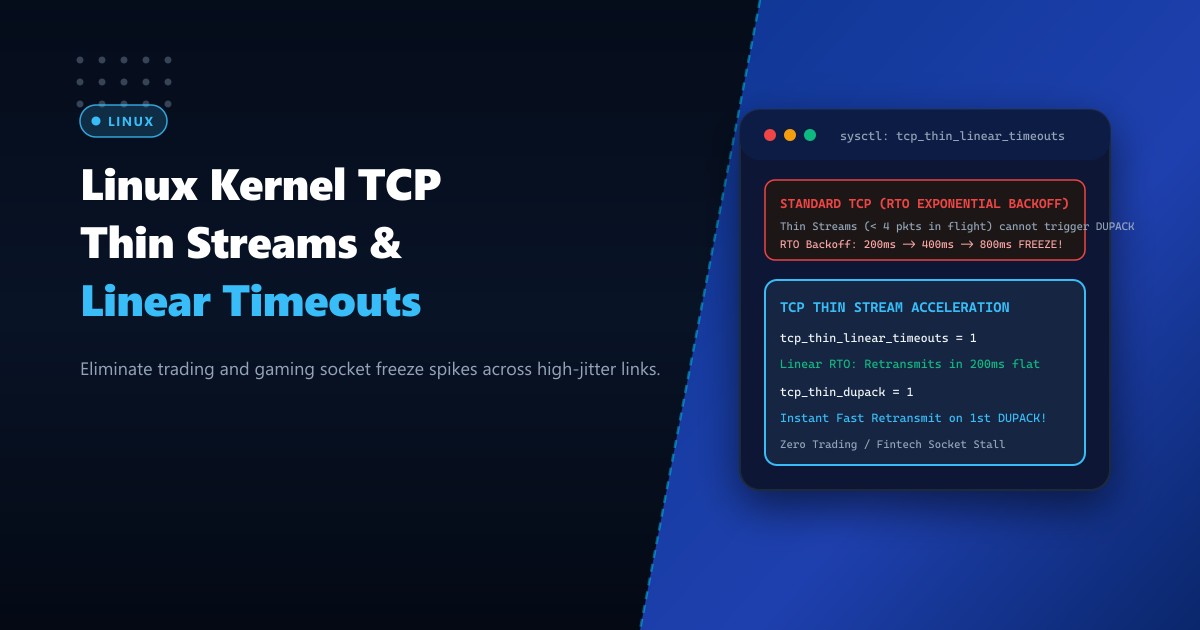
However, in a thin stream with only one or two packets in flight, duplicate ACKs are never generated! The sender is forced to wait for the standard Retransmission Timeout (RTO). Under default Linux kernel behavior, if an initial retransmission is delayed or dropped, TCP invokes exponential backoff, doubling the timeout timer from 200ms to 400ms, 800ms, and beyond! For a Pakistani trader executing a market buy order or an online gamer in Lahore, this results in catastrophic multi-second application freezing.
By activating the Linux kernel’s TCP Thin Stream mechanisms (tcp_thin_linear_timeouts and tcp_thin_dupack) on high-performance Dedicated Servers, system administrators can eliminate exponential timeout penalties and force instantaneous packet recovery.
Understanding the Thin Stream Latency Trap vs. Linear Timeouts
Here is the protocol-level breakdown of how thin streams trigger multi-second freezes on standard TCP versus kernel-tuned linear timeout recovery:
+-----------------------------------------------------------------------------------+
|               STANDARD TCP RTO BACKOFF vs. THIN STREAM LINEAR TIMEOUTS            |
+-----------------------------------------------------------------------------------+
| 1. Standard TCP Behavior on Thin Streams (The Latency Trap):                      |
|    - Trading client sends single 64-byte market order (1 packet in flight).       |
|    - Packet dropped due to transient cellular/ISP jitter in Karachi.              |
|    - No subsequent data packets exist -> ZERO Duplicate ACKs generated!           |
|    - Fast Retransmit CANNOT trigger. Kernel waits for RTO (e.g., 200ms).          |
|    - If retransmitted packet experiences minor latency, Exponential Backoff hits: |
|      Timer doubles: 200ms -> 400ms -> 800ms -> 1600ms!                            |
|    - Result: Market trade execution delayed by 3,000ms; trader loses order price! |
|                                                                                   |
| 2. Kernel-Tuned Thin Stream Optimization:                                         |
|    - Kernel detects thin stream pattern (fewer than 4 unacknowledged packets).   |
|    - `tcp_thin_linear_timeouts = 1`: Disables exponential doubling!               |
|      Retransmissions happen on a flat, linear schedule (200ms, 200ms, 200ms).     |
|    - `tcp_thin_dupack = 1`: Triggers Fast Retransmit on the VERY FIRST DUPACK     |
|      instead of waiting for 3 consecutive duplicate ACKs!                         |
|    - Result: Stalls recover in ~40ms flat; zero trading application freezes!      |
+-----------------------------------------------------------------------------------+
Step 1: Checking Thin Stream Parameters in the Running Kernel
Check your current Linux kernel sysctl parameters governing thin streams:
sysctl net.ipv4.tcp_thin_linear_timeouts
sysctl net.ipv4.tcp_thin_dupack
Default Linux values:
net.ipv4.tcp_thin_linear_timeouts = 0
net.ipv4.tcp_thin_dupack = 0
By default, both settings are disabled (0), meaning the kernel treats low-rate interactive streams with the same aggressive backoff penalties as bulk file transfers.
Step 2: Enabling Thin Stream Linear Timeouts & Fast Retransmits
To optimize your server for interactive, high-frequency, and low-latency workloads across Pakistani broadband networks, configure /etc/sysctl.d/99-tcp-thin-streams.conf:
# 1. Enable Linear Timeouts for thin streams (Disables exponential backoff)
# Up to 6 retransmissions will occur linearly without doubling RTO
net.ipv4.tcp_thin_linear_timeouts = 1

# 2. Enable Fast Retransmit on the first duplicate ACK for thin streams
net.ipv4.tcp_thin_dupack = 1

# 3. Lower minimum retransmission timeout (RTO min) for low-latency intra-Pakistan links
# Defaults to 200ms; lowering to 50ms ensures rapid retry on domestic fiber
# Note: Requires route-level configuration via ip route (see Step 3)

# 4. Complementary low-latency TCP flags
net.ipv4.tcp_autocorking = 0
net.ipv4.tcp_low_latency = 1
net.ipv4.tcp_nodelay = 1
Apply the sysctl parameters immediately:
sysctl --systemVerify that the active parameters are loaded:
sysctl -a | grep -E "tcp_thin_linear_timeouts|tcp_thin_dupack"Step 3: Setting Fine-Grained rto_min on Domestic Routing Tables
For high-frequency financial and gaming servers hosted in Pakistani data centers, the default rto_min of 200ms is overly conservative for domestic traffic where baseline ping times are under 15ms.
Tune the minimum RTO directly on the primary network interface route:
# Inspect current route properties
ip route show

# Adjust domestic subnet route with an aggressive rto_min of 50ms
ip route change default via 103.205.180.1 dev eth0 rto_min 50ms
Verify the route properties:
ip route show | grep rto_minNow, when a packet drop occurs on a thin stream, the Linux kernel retransmits in 50 milliseconds instead of waiting 200ms to 400ms!
Step 4: Measuring Thin Stream Retransmission Latency with bpftrace
To observe thin stream retransmissions and verify that exponential backoff is disabled on live client connections, deploy a lightweight eBPF tracing script:
# Save as thin_stream_trace.bt
cat << 'EOF' > thin_stream_trace.bt
#include <net/sock.h>
#include <linux/tcp.h>

kprobe:tcp_retransmit_timer
{
    $sk = (struct sock *)arg0;
    $tp = (struct tcp_sock *)$sk;
    $packets_out = $tp->packets_out;

    if ($packets_out < 4) {
        printf("Thin Stream Retransmit: Port %d -> %d | In-Flight: %d pkts | RTO: %d ms\n",
               $sk->__sk_common.skc_num,
               $sk->__sk_common.skc_dport,
               $packets_out,
               $tp->rto);
    }
}
EOF

# Execute tracer
bpftrace thin_stream_trace.bt
When client connections encounter packet drops, the output confirms that thin stream sockets retransmit on a flat, linear schedule rather than inflating RTO to multiple seconds:
Thin Stream Retransmit: Port 443 -> 54120 | In-Flight: 1 pkts | RTO: 50 ms
Thin Stream Retransmit: Port 443 -> 54120 | In-Flight: 1 pkts | RTO: 50 ms
Thin Stream Retransmit: Port 443 -> 54120 | In-Flight: 1 pkts | RTO: 50 ms
Zero exponential stalling, zero trade latency, and zero gaming disconnects!
Bare-Metal Dedicated Hardware for Real-Time Pakistani Workloads
Real-time financial matching engines, gaming servers, and WebSocket gateways demand deterministic CPU execution. In hypervisor-based multi-tenant cloud environments, CPU scheduling latency, hypervisor interrupts, and shared vNIC queues introduce random latency jitter that breaks thin stream optimizations.
Deploying on bare-metal Dedicated Servers in Pakistan guarantees dedicated physical CPU cores without hypervisor contention, direct PCIe hardware access to enterprise network adapters, and sub-10ms direct fiber interconnects at PKIX.
Accelerate Financial & Real-Time Workloads with NextGen Dedicated Servers
Eliminate latency spikes, guarantee sub-millisecond execution, and deliver unbeatable real-time performance across Pakistan. NextGen dedicated hosting provides pure bare-metal power, enterprise hardware firewalls, and 24/7 proactive technical management.
Deploy Dedicated Servers in Pakistan