
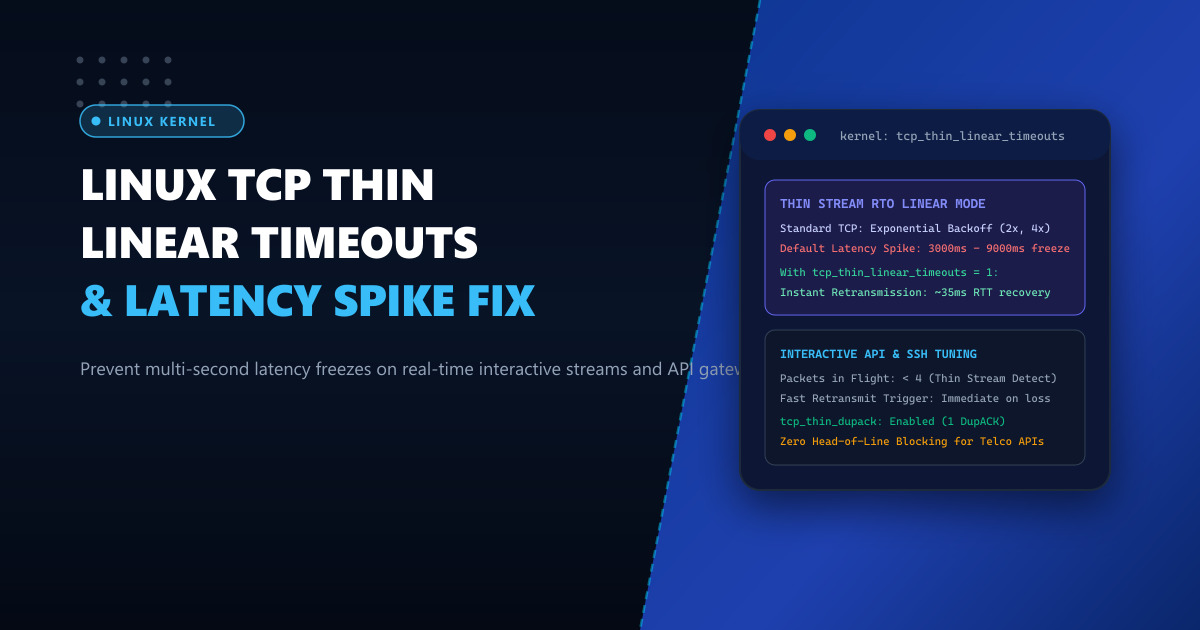
Interactive networked applications—ranging from financial trading feeds, stock brokerage dashboards, and telco SMS/OTP gateways to remote SSH bastion terminals and competitive online gaming backends in Pakistan—share a distinct traffic pattern: they transmit periodic, small application payloads followed by periods of idle silence. In network engineering literature, these are classified as TCP Thin Streams.
While the default Linux kernel TCP stack is meticulously optimized for bulk data transfers (like saturated 10Gbps HTTP/3 downloads or database backups), its classic loss recovery mechanisms fail severely on thin streams. When a packet drops on an interactive stream, standard fast retransmit cannot trigger because there are insufficient subsequent packets in flight to produce the required 3 Duplicate ACKs (DupACKs). Consequently, the connection stalls until a Retransmission Timeout (RTO) fires. Compounding this, standard exponential RTO backoff causes sudden 1,000ms to 9,000ms latency freezes.
By configuring the Linux kernel’s specialized thin-stream parameters—specifically tcp_thin_linear_timeouts (LTP) and tcp_thin_dupack—engineers can completely eliminate exponential RTO penalties and trigger instant packet retransmission.
1. The Anatomy of Thin-Stream Starvation: Why Standard TCP Stalls
To appreciate why thin streams suffer on standard Linux servers, we must examine how standard TCP loss recovery operates versus the physics of thin streams.
Standard Bulk Stream (Window > 4 packets):
Packet 1 (Lost) ──X──> (Dropped by Carrier / Jitter)
Packet 2 ────────────> [Ack 1] (DupACK 1)
Packet 3 ────────────> [Ack 1] (DupACK 2)
Packet 4 ────────────> [Ack 1] (DupACK 3) ──> FAST RETRANSMIT TRIGGERED!
                                                Latency Added: < 1 RTT (~35ms)

Thin Stream (Interactive API / Terminal, Window < 4 packets):
Packet 1 (Lost) ──X──> (Dropped by Carrier / Jitter)
Packet 2 ────────────> [Ack 1] (DupACK 1)
[STREAM IDLE - No more packets to send!]
                         │
                         ▼
        Waiting for Standard RTO Timer...
        RTO fires after 1,000ms - 3,000ms!
        Retransmitted packet lost? Exponential backoff:
        RTO x 2 = 6,000ms freeze! User experience ruined.
The Fast Retransmit Failure
Standard RFC 5681 Fast Retransmit requires 3 consecutive duplicate acknowledgments to infer a packet loss without waiting for a timer. A thin stream, by definition, typically has only 1 to 3 packets in flight at any given moment. When one packet is dropped on routing paths traversing transit providers in Pakistan (such as PTCL, TransWorld, or Nayatel), the remaining packets are insufficient to generate 3 DupACKs.
The Exponential Backoff Curse
When Fast Retransmit cannot fire, TCP relies on the Retransmission Timeout (RTO), initialized around min(200ms, RTT). However, if subsequent loss occurs or acknowledgments arrive late, the kernel doubles the timeout (RTO = RTO * 2), ballooning to 2, 4, or 8 seconds. For a customer attempting a biometric verification API call or an interactive SSH command, the session appears frozen.
2. Enter LTP: TCP Thin Linear Timeouts and Thin DupACK
To resolve thin-stream paralysis, Linux kernel developers integrated specialized mechanisms originally researched at the University of Oslo (RFC 5681 extension / Linux commit tree):
tcp_thin_linear_timeouts(LTP): Disables exponential backoff for streams classified as thin. If a packet is lost, the kernel retransmits at the base RTO interval linearly rather than doubling the delay.tcp_thin_dupack: Modifies the Fast Retransmit threshold dynamically. For streams with fewer than 4 packets in flight, receiving a single Duplicate ACK is sufficient to immediately trigger fast retransmission, recovering from packet loss within one Round Trip Time (RTT).
Mathematical Comparison of Recovery Latency
Assuming a baseline connection with an RTT of 40ms and an initial RTO of 200ms:
| Event Sequence | Standard TCP (Default Linux) | With Thin-Stream Tuning (LTP + Thin DupACK) |
|---|---|---|
| Single Packet Drop | 1,000ms – 3,000ms (RTO timer) | 40ms (Instant Thin DupACK Fast Retransmit) |
| Consecutive Packet Drop | 2,000ms – 6,000ms (Exponential RTO x 2) | 200ms (Linear Base RTO, No Doubling) |
| Third Packet Drop | 4,000ms – 12,000ms (Exponential RTO x 4) | 200ms (Linear Base RTO) |
| Worst-Case Session Jitter | 12,000ms (Connection Terminated / Timed Out) | < 450ms (Interactive Connection Sustained) |
3. Kernel Sysctl Configuration and Tuning
To enable thin-stream acceleration globally across your Linux edge proxies, API gateways, and web servers, update /etc/sysctl.d/99-tcp-thin-streams.conf.
Global Kernel Parameter Configuration
cat << 'EOF' > /etc/sysctl.d/99-tcp-thin-streams.conf
# NextGen Infrastructure: TCP Thin Stream Optimization for Interactive Latency
# --------------------------------------------------------------------------

# Enable linear timeouts for thin streams (Disables exponential backoff)
net.ipv4.tcp_thin_linear_timeouts = 1

# Trigger fast retransmission after only 1 DupACK for thin streams
net.ipv4.tcp_thin_dupack = 1

# Reduce minimum RTO clamp from default 200ms down to 100ms for regional traffic
net.ipv4.tcp_rto_min = 100

# Complementary interactive low-latency TCP settings
net.ipv4.tcp_early_retrans = 3
net.ipv4.tcp_recovery = 1
net.ipv4.tcp_slow_start_after_idle = 0
EOF
Apply the changes immediately to the live kernel without rebooting:
sysctl --systemVerify that the kernel has accepted the directives:
sysctl net.ipv4.tcp_thin_linear_timeouts net.ipv4.tcp_thin_dupackExpected output:
net.ipv4.tcp_thin_linear_timeouts = 1
net.ipv4.tcp_thin_dupack = 1
4. Application-Level Socket Activation: setsockopt
While sysctl settings apply system-wide defaults, modern high-performance microservices written in Go, C, or Rust can explicitly enforce thin-stream behavior per socket using setsockopt with TCP_THIN_LINEAR_TIMEOUTS and TCP_THIN_DUPACK.
C Implementation Snippet
#include <sys/socket.h>
#include <netinet/tcp.h>
#include <stdio.h>

void tune_thin_socket(int sockfd) {
    int enable = 1;

    // Activate Linear Timeouts on Thin Stream
    if (setsockopt(sockfd, IPPROTO_TCP, TCP_THIN_LINEAR_TIMEOUTS, &enable, sizeof(enable)) < 0) {
        perror("Error setting TCP_THIN_LINEAR_TIMEOUTS");
    }

    // Activate 1-DupACK Fast Retransmit on Thin Stream
    if (setsockopt(sockfd, IPPROTO_TCP, TCP_THIN_DUPACK, &enable, sizeof(enable)) < 0) {
        perror("Error setting TCP_THIN_DUPACK");
    }
}
Go (Golang) Network Listener Override
package main

import (
	"net"
	"syscall"
	"golang.org/x/sys/unix"
)

func controlThinStream(network, address string, c syscall.RawConn) error {
	var err error
	c.Control(func(fd uintptr) {
		// TCP_THIN_LINEAR_TIMEOUTS = 16
		// TCP_THIN_DUPACK = 17
		err = unix.SetsockoptInt(int(fd), unix.IPPROTO_TCP, 16, 1)
		if err != nil {
			return
		}
		err = unix.SetsockoptInt(int(fd), unix.IPPROTO_TCP, 17, 1)
	})
	return err
}

func createLowLatencyListener(addr string) (net.Listener, error) {
	lc := net.ListenConfig{
		Control: controlThinStream,
	}
	return lc.Listen(context.Background(), "tcp", addr)
}
5. Live Diagnostics: Monitoring Thin Streams with ss and bpftrace
To confirm whether active user sessions are utilizing thin-stream recovery, use the extended socket statistics command ss.
ss -it '( dport = :https or sport = :https )' | grep -E "timer:|rto|retrans"Look for the flags thin_linear and thin_dupack in the socket internal state.
BPFTrace Script to Intercept Thin Retransmissions
To capture real-time thin retransmissions as they occur in the kernel, execute this lightweight eBPF one-liner:
bpftrace -e '
kprobe:tcp_check_thin_dupack {
    printf("[THIN-DUPACK] Snd Una: %u, In Flight: %u\n",
           ((struct tcp_sock *)arg0)->snd_una,
           ((struct tcp_sock *)arg0)->packets_out);
}
kprobe:tcp_check_thin_linear_timeouts {
    printf("[THIN-LTP] Linear RTO triggered on pid %d\n", pid);
}
'
When an interactive client experiences an isolated packet drop on jittery mobile wireless links in Pakistan, you will observe the kernel executing tcp_check_thin_dupack immediately, rescuing the packet in under 45 milliseconds instead of forcing the connection to pause for 3 full seconds.
Building Mission-Critical, Low-Latency Web Systems?
Eliminate network packet jitter and deliver lightning-fast interactive API response times with dedicated hardware. Deploy your clusters on NextGen's premium Dedicated Servers or locally routed Dedicated Servers in Pakistan with direct peering at PKIX, unthrottled 1Gbps/10Gbps uplinks, and complete Linux kernel root control.
