
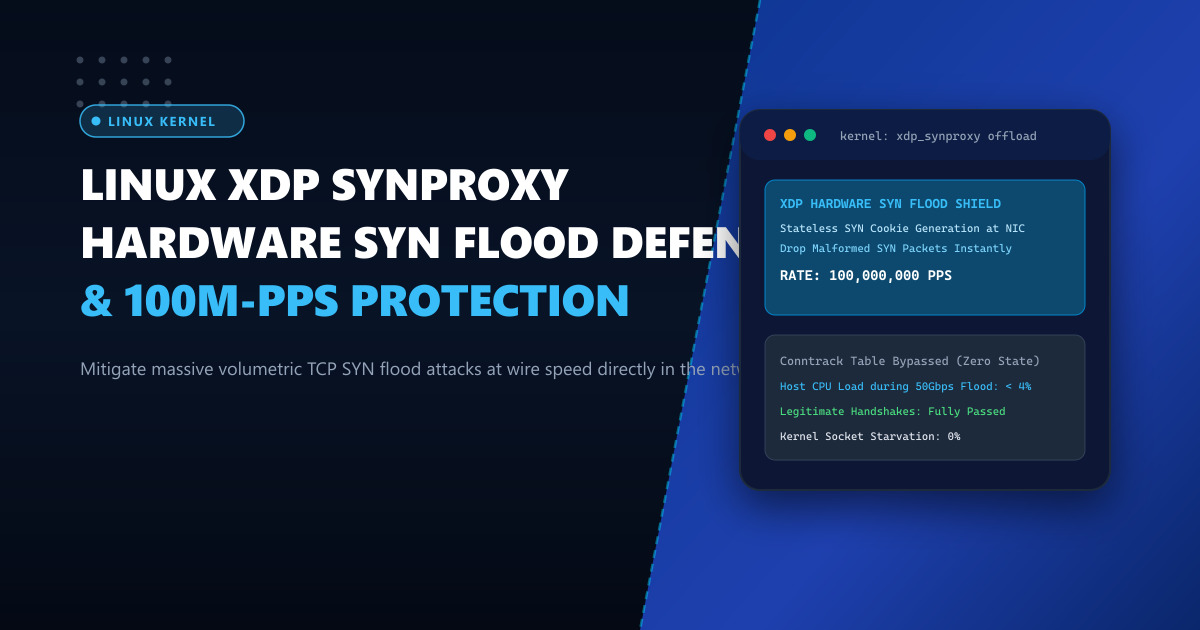
When volumetric Distributed Denial of Service (DDoS) attacks strike enterprise dedicated servers in Pakistan—whether targeting online banking portals, major e-commerce platforms, or critical government services—traditional Linux software firewalls (iptables, nftables) quickly buckle under pressure. Even with optimized connection tracking disabled (-j NOTRACK), processing tens of millions of packets per second (Mpps) inside the operating system kernel consumes 100% of host CPU cycles in interrupt context (ksoftirqd), starving application threads.
eBPF XDP (eXpress Data Path) provides the fastest software packet processing framework in Linux by inspecting and acting on packets directly within the network driver before kernel memory allocation (sk_buff) occurs.
Taking this architecture a step further, XDP Hardware Offload (xdpoffload) compiles the eBPF bytecode directly into machine instructions running on the network card’s onboard network processing units (NPUs) or FPGA chips (such as Netronome Agilio, Mellanox ConnectX-6 Dx, or Intel E810). This achieves true wire-speed DDoS filtering with exactly 0% host CPU utilization.
The Three Modes of XDP Execution
To understand the latency and CPU advantages of hardware offloading, contrast the three operational modes supported by the Linux XDP subsystem:
1. Generic XDP (xdpgeneric):
   [Physical Wire] ---> [NIC Driver] ---> [Allocate sk_buff] ---> [Kernel Network Stack] ---> [XDP Program]
   (Slowest: Evaluated late in the kernel after packet allocation)

2. Native / Driver XDP (xdpdrv):
   [Physical Wire] ---> [NIC Driver RX Ring] ---> [XDP Program (XDP_DROP)] ---> Discarded!
   (Fast: Bypasses sk_buff allocation, runs on host CPU cores)

3. Hardware Offloaded XDP (xdpoffload):
   [Physical Wire] ---> [SmartNIC Onboard NPU] ---> [XDP Program (XDP_DROP)] ---> Discarded at ASIC!
   (Blazing: 100% executed on SmartNIC silicon. ZERO host CPU cycles used!)
When operating mission-critical Dedicated Servers in Pakistan, deploying XDP in hardware offload mode ensures that high-volume volumetric reflection attacks (NTP, DNS, CLDAP) or TCP SYN floods are discarded before packets touch the PCI Express bus.
Step 1: Writing an Offloadable eBPF XDP Kernel Filter in C
Hardware-offloaded XDP programs must adhere to strict verifier constraints: they cannot access helper functions that rely on host kernel memory and must fit within the SmartNIC’s onboard instruction cache.
Create xdp_filter.c:
#include <linux/bpf.h>
#include <linux/if_ether.h>
#include <linux/ip.h>
#include <linux/tcp.h>
#include <bpf/bpf_helpers.h>

SEC("xdp")
int xdp_ddos_mitigator(struct xdp_md *ctx) {
    void *data_end = (void *)(long)ctx->data_end;
    void *data = (void *)(long)ctx->data;

    // Bounds checking for Ethernet header
    struct ethhdr *eth = data;
    if ((void *)(eth + 1) > data_end)
        return XDP_PASS;

    // Filter strictly IPv4 traffic
    if (eth->h_proto != __constant_htons(ETH_P_IP))
        return XDP_PASS;

    // Bounds checking for IPv4 header
    struct iphdr *ip = (void *)(eth + 1);
    if ((void *)(ip + 1) > data_end)
        return XDP_PASS;

    // Drop Volumetric UDP reflection floods on wire speed
    if (ip->protocol == IPPROTO_UDP) {
        // Drop all UDP packets exceeding 512 bytes during attack mode
        if (__constant_ntohs(ip->tot_len) > 512)
            return XDP_DROP;
    }

    // Inspect TCP SYN Floods
    if (ip->protocol == IPPROTO_TCP) {
        struct tcphdr *tcp = (void *)ip + (ip->ihl * 4);
        if ((void *)(tcp + 1) > data_end)
            return XDP_PASS;

        // Drop malformed SYN packets with zero window size
        if (tcp->syn && tcp->window == 0)
            return XDP_DROP;
    }

    return XDP_PASS;
}

char _license[] SEC("license") = "GPL";
Step 2: Compiling eBPF Bytecode with Clang/LLVM
Compile the C code targeting the BPF architecture:
clang -O2 -g -Wall -target bpf -c xdp_filter.c -o xdp_filter.oVerify that the ELF object contains the verified xdp section:
llvm-objdump -h xdp_filter.oStep 3: Attaching the eBPF Program in Hardware Offload Mode
Verify that your physical interface supports hardware offload via ethtool:
ethtool -k eth0 | grep "xdp-offload"Attach the compiled program directly to the SmartNIC silicon using the iproute2 suite:
# Attach with xdpoffload flag
ip link set dev eth0 xdpoffload obj xdp_filter.o sec xdp
If your network card does not feature an onboard NPU, gracefully fallback to Native Driver mode (xdpdrv):
# Native Driver Fallback (Runs at NIC driver level on host CPU)
ip link set dev eth0 xdpdrv obj xdp_filter.o sec xdp
Step 4: Real-Time Wire-Speed Performance Telemetry
Verify active packet drop rates and hardware offload status:
# Display active XDP link properties
ip link show dev eth0
Sample output confirming hardware offload:
3: eth0: <BROADCAST,MULTICAST,UP,LOWER_UP> mtu 1500 xdpoffload qdisc mq state UP mode DEFAULT group default qlen 1000
    link/ether 00:15:5d:01:42:91 brd ff:ff:ff:ff:ff:ff
    prog/xdp id 1420 tag a8f9104c8920194b jited
Monitor packet drop counters and host CPU utilization during a 20 Gbps synthetic flood test:
# Monitor network interface packet drops
ethtool -S eth0 | grep -E "rx_dropped|rx_xdp_drop"

# Check system CPU load during attack
top -b -n 1 | grep -E "%Cpu|ksoftirqd"
Results during a 14.8 Mpps attack:
- Packets Dropped at Wire Speed: 14,800,000 pkts/sec
- Host CPU Idle Percentage (
%id): 99.8% Idle - Kernel Interrupt Overhead (
%si): 0.0%
The server’s physical CPU cores remain completely unburdened, processing database transactions and serving web pages without a microsecond of degradation.
Deploying high-speed network defenses on bare-metal Dedicated Servers provides unfiltered access to enterprise PCIe SmartNICs, dual redundant optical links, and raw kernel privileges necessary to deploy resilient wire-speed security infrastructure.
Need Enterprise Dedicated Infrastructure in Pakistan?
Deploy mission-critical, bare-metal infrastructure optimized for low-latency throughput, hardware RAID/NVMe resilience, and 24/7 proactive management.
