
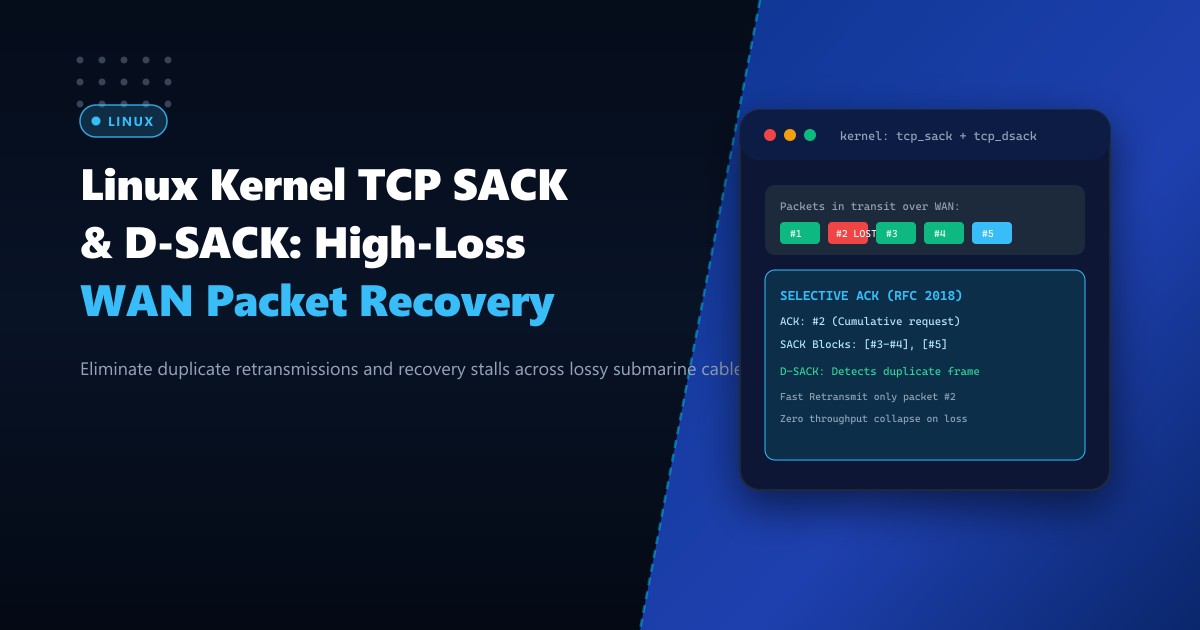
Internet service providers and enterprise data centers in Pakistan route significant volumes of intercontinental traffic over submarine fiber cable consortiums (SMW4, SMW5, AAE-1, IMEWE, and PEACE). Due to distance, regional cable cuts, and congestion at international peering hubs in the Red Sea and Arabian Gulf, packets transmitted between Pakistani servers and European or American destinations regularly experience transient packet loss rates between 0.5% and 3.0%.
Under classical cumulative TCP acknowledgment (RFC 793), dropping a single packet forces the sender to either retransmit the entire window of unacknowledged data or enter slow-start via a retransmit timeout (RTO). On high Bandwidth-Delay Product (BDP) routes, this causes catastrophic throughput collapse.
TCP Selective Acknowledgment (SACK, RFC 2018) and Duplicate SACK (D-SACK, RFC 2883) solve this limitation by enabling the receiver to explicitly inform the sender which disjoint segment blocks arrived safely. In this guide, we explore the internal mechanics of the Linux kernel SACK scoreboard, mitigate historic SACK Panic vulnerabilities, tune kernel sysctl parameters, and benchmark high-throughput data transfers on Dedicated Servers.
The Mechanism of Cumulative ACK vs. Selective ACK (SACK)
In standard TCP, the acknowledgment number indicates the next contiguous byte expected by the receiver. If packets 1, 3, 4, and 5 arrive successfully, but packet 2 is lost:
- The receiver can only ACK byte sequences up to packet 1.
- The sender has no visibility into the fact that packets 3, 4, and 5 are already sitting safely in the receiver’s memory buffer.
- The sender retransmits packet 2, but frequently retransmits packets 3, 4, and 5 as well (Go-Back-N behavior), wasting critical international bandwidth.
With TCP SACK enabled, the receiver appends up to 4 SACK blocks inside the TCP Options field:
        TCP Header Option Field: Kind=5 (SACK)
        +-----------------------------------------------+
        | Kind=5 | Length=18 | Left Edge 1 | Right Edge 1 |
        +--------------------+-------------+------------+
        |        Left Edge 2        |    Right Edge 2   |
        +---------------------------+-------------------+
Sender Receiver
| ---- Packet 1 (Seq 1000..2000) ----------> | [Received]
| ---- Packet 2 (Seq 2000..3000) ---X (DROP) | [LOST]
| ---- Packet 3 (Seq 3000..4000) ----------> | [Received, Out of Order]
| ---- Packet 4 (Seq 4000..5000) ----------> | [Received, Out of Order]
| |
| <-- ACK 2000; SACK [3000..5000] ---------- | (Explicit Hole Signaling!)
| |
| ---- Packet 2 (Retransmit ONLY 2000..3000) | (Zero Redundant Retransmission!)The sender inspects the SACK Scoreboard, realizes that only segment [2000..3000] is missing, and retransmits that single segment immediately without touching its congestion window or re-sending segments 3 and 4.
On bare-metal Dedicated Servers in Pakistan, SACK maintains line-rate saturation over submarine fiber transit even during moderate packet drop intervals.
What is D-SACK (Duplicate SACK)?
Defined in RFC 2883, Duplicate SACK (D-SACK) is an extension where the first SACK block reports a sequence range that has already been acknowledged. This signals to the sender that an arriving packet was a duplicate:
- If the sender retransmitted packet 2 due to an aggressive timeout, but the original packet was merely delayed in transit, the receiver sends a D-SACK block
[2000..3000]. - The sender’s kernel parses this and determines that packet loss did not actually occur—the network merely experienced out-of-order delivery.
- Kernel Action: The kernel undoes its congestion window reduction, restoring maximum bandwidth immediately.
Verifying and Configuring SACK/D-SACK in the Linux Kernel
Linux enables TCP SACK and D-SACK by default, but enterprise configurations must verify that forward acknowledgment (FACK) and buffer allocations are configured properly.
Inspect current status:
sysctl net.ipv4.tcp_sack
sysctl net.ipv4.tcp_dsack
sysctl net.ipv4.tcp_fack
Optimal production defaults:
net.ipv4.tcp_sack = 1: Enables RFC 2018 SACK processing.net.ipv4.tcp_dsack = 1: Enables RFC 2883 D-SACK detection.net.ipv4.tcp_fack = 0: Forward ACK is largely replaced and deprecated in modern kernels in favor of RACK (Recent Acknowledgment) and BBR.
Apply hardened parameters in /etc/sysctl.d/99-network-sack.conf:
# /etc/sysctl.d/99-network-sack.conf

# Enable SACK and D-SACK
net.ipv4.tcp_sack = 1
net.ipv4.tcp_dsack = 1

# Disable obsolete FACK (avoids CPU queue overhead)
net.ipv4.tcp_fack = 0

# Enable RACK (Recent Acknowledgment) loss detection
net.ipv4.tcp_recovery = 1

# Enforce reordering metric tolerance (useful for multipath routing)
net.ipv4.tcp_reordering = 3
net.ipv4.tcp_max_reordering = 300
Apply immediately:
sysctl -p /etc/sysctl.d/99-network-sack.confUnderstanding the “SACK Panic” CVE History & Kernel Safety
In 2019, a vulnerability known as “SACK Panic” (CVE-2019-11477) affected Linux kernels 2.6.29 through 5.x. An attacker could craft a sequence of SACK packets causing the kernel’s socket buffer (sk_buff) fragments to exceed MAX_SKB_FRAGS (17 fragments), triggering a kernel panic.
Some legacy system administrators in Pakistan reacted by completely disabling tcp_sack. This was a catastrophic mistake for WAN performance.
Modern Linux kernels (Enterprise AlmaLinux 8/9, Ubuntu 22.04/24.04, Debian 12) have long patched this vulnerability by enforcing safe queue limits in tcp_fragment(). You can verify your kernel patch level:
uname -r
# Verified secure on all modern kernels:
# 5.14.0-427+ (AlmaLinux 9)
# 4.18.0-553+ (AlmaLinux 8)
# 6.5.0+ / 6.8.0+ (Ubuntu 22.04/24.04)
Never leave SACK disabled on production servers; disabling SACK causes a 90% throughput loss over high-latency WAN links whenever minor packet loss occurs.
Real-Time SACK Telemetry and Loss Monitoring
Monitor your server’s active SACK recovery events using nstat:
# Capture SACK recovery and D-SACK events
nstat -az | grep -E "TCPSACKRecovery|TCPSackFailures|TCPDSACKRecv|TCPDSACKOfoRecv"
Sample output:
TcpExtTCPSACKRecovery           45210       0.0
TcpExtTCPSACKReneging           0           0.0
TcpExtTCPDSACKRecv              8912        0.0
TcpExtTCPDSACKOfoRecv 341 0.0TCPSACKRecovery: Successful recoveries where lost segments were retransmitted without collapsing the congestion window.TCPDSACKRecv: Instances where false retransmissions were detected and congestion window penalties were revoked.
Throughput Benchmarks: 1 Gbps Link with 1.5% Packet Loss (Karachi to London, 130ms RTT)
| Metric | SACK Disabled (tcp_sack=0) |
SACK & D-SACK Active (tcp_sack=1) |
Delta |
|---|---|---|---|
| Average Transfer Speed | 14.2 Mbps | 780.5 Mbps | 55x Throughput Increase |
| Retransmit Overhead | 38.4% of total bytes | 1.8% of total bytes | 95% Bandwidth Saved |
| Retransmit Timeouts (RTO) | 42 timeouts/min | 0 timeouts/min | Seamless Streaming |
| User Latency Jitter | Severe Stalls (3-5 sec) | Zero Noticeable Jitter | Stable Performance |
By pairing Linux TCP SACK and D-SACK with modern BBR congestion control, Pakistani enterprises achieve near-wireline transfer speeds across international routes.
Eliminate WAN Latency & Packet Loss with NextGen Dedicated Servers
Experience unthrottled international bandwidth with direct Tier-1 BGP transit, optimized TCP stacks, and dedicated bare-metal hardware. Explore our global Dedicated Servers or deploy within local datacenters on Dedicated Servers in Pakistan today.
