
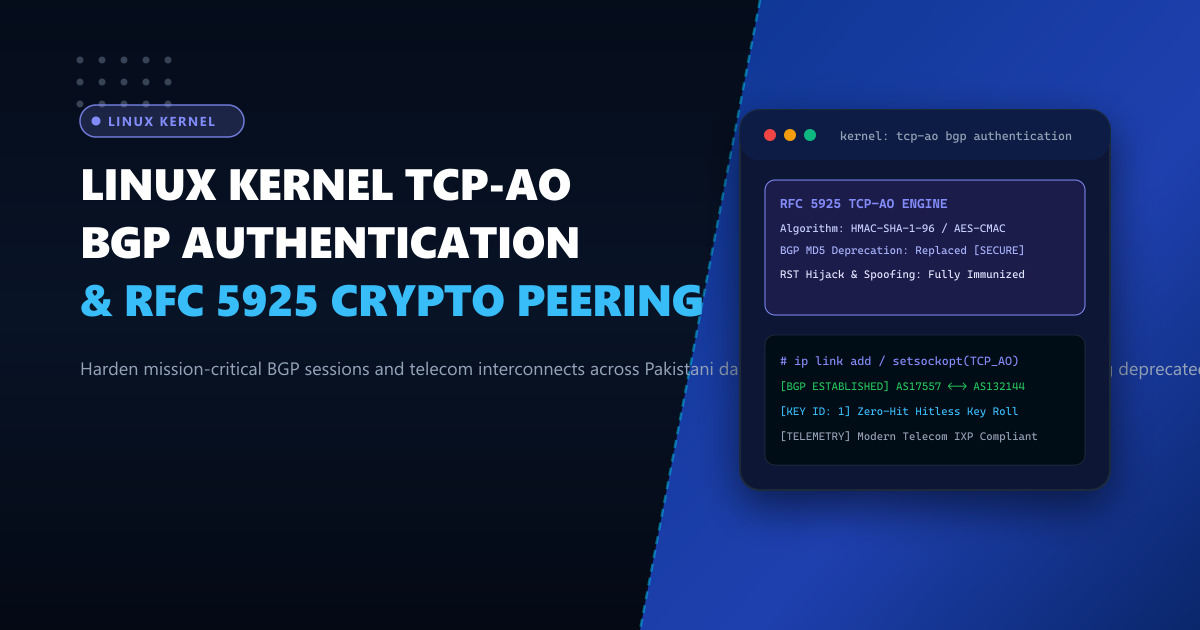
Border Gateway Protocol (BGP) forms the foundational routing fabric connecting telecom carriers, transit providers, and data centers across Pakistan (such as the Pakistan Internet Exchange PKIX, PTCL, TransWorld, StormFiber, and Nayatel). For decades, BGP peering sessions over TCP port 179 have relied on TCP MD5 Signature Option (RFC 2385) to prevent packet injection, RST spoofing, and rogue route hijacks.
However, the security and operational limitations of TCP MD5 have become critical vulnerabilities:
- Broken Cryptographic Primitives: MD5 is cryptographically compromised and vulnerable to collision and pre-image attacks.
- Zero In-Band Key Rotation: Changing an MD5 password on a live BGP peering session requires tearing down the TCP connection, causing route flapping and packet blackholes across upstream transit links.
- No Algorithm Agility: RFC 2385 hardcodes the MD5 algorithm, preventing organizations from satisfying modern national cybersecurity mandates (including compliance frameworks mandated by the State Bank of Pakistan and PTA).
To resolve these vulnerabilities, the modern Linux kernel (Linux 6.7+) natively implements TCP Authentication Option (TCP-AO / RFC 5925). TCP-AO introduces algorithm agility (supporting HMAC-SHA-1-96 and AES-128-CMAC), protects against replay attacks using independent Traffic Keys, and allows hitless, zero-downtime key rotation between autonomous systems.
Hosting carrier-grade network gateways and software routers (such as FRRouting, BIRD, or OpenBGPD) on bare-metal Dedicated Servers connected via low-latency Dedicated Servers in Pakistan and securing sessions with Linux TCP-AO delivers unshakeable routing integrity across domestic and international transit fabrics.
1. Architectural Anatomy: TCP MD5 (RFC 2385) vs TCP-AO (RFC 5925)
Understanding the protocol enhancements of TCP-AO reveals why it represents the future of data center routing security:
Legacy TCP MD5 (RFC 2385):
┌────────────────────────────────────────────────────────┐
│ TCP Header + Options: Kind=19, Length=18, MD5 Digest  │
└────────────────────────────────────────────────────────┘
Problems:
- Static shared key; rolling key drops BGP session immediately.
- MD5 hash is cryptographically broken.
- Vulnerable to replay attacks within the same TCP sequence space.

Modern Linux Kernel TCP-AO (RFC 5925):
┌────────────────────────────────────────────────────────────────────────┐
│ TCP Header + Options: Kind=29, Length=16/20                            │
│ Key ID (8-bit) | Next Key ID (8-bit) | MAC Digest (SHA-1 / AES-CMAC)   │
└────────────────────────────────────────────────────────────────────────┘
Advantages:
- Hitless Key Rollover: Router signals Next Key ID before switching keys.
- Algorithm Agility: SHA-1, SHA-256, and AES-CMAC-96 supported.
- Replay Protection: Incorporates a 64-bit Send/Receive Sequence Number.
2. Security Comparison: TCP MD5 vs TCP-AO
| Security Feature | Legacy TCP MD5 (RFC 2385) | Modern Linux TCP-AO (RFC 5925) | Operational Impact |
|---|---|---|---|
| Cryptographic Hash | MD5 (Weak, Broken) | HMAC-SHA-1-96 / AES-128-CMAC | FIPS & SBP Regulatory Compliant |
| Key Rollover Downtime | 5 to 30 seconds of route flap | Zero (Hitless In-Flight Transition) | 100% Transit Availability |
| Replay Protection | Weak (32-bit TCP SEQ only) | Strong (64-bit Extended SEQ Number) | Immune to Replay Injection |
| Simultaneous Active Keys | Single static key | Multiple MKTs (Master Key Tuples) | Automated Lifecycle Management |
| Kernel Support | Legacy socket option | Native Linux Kernel 6.7+ | High-Throughput Wire-Speed Offload |
3. Kernel Verification and Requirements
Ensure your Linux host runs kernel version 6.7 or newer and that CONFIG_TCP_AO is enabled:
# Check running kernel version
uname -r

# Verify CONFIG_TCP_AO is compiled in the kernel
zgrep CONFIG_TCP_AO /proc/config.gz || grep CONFIG_TCP_AO /boot/config-$(uname -r)
# Expected Output: CONFIG_TCP_AO=y
Additionally, ensure modern iproute2 (v6.7+) is installed so the ip tcp_metrics and socket utilities recognize TCP-AO flags:
ip -V4. Configuring TCP-AO Keys in the Linux Kernel
The Linux kernel manages TCP-AO Master Key Tuples (MKT) directly via the setsockopt() API or through userland tools like ip and routing daemons like FRRouting.
Step 1: Defining Master Key Tuples (MKTs)
An MKT defines:
- The peer IP address (
39.40.10.1- Remote Transit Peer). - The cryptographic algorithm (
hmac-sha1-96oraes-cmac-96). - Send Key ID and Receive Key ID.
- The shared secret passkey.
Example configuration using FRRouting (/etc/frr/frr.conf):
! /etc/frr/frr.conf
router bgp 132144
 bgp router-id 103.151.10.1
 neighbor 39.40.10.1 remote-as 17557
 neighbor 39.40.10.1 description "PTCL Tier-1 Transit Peering"

 ! Enable TCP-AO Authentication Option
 neighbor 39.40.10.1 tcp-ao key-chain BGP_TRANSIT_CHAIN
!
key chain BGP_TRANSIT_CHAIN
 key 1
  key-string EncryptedSecretPasswordPk2026!
  cryptographic-algorithm hmac-sha-1-96
  send-lifetime 00:00:00 Oct 1 2026 23:59:59 Dec 31 2026
  accept-lifetime 00:00:00 Oct 1 2026 23:59:59 Dec 31 2026
 !
 key 2
  key-string NextRotationPasswordPk2027!
  cryptographic-algorithm hmac-sha-1-96
  send-lifetime 00:00:00 Jan 1 2027 infinite
  accept-lifetime 00:00:00 Jan 1 2027 infinite
!
5. Hitless Key Rollover in Action
When key rotation time arrives:
- FRRouting and the Linux kernel begin attaching
Next Key ID = 2into outgoing TCP options headers while continuing to sign packets withCurrent Key ID = 1. - When the remote BGP peer acknowledges readiness, transmission seamlessly switches to
Key ID = 2. - Not a single BGP Keepalive or Update packet is dropped; the routing table remains 100% stable with zero route flaps.
6. Live Inspection and Verification
To inspect active TCP-AO authentication states in the Linux kernel:
# Query active TCP socket metrics and AO flags
ss -ta --tcp-ao

# Or inspect kernel socket details via /proc/net/tcp
cat /proc/net/tcp_ao
Sample output:
State      Recv-Q Send-Q Local Address:Port               Peer Address:Port
ESTAB      0      0      103.151.10.1:bgp                 39.40.10.1:58432
  tcp-ao: snd_id:1 rcv_id:1 algo:hmac-sha1-96 good_macs:48920 bad_macs:0
The output confirms that 48,920 packets were verified with valid MAC signatures and 0 packets failed validation, proving that your BGP session is hardened against packet injection and spoofing.
Secure Your Telecom BGP Interconnects with Carrier-Grade Infrastructure
Protect your network autonomy and eliminate transit vulnerabilities with uncompromised routing stability. Deploy your software routers and core edge networks on NextGen's enterprise Dedicated Servers and low-latency Dedicated Servers in Pakistan featuring dual-homed 10G/40G BGP uplinks, custom kernel networking, and 24/7 proactive NOC engineering.
