
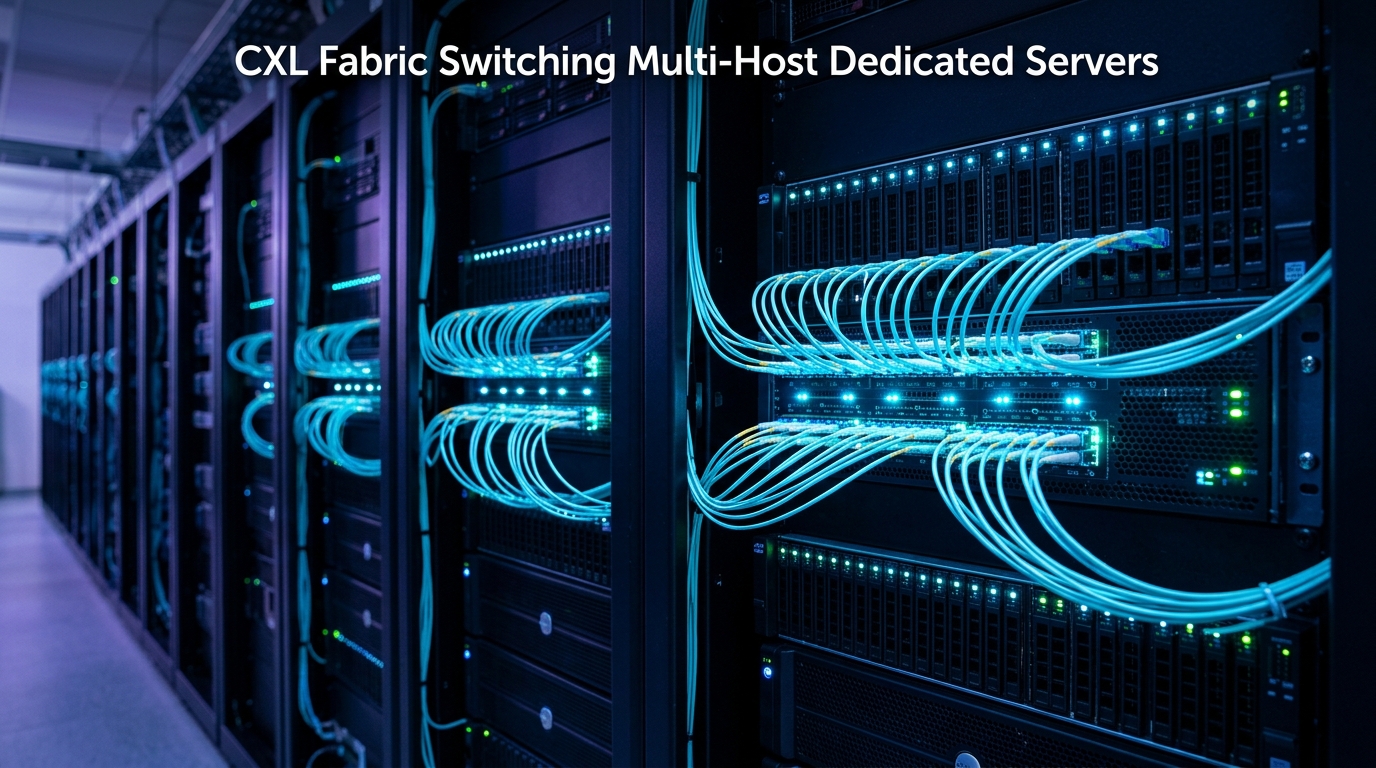
Modern in-memory computing workloads—spanning Redis distributed clusters, Apache Cassandra, ClickHouse analytical engines, and large-scale AI vector databases—face a fundamental hardware bottleneck: the DRAM Memory Wall.
Traditional enterprise servers max out physical memory channels based on CPU socket limits (typically 8 to 12 DDR5 channels per socket). As memory capacity requirements climb into multi-terabyte ranges, purchasing top-tier high-density 128GB or 256GB registered DIMMs (RDIMMs) incurs astronomical costs. Furthermore, memory stranding is widespread: one server may run at 95% memory utilization while three adjacent servers sit at 20% utilization, with zero capability to share spare DRAM across the rack.
Compute Express Link (CXL) 2.0 and 3.0 fundamentally transforms server architecture. Built on top of the physical PCIe Gen5 interface, CXL introduces cache-coherent, low-latency interconnects that decouple memory from the CPU socket. Through CXL Fabric Switches, pools of disaggregated DDR5 memory can be dynamically carved up, assigned, and reallocated across multiple host compute nodes in real time.
This guide explores the low-level hardware architecture of CXL fabric switches, PCIe Gen5 memory expansion controllers, Linux kernel memory tiering, and how Pakistani enterprise infrastructure teams can deploy memory pooling to maximize efficiency.
1. The CXL Protocol Triad: CXL.io, CXL.cache, and CXL.mem
Compute Express Link operates via three sub-protocols multiplexed over the PCIe Gen5 physical layer (32 GT/s per lane):
┌─────────────────────────────────────────────────────────────────┐
│               PCIe Gen5 Physical Layer (32 GT/s)                │
└────────────────────────────────┬────────────────────────────────┘
                                 │
         ┌───────────────────────┼───────────────────────┐
         ▼                       ▼                       ▼
    [ CXL.io ]              [ CXL.cache ]           [ CXL.mem ]
* Device discovery      * Device accesses host   * Host CPU accesses
* Configuration         * CPU cache coherently   * Device-attached memory
* Traditional DMA       * (Accelerators / GPUs)  * (Direct byte addressable)
Protocol Responsibilities:
- CXL.io: Equivalent to standard PCIe initialization, device enumeration, power management, and interrupts.
- CXL.cache: Enables connected endpoint accelerators (like NPUs and GPUs) to snoop and access host CPU cache hierarchies coherently with sub-50ns overhead.
- CXL.mem: Enables host CPUs to treat external memory expansion devices as native, byte-addressable system RAM using standard
LOAD/STOREprocessor instructions, completely bypassing OS kernel block storage layers.
2. Architecture of CXL Fabric Switches: Memory Disaggregation
In standard servers, memory is captive to a single motherboard. With CXL 2.0/3.0 Fabric Switching, memory devices (CXL Type-3 Memory Expanders) connect to a high-radix switch fabric:
[ Host Node A (EPYC / Xeon) ]      [ Host Node B (EPYC / Xeon) ]
       │ (PCIe Gen5 x16)                  │ (PCIe Gen5 x16)
       └────────────────► ┌─────────────┐ ◄────────────────┘
                          │ CXL Fabric  │
                          │   Switch    │
                          └──────┬──────┘
                                 │
     ┌───────────────────────────┼───────────────────────────┐
     ▼                           ▼                           ▼
[ CXL Expander Pool 1 ] [ CXL Expander Pool 2 ] [ CXL Expander Pool 3 ]
  (512GB DDR5 CXL.mem)    (1TB DDR5 CXL.mem)      (2TB DDR5 CXL.mem)
Key Technical Capabilities:
- Dynamic Memory Allocation (Pooling): A centralized orchestrator (using the DMTF Redfish CXL fabric model) can assign 256GB of memory from Pool 1 to Host Node A during a morning traffic surge, and dynamically reassign it to Host Node B for nightly batch processing.
- Shared Memory (Multi-Host Coherency in CXL 3.0): Multiple independent servers can access the identical physical memory address space without copying data over network TCP/IP sockets or RDMA!
- Latency Profile: While local socket-attached DDR5 latency is ~80ns, CXL-attached pooled memory operates at approximately 150ns to 200ns—substantially faster than NVMe storage (10,000ns+) and near-native DRAM speeds.
For enterprises and fintech platforms in Pakistan operating massive database fleets, deploying bare-metal nodes via our Dedicated Servers in Pakistan provides physical PCIe Gen5 slots, high-throughput fabrics, and dedicated local hardware isolation.
3. Linux Kernel Integration: CXL Subsystem & Memory Tiering
The modern Linux kernel (6.x+) includes full upstream support for CXL devices via the cxl driver stack and the memtier kernel NUMA abstractions.
Step 1: Enumerating CXL Endpoints and Decoders
Inspect attached CXL memory controllers using cxl-cli:
# Install user-space CXL management utilities
sudo apt update && sudo apt install -y cxl-tools ndctl

# List all discovered CXL memory devices
cxl list -M -u

# Inspect CXL root decoders and endpoint configurations
cxl list -D -d decoder0.0
Sample output displaying a CXL Type-3 Memory Expander:
[
  {
    "memdev": "mem0",
    "ram_size": 274877906944,
    "serial": "0x534b48796e697831",
    "numa_node": 2,
    "host": "cxl_mem.0"
  }
]
Step 2: CXL Memory as NUMA Tiering (Kernel Top-Tier vs Lower-Tier)
When CXL.mem initializes, the Linux kernel assigns it as a distinct NUMA node (e.g., Node 2). The kernel treats local socket-attached DDR5 as Tier 1 (Top Tier) and CXL-attached memory as Tier 2 (Capacity Tier).
Enable automatic kernel memory tiering via sysctl:
# Enable NUMA balancing with memory tiering promotion/demotion
echo 1 | sudo tee /proc/sys/kernel/numa_balancing

# Check memory tiering status in kernel logs
dmesg | grep -i "memory tier"
The kernel’s kswapd daemon automatically migrates cold (rarely accessed) pages down to CXL memory, reserving ultra-fast local DDR5 for hot CPU working sets!
4. Workload Optimization: Pinning In-Memory Databases to CXL Tiers
High-concurrency database workloads like ClickHouse, Redis, and MySQL can be bound directly to CXL memory allocations using numactl:
# Check NUMA topology and CXL node memory sizes
numactl --hardware

# Launch Redis instance utilizing local RAM for index + CXL RAM for large keyspace:
numactl --preferred=2 redis-server /etc/redis/redis-cxl.conf

# Interleave allocation across local CPU DDR5 and CXL pooled memory
numactl --interleave=0,2 clickhouse-server --config-file=/etc/clickhouse-server/config.xml
5. Architectural Comparison: Memory Scaling Paradigms
| Architecture | Expansion Ceiling | Latency Profile | Inter-Server Sharing | Hardware Cost per GB |
|---|---|---|---|---|
| Traditional Socket DDR5 | Sockets/Channels limited (1-2TB) | Ultra-fast (~80ns) | Impossible (Stranded) | Extremely High (256GB DIMMs) |
| RDMA over Converged Ethernet (RoCE) | Cluster scale | High (~1,500ns - 3,000ns) | Software coordinated | Moderate |
| NVMe-oF / Memory mapped SSD | Multi-Terabyte | Very High (~10,000ns) | Block storage only | Low |
| CXL 2.0/3.0 Fabric Memory | Multi-Terabyte (Disaggregated) | Near-Native (~170ns) | Hardware Direct Byte-Addressable | Optimal (Standard density DDR5) |
For development teams and mid-tier SaaS providers seeking high-performance memory and compute without dedicated hardware management, our pure NVMe Cloud VPS instances deliver predictable vCPU performance and private networking.
For multinational corporations deploying distributed AI inference pipelines and real-time big data clusters across European and Asian data hubs, combining domestic nodes with our high-bandwidth Dedicated Servers delivers 10Gbps unmetered uplinks and enterprise hardware customization.
Related Dedicated Hardware & Storage Architecture Guides
Deepen your enterprise systems knowledge with our engineering technical series:
- CXL Memory Tiering with Linux Kernel Memtier on Dedicated Hardware
- ClickHouse Analytical Database Production Tuning on Linux VPS
- NVMe TCG Opal Hardware SED Encryption on Dedicated Servers
Deploy Enterprise Dedicated Servers in Pakistan
Harness the speed of PCIe Gen5, unthrottled hardware resources, and multi-terabyte memory capabilities. Deploy custom bare-metal clusters with 24/7 senior infrastructure engineering support and local PKIX peering.
