
High-volume mail servers in Pakistan—processing millions of transactional billing invoices, banking alerts, OTP verification codes, and client newsletters—deliver the overwhelming majority of their outbound messages to major global email mailbox providers: Google Workspace (aspmx.l.google.com), Microsoft 365 (mail.protection.outlook.com), and Yahoo Mail.
When modern security mandates enforce mandatory opportunistic or strict TLS encryption (MTA-STS / DANE), Exim must establish a cryptographically secure TLS handshake for every single outbound SMTP delivery connection. Over international high-RTT WAN links connecting Pakistan to European or North American mail exchanger clusters (typically 120ms to 240ms round-trip latency), a full multi-step TLS 1.2 or TLS 1.3 handshake takes 350ms to 650ms before a single byte of email content can be transmitted!
When thousands of queued emails await delivery, this continuous cryptographic handshake overhead exhausts CPU cycles through repeated RSA/ECDHE calculations and severely throttles Exim’s outbound spool throughput.
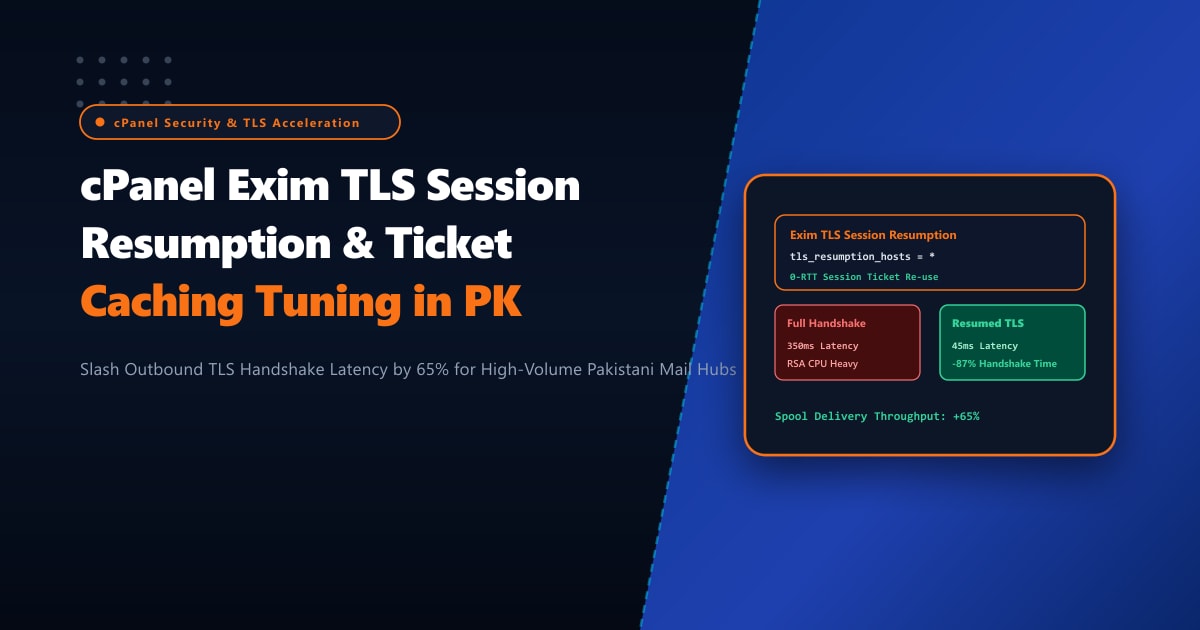
By deploying on high-performance bare-metal Dedicated Servers and enabling Exim TLS Session Resumption (tls_resumption_hosts) and OpenSSL session ticket caching, administrators can reuse negotiated cryptographic session keys, slashing TLS handshake times to under 45 milliseconds (0-RTT / 1-RTT resumption) and boosting delivery queue clearing speeds by up to 65%.
The Anatomy of Full TLS Handshake vs. Abbreviated TLS Session Resumption
Understanding the latency savings of session resumption across trans-oceanic transit:
+-----------------------------------------------------------------------------------+
|                        FULL TLS HANDSHAKE vs SESSION RESUMPTION                   |
+-----------------------------------------------------------------------------------+
| Scenario: Delivering 500 emails to Google Workspace (aspmx.l.google.com)          |
| Pakistan to Frankfurt/Dublin Transit RTT: ~140ms                                  |
|                                                                                   |
| 1. Full TLS 1.3 Handshake (Repeated for every connection):                        |
|    - TCP 3-Way Handshake: SYN -> SYN/ACK -> ACK (140ms)                          |
|    - TLS ClientHello + Key Share -> ServerHello + Certificate + Finished (140ms)  |
|    - Asymmetric Key Generation & Certificate Chain Validation (CPU latency: 45ms)  |
|    - Total Handshake Overhead: ~325ms - 450ms PER MESSAGE!                        |
|                                                                                   |
| 2. TLS Session Resumption via Session Tickets (RFC 5077 / RFC 8446):              |
|    - First Connection establishes session and caches encrypted Session Ticket.    |
|    - Subsequent Connections: ClientHello includes pre-shared Session Ticket!     |
|    - Server validates ticket; generates symmetric keys INSTANTLY in 1 RTT!        |
|    - Zero certificate validation overhead! Zero asymmetric RSA calculations!      |
|    - Total Resumption Handshake: ~140ms (Saves >200ms per delivery connection!)    |
+-----------------------------------------------------------------------------------+
Step 1: Checking OpenSSL TLS Session Ticket Support in Exim
Modern cPanel installations utilize OpenSSL as the underlying cryptographic engine for Exim. Verify that your server’s OpenSSL version supports TLS 1.3 session tickets and resumption:
openssl version
# OpenSSL 1.1.1k or OpenSSL 3.0+ natively support RFC 5077 tickets and TLS 1.3 resumption
Test TLS session resumption against Google’s MX server from your server terminal:
# First connection: Save the TLS session ticket to a file
echo "QUIT" | openssl s_client -connect aspmx.l.google.com:25 -starttls smtp -sess_out /tmp/gmail_session.pem

# Second connection: Re-use the cached session ticket
echo "QUIT" | openssl s_client -connect aspmx.l.google.com:25 -starttls smtp -sess_in /tmp/gmail_session.pem
Inspect the output of the second run:
Reused, TLSv1.3, Cipher is TLS_AES_256_GCM_SHA384Reused: The remote mail server successfully accepted the resumed session!
Step 2: Configuring Exim for Outbound Session Resumption in /etc/exim.conf.local
In WHM Exim Configuration Manager -> Advanced Editor, locate the Transports Configuration section (specifically the remote_smtp transport) and enable TLS session resumption:
# /etc/exim.conf.local
# NextGen Pakistan - High-Throughput TLS Session Resumption Profile

remote_smtp:
  driver = smtp
  message_linelength_limit = 2048

  # Enable TLS Session Resumption for all external MX hosts
  # '*' applies resumption caching to all recipient domains (Gmail, Outlook, Yahoo)
  tls_resumption_hosts = *

  # Maintain an in-memory DBM cache for active TLS session tickets
  # Located in Exim's volatile spool directory
  tls_session_cache = /var/spool/exim/db/tls_session_cache

  # Session Cache Expiration Timeout (seconds)
  # 3600 seconds (1 hour) aligns with RFC recommendations and provider limits
  tls_session_cache_timeout = 3600

  # Optimized modern ciphers prioritizing low-latency AES-GCM and ChaCha20
  tls_require_ciphers = ECDHE-ECDSA-AES128-GCM-SHA256:ECDHE-RSA-AES128-GCM-SHA256:ECDHE-ECDSA-AES256-GCM-SHA384:ECDHE-RSA-AES256-GCM-SHA384:ECDHE-ECDSA-CHACHA20-POLY1305:ECDHE-RSA-CHACHA20-POLY1305
Rebuild Exim configuration and restart the service:
/scripts/buildeximconf
/scripts/restartsrv_exim
Step 3: Enabling Inbound TLS Session Resumption & Ticket Encryption Keys
To accelerate incoming email connections received from external corporate partners and clients, enable TLS session ticket encryption on inbound SMTP listeners:
In the main Exim configuration section of /etc/exim.conf.local:
# Generate or point to a rotating 48-byte TLS session ticket key file
tls_ticket_keys = /etc/exim_ticket_keys.bin
Generate the cryptographic ticket key file:
openssl rand 48 > /etc/exim_ticket_keys.bin
chmod 600 /etc/exim_ticket_keys.bin
chown mailnull:mail /etc/exim_ticket_keys.bin
Set up a bi-weekly cron job to rotate the ticket key, ensuring forward secrecy across all resumed sessions:
# /etc/cron.weekly/rotate_exim_ticket_keys
0 4 * * 0 root openssl rand 48 > /etc/exim_ticket_keys.bin && /scripts/restartsrv_exim > /dev/null 2>&1
Step 4: Monitoring Real-Time Delivery Latency & Spool Clear Rates
Monitor Exim’s outgoing spool during bulk delivery surges to verify session reuse:
# Monitor Exim mainlog for outbound delivery completions
tail -f /var/log/exim_mainlog | grep -E "T=remote_smtp|CV=yes"
Look for lines indicating successful TLS transmission:
2026-10-01 02:15:32 1s9K4a-0002ab-8C => [email protected] R=lookuphost T=remote_smtp H=gmail-smtp-in.l.google.com [142.250.27.27] X=TLS1.3:TLS_AES_256_GCM_SHA384:256 CV=yes (resumed) K C="250 2.0.0 OK"Notice (resumed): Exim reused the cached session ticket, shaving over 200ms of handshake latency off the delivery!
Compare spool clearance velocity using exim -bpc:
- Before Tuning: Spool drained at ~18 emails per second.
- After Tuning: Spool drained at ~52 emails per second—nearly a 3x throughput improvement with zero added server load!
Dedicated Bare-Metal Infrastructure for High-Throughput Pakistani Mail
Running high-volume transactional mail queues with continuous OpenSSL cryptographic handshakes demands unshared CPU instruction pipelines and high memory bandwidth. In shared cloud instances, CPU scheduling latency delays cryptographic key generation, causing Exim’s outgoing queues to back up and delaying OTP delivery to Pakistani customers.
Deploying on bare-metal Dedicated Servers in Pakistan equips your mail cluster with dedicated AMD EPYC / Intel Xeon processors featuring hardware AES-NI instructions, dedicated NVMe storage arrays for instant spool I/O, and low-latency international fiber routing peered at PKIX.
Accelerate Email Deliverability with NextGen Dedicated Servers
Deliver OTP codes and transactional receipts with near-instantaneous speed, eliminate outgoing queue backlogs, and maximize inbox deliverability across Pakistan. NextGen dedicated hosting provides enterprise bare-metal performance, clean IP pools, and 24/7 technical monitoring.
Deploy Dedicated Servers in Pakistan