
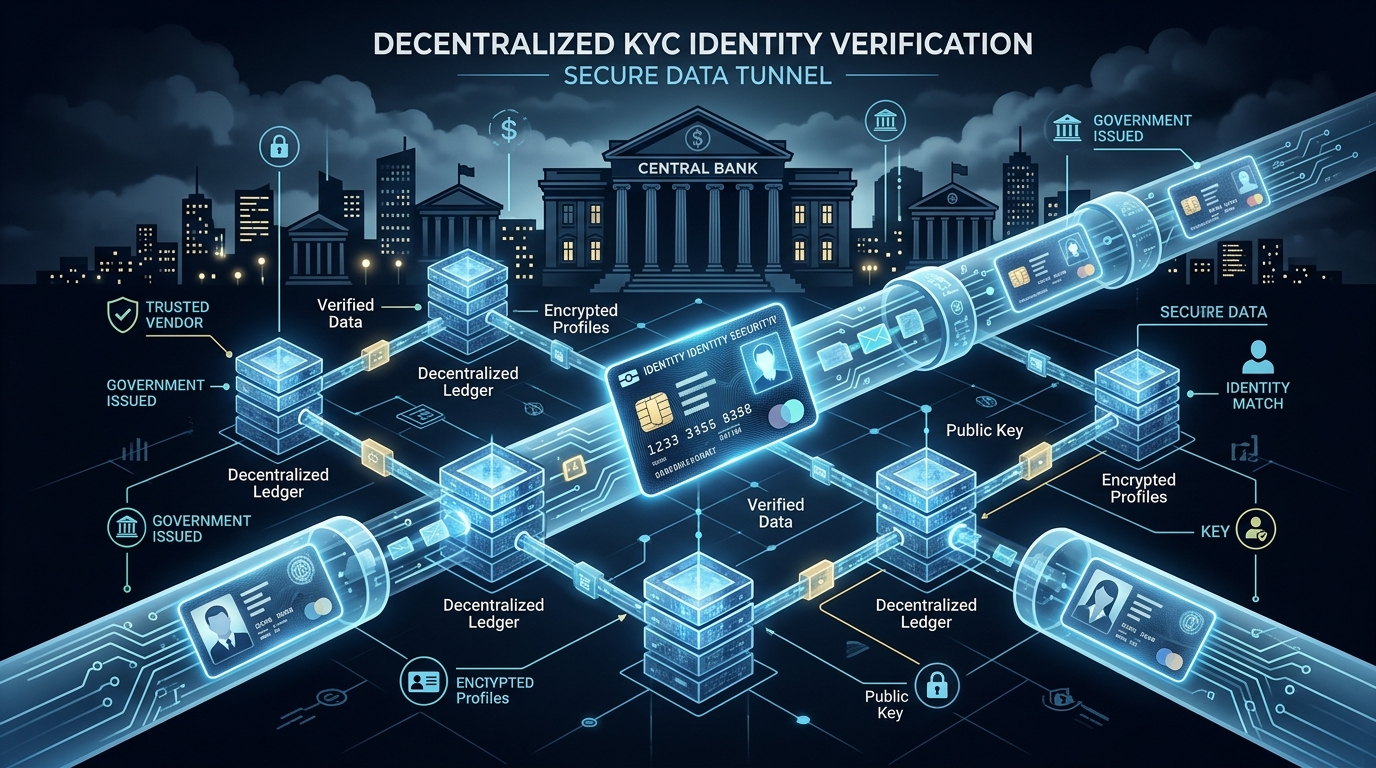
Digital onboarding has fundamentally reshaped banking and financial technology across Pakistan. With the rollout of the State Bank of Pakistan’s (SBP) Digital Banking Framework and the widespread adoption of the Raast instant payment grid, Pakistani consumers expect bank accounts, digital wallets, and mutual fund portfolios to be opened within minutes directly from a mobile device.
However, traditional Electronic Know Your Customer (eKYC) systems face significant operational hurdles:
- Repetitive Identity Friction: A customer opening accounts across three separate financial institutions must repeatedly submit CNIC scans, facial liveness checks, and proof of income.
- Data Silo Vulnerabilities: Storing sensitive unencrypted identity documents in centralized cloud databases creates catastrophic breach risks under Pakistan’s Personal Data Protection Bill (PDPB).
- Prohibitive Verification Costs: Querying centralized identity verification repositories (such as NADRA Verisys and Bio-Verisys) repeatedly for every minor service consumes substantial operational capital.
The technological solution adopted by pioneering Pakistani consortiums is Decentralized, Blockchain-Enabled eKYC.
By combining permissioned distributed ledgers (Hyperledger Fabric), zero-knowledge cryptographic proofs (ZKP), and Hardware Security Modules (HSM), banks and fintechs can securely share immutable verification hashes without exposing raw customer personal data.
This guide provides an end-to-end systems architecture manual for deploying and maintaining compliant blockchain eKYC infrastructure in Pakistan.
1. Decentralized eKYC Architecture Topology
In a blockchain-based eKYC network, customer data never lives on the shared ledger. Instead, only cryptographic hashes, digital signatures, and revocable verifiable credentials (VCs) are recorded:
[ Customer Mobile App (Biometrics + CNIC) ]
                    │
                    ▼ (TLS 1.3 End-to-End Encrypted)
    [ Bank A Digital Onboarding API Gateway ]
                    │
                    ├─► [ NADRA Verisys / Bio-Verisys Gateway ] (Performs One-Time Verification)
                    │
                    ├─► [ Local Enterprise DB / Private Vault ] (Stores Encrypted PII locally)
                    │
                    ▼
    [ Hardware Security Module (HSM) / KMS ]
    * Generates Cryptographic Hash & Digital Signature:
      Hash = SHA256(CNIC + BiometricToken + Timestamp)
                    │
                    ▼
    [ Permissioned Blockchain Network (Hyperledger Fabric) ]
    ┌───────────────────────────┬───────────────────────────┐
    │ Bank A Validating Node    │ Bank B Validating Node    │
    │ (Stores Immutable Hash)   │ (Reads Verification State)│
    └───────────────────────────┴───────────────────────────┘
When the customer subsequently applies for an account at Bank B, Bank B queries the permissioned blockchain ledger. Seeing Bank A’s cryptographically signed verification hash, Bank B requests cryptographic verification with customer consent via Zero-Knowledge Proofs—onboarding the customer in under 5 seconds with zero redundant NADRA API fees!
2. Regulatory Compliance: SBP & SECP Directives
Deploying financial infrastructure in Pakistan requires strict adherence to statutory regulatory frameworks:
1. Data Localization Mandates
The State Bank of Pakistan explicitly mandates that critical financial data, customer transaction histories, and identity records of Pakistani citizens must reside within datacenters physically located inside the sovereign territory of Pakistan. Public overseas clouds (AWS US-East, Google Cloud Europe) cannot be used for primary storage of non-anonymized citizen PII.
2. Hardware Security Modules (HSM) for Key Management
Cryptographic private keys used by blockchain validating nodes to endorse smart contract transactions must be stored in FIPS 140-2 Level 3 validated Hardware Security Modules (HSMs) or isolated bare-metal enclaves.
For financial institutions, microfinance banks, and licensed payment providers in Karachi, Lahore, and Islamabad, deploying on Dedicated Servers in Pakistan guarantees physical hardware isolation, biometric datacenter access controls, and local Tier-3 hosting compliance.
3. Provisioning a Hyperledger Fabric Node on Linux
Deploying a permissioned eKYC endorsing peer node on enterprise Linux:
# 1. Update system packages & install Docker / Docker Compose
sudo apt update && sudo apt upgrade -y
sudo apt install -y git curl docker.io docker-compose-plugin

# 2. Download Hyperledger Fabric binaries and docker images
curl -sSLO https://raw.githubusercontent.com/hyperledger/fabric/main/scripts/install-fabric.sh
chmod +x install-fabric.sh
./install-fabric.sh --fabric-version 2.5.8 binary docker
Configuring Peer Environment & Private Data Collections
To ensure strict privacy under SBP regulations, utilize Fabric’s Private Data Collections (PDC). Identity metadata is shared strictly between authorized peers through gossip protocols rather than recorded on the shared ledger blocks:
# collections_config.json
[
  {
    "name": "kycPrivateDetails",
    "policy": "OR('BankAMSP.member', 'BankBMSP.member')",
    "requiredPeerCount": 1,
    "maxPeerCount": 3,
    "blockToLive": 1000000,
    "memberOnlyRead": true,
    "memberOnlyWrite": true
  }
]
Deploy the eKYC smart contract (Chaincode):
peer lifecycle chaincode package kyc_cc.tar.gz --path ./chaincode/kyc/ --lang golang --label kyc_1.0
peer lifecycle chaincode install kyc_cc.tar.gz
4. Hardening Network Security & TLS Mutual Authentication (mTLS)
All communication between onboarding mobile apps, core banking switches, and blockchain ordering nodes must enforce Mutual TLS (mTLS):
# /etc/nginx/sites-available/ekyc-gateway.conf
server {
    listen 443 ssl http2;
    server_name ekyc.bankdomain.pk;

    ssl_certificate /etc/ssl/certs/bank-fullchain.pem;
    ssl_certificate_key /etc/ssl/private/bank-privkey.pem;

    # Enforce Client Certificate Verification (mTLS)
    ssl_client_certificate /etc/ssl/certs/consortium-ca.crt;
    ssl_verify_client on;
    ssl_verify_depth 2;

    ssl_protocols TLSv1.3;
    ssl_prefer_server_ciphers off;

    location /api/v1/verify {
        proxy_pass http://127.0.0.1:7051;
        proxy_set_header X-Client-DN $ssl_client_s_dn;
    }
}
With mTLS enabled, only authorized banking applications possessing consortium-signed x509 certificates can execute eKYC queries.
5. Architectural Comparison: eKYC Implementation Models
| Metric | Centralized Legacy eKYC | Public Blockchain (Ethereum/Solana) | Permissioned Consortium (Hyperledger) |
|---|---|---|---|
| SBP Data Sovereignty | High Risk if overseas | Non-Compliant (Public ledger) | 100% Compliant (Domestic nodes) |
| Per-Transaction Cost | Recurring NADRA Fees | Gas Fees (Volatile Cryptos) | Predictable Zero-Fee Endorsements |
| Transaction Throughput | 100 – 250 TPS | 15 – 3,000 TPS (Public congestion) | 5,000+ TPS (Dedicated Hardware) |
| Privacy / PII Security | Centralized Honeypot | Completely Public (Zero privacy) | Private Data Collections + ZKP |
For fintech startups building MVPs that require compliant sandbox hosting, our pure NVMe Cloud VPS instances deliver isolated private networks, full root access, and local sub-15ms domestic ping times.
For multinational financial institutions operating cross-border remittance switches across the GCC, Europe, and Asia, our global Dedicated Servers provide 10Gbps unmetered bandwidth and certified enterprise security infrastructure.
Related Fintech & Enterprise Security Guides
Advance your compliance and enterprise systems engineering:
- Domain Registration in Karachi: Corporate & Fintech Governance Guide
- HashiCorp Vault Secrets Management on Linux VPS
- Wazuh SIEM & XDR Security Monitoring for Compliance in Pakistan
Deploy SBP-Compliant Dedicated Infrastructure in Pakistan
Ensure 100% data residency compliance, deploy permissioned blockchain nodes, and protect citizen data with certified Tier-3 datacenter hosting. Pure NVMe storage, local PKIX peering, and 24/7 senior engineering support.
