
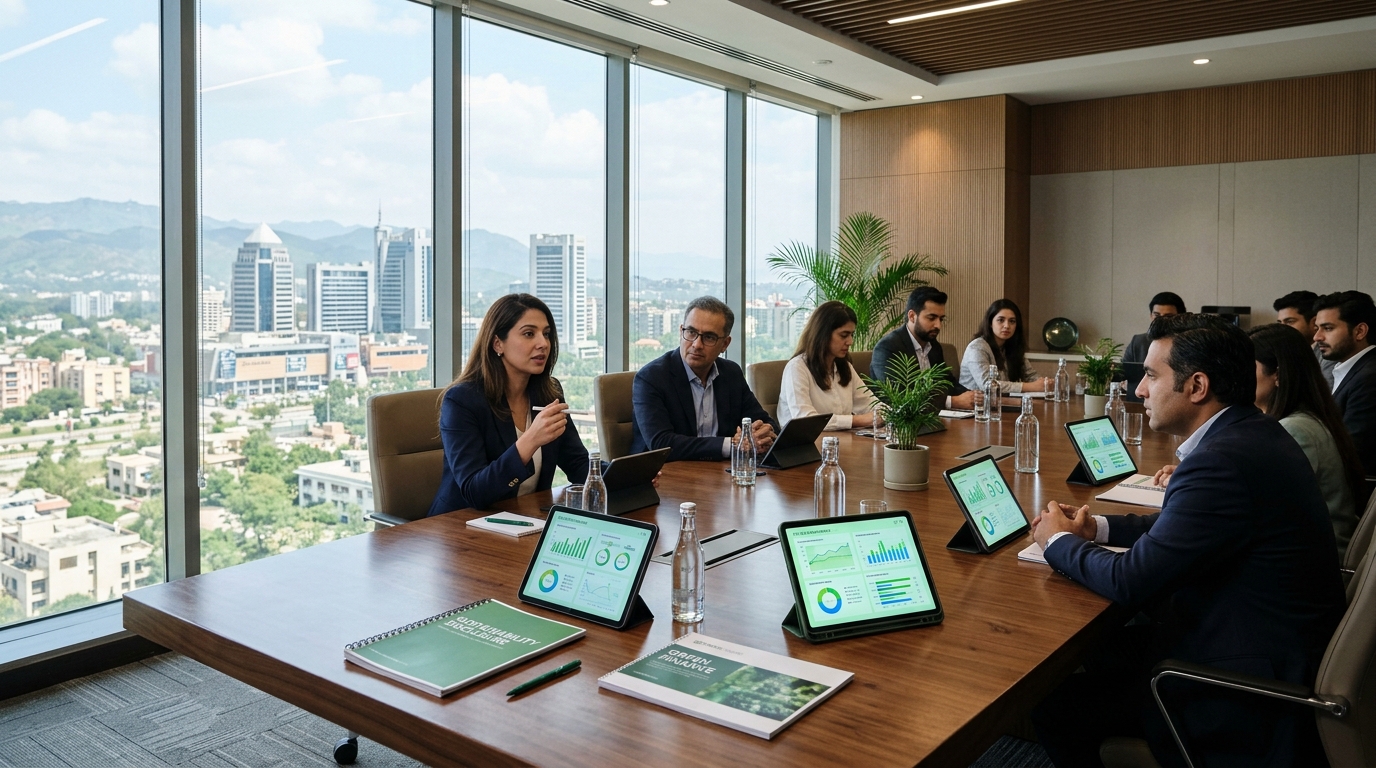
The Securities and Exchange Commission of Pakistan (SECP) has formally enforced the mandatory phased adoption of International Sustainability Standards Board (ISSB) Standards—IFRS S1 and IFRS S2—for companies listed on the Pakistan Stock Exchange (PSX) and large Public Interest Companies (PICs).[1] Concurrently, the commission has operationalized the centralized ESG Sustain Portal (esgsustain.secp.gov.pk), establishing an integrated digital infrastructure for corporate carbon auditing, sustainability metrics filing, and green capital disclosures.
The regulatory transition marks a historic departure from voluntary corporate social responsibility (CSR) narratives to legally enforceable, audited environmental and climate reporting under Section 238 of the Companies Act, 2017. By embedding IFRS S1 (General Requirements for Disclosure of Sustainability-related Financial Information) and IFRS S2 (Climate-related Disclosures) directly into corporate reporting obligations, the SECP aligns Pakistan’s capital markets with global institutional investor mandates, the Pakistan Green Taxonomy (PGT), and national commitments under the Paris Agreement.
1. Statutory Architecture: IFRS S1, IFRS S2, and Regulatory Roadmaps
The regulatory directive establishes concrete reporting boundaries calibrated against company market capitalization, turnover, and public interest classification:[2]
| Standard / Component | Regulatory Objective | Core Disclosure Mandates | Compliance Timeline |
|---|---|---|---|
| IFRS S1 | Sustainability Financial Disclosures | Governance, strategy, risk management, and metrics across all sustainability-related risks | Phase 1 (Top PSX-100 & PICs) Active; Phase 2 Effective July 1, 2026 |
| IFRS S2 | Climate-Related Disclosures | Physical and transition climate risks, climate scenario analysis, Scope 1, Scope 2, and Scope 3 emissions | Aligned with IFRS S1 phased rollout |
| Pakistan Green Taxonomy (PGT) | Sustainable Asset Classification | Decarbonization thresholds, energy efficiency, circular economy, and water conservation benchmarks | Integrated into ESG Sustain Portal metrics |
| ESG Sustain Portal | Centralized Digital Filing | Digital submission of structured quantitative sustainability data via esgsustain.secp.gov.pk |
Mandatory registration and annual filing |
| ESG Mutual Funds Framework | Green Collective Investments | Mandating minimum 50% net asset allocation in verified ESG-compliant investee companies | Active across Asset Management Companies (AMCs) |
2. Core Pillars of the Mandatory SECP ESG Regulatory Framework
The regulatory regime introduces five mandatory operating pillars across corporate boards, audit committees, and sustainability executives in Pakistan:[1]
Pillar 1: Transition from Voluntary CSR to Audited Financial Metrics
Under earlier guidelines, corporate disclosures often featured descriptive, unverified marketing reports. Under IFRS S1 and S2:
- Financial Materiality: Companies must explain how sustainability and climate risks reasonably affect their cash flows, access to finance, and cost of capital over short, medium, and long-term horizons.
- Audit & Assurance: Disclosures must be presented as part of the formal general-purpose financial report (Annual Report) and are subject to statutory verification and external assurance protocols.
Pillar 2: Greenhouse Gas (GHG) Scope 1, 2, and 3 Disclosures
Under IFRS S2, listed corporate enterprises must calculate and disclose their absolute greenhouse gas emissions:
- Scope 1 (Direct Emissions): Emissions originating directly from industrial boilers, chemical processing, corporate vehicle fleets, and on-site diesel power generation.
- Scope 2 (Indirect Energy Emissions): Emissions stemming from purchased electricity, steam, heating, and cooling consumed from national grids (such as K-Electric, LESCO, and FESCO).
- Scope 3 (Value Chain Emissions): Upstream and downstream value chain emissions, including raw material transportation, outsourced cloud hosting, and product lifecycle disposal. Phased transitional relief is provided for initial reporting cycles to allow supply chains to mature.
Pillar 3: Mandatory Onboarding onto the ESG Sustain Portal
To standardize sustainability reporting and prevent greenwashing, the SECP launched the ESG Sustain Portal (esgsustain.secp.gov.pk):[3]
- Every PSX-listed entity must register a designated corporate administrator on the portal.
- Disclosures are submitted through structured digital XBRL/XML-aligned forms, ensuring foreign institutional asset managers (such as foreign emerging market funds) can query, benchmark, and compare Pakistani corporate performance automatically.
Pillar 4: Board of Directors Governance Accountability
Amendments to the Listed Companies (Code of Corporate Governance) Regulations explicitly integrate sustainability into boardroom duties:[4]
- Boards must formally assign oversight of climate and sustainability-related risks to a dedicated board committee (such as a Risk & Sustainability Committee).
- Executive compensation and key performance indicators (KPIs) for chief executive officers (CEOs) and senior management must incorporate measurable sustainability targets.
3. Macroeconomic Implications for Foreign Investment and Trade
The nationwide enforcement of ISSB standards is strategically positioned to insulate Pakistan’s export-driven economy from emerging international trade barriers:
- Compliance with the European Union CBAM: The EU’s Carbon Border Adjustment Mechanism (CBAM) imposes carbon tariffs on imports from non-compliant nations. Audited IFRS S1 and S2 disclosures enable Pakistani textile, chemical, and cement exporters to provide verified emissions telemetry, safeguarding billions of dollars in export revenues.
- Accessing Global Green Finance and Green Bonds: International development finance institutions (such as IFC, ADB, and global climate funds) require standardized ISSB disclosures before issuing green credit lines, sustainability-linked loans, or underwriting corporate green bonds on the PSX.
- Enhancing Foreign Portfolio Inflows: Top global institutional investors (holding tens of trillions in ESG-mandated assets) are statutorily barred from investing in markets lacking standardized ESG transparency. The SECP’s framework positions PSX equities for substantial foreign institutional capital inflows.
4. Compliance Timelines and Implementation Roadmap
The SECP has outlined strict adherence schedules for capital market participants:
- Phase 1 (Active): Mandated for large-cap PSX-100 constituents, Public Interest Companies, and commercial banks with annual financial years ending in 2025/2026.
- Phase 2 (Commencing July 1, 2026): Mandatory expansion across all remaining listed commercial companies, Non-Banking Financial Institutions (NBFIs), and licensed investment advisors.
- Enforcement Measures: Failure to file mandatory sustainability disclosures via the ESG Sustain Portal exposes the reporting entity to statutory penalties under Section 238 and Section 510 of the Companies Act, 2017, alongside potential regulatory trading freezes on the PSX.
5. Technology Infrastructure for ESG Compliance and Real-Time Data Auditing
Processing granular energy metrics, IoT sensor feeds from factory floors, supply chain emissions logs, and hosting secure enterprise ESG reporting platforms requires resilient digital hosting infrastructure.
- Dedicated High-Performance Infrastructure: Deploying enterprise carbon auditing software, automated ESG analytics engines, and ERP integration microservices on Dedicated Servers ensures complete data privacy, unshared processing power, and isolated hardware security.
- Domestic Low-Latency Data Hosting in Pakistan: To maintain data sovereignty over national corporate assets while ensuring rapid reporting and dashboard responsiveness, hosting on Dedicated Servers in Pakistan delivers Tier-3 certified Karachi and Lahore facilities with unmetered domestic bandwidth and sub-10ms response times across the country.
Deploy Secure, Audited Enterprise Infrastructure with Nextgen
Power your corporate ERPs, carbon accounting databases, and financial applications with dedicated bare-metal infrastructure in Pakistan. Ensure complete regulatory data compliance, unshared AMD EPYC and Intel Xeon compute, enterprise NVMe storage, and unmetered domestic bandwidth across Tier-3 Karachi and Lahore data centers.
Sources & Official References
- Securities and Exchange Commission of Pakistan (SECP). (2025). ESG Disclosure Guidelines for Listed Companies and Roadmap for the Adoption of ISSB Standards (IFRS S1 and IFRS S2). SECP Islamabad. https://www.secp.gov.pk
- International Sustainability Standards Board (ISSB). (2024). IFRS S1 General Requirements for Disclosure of Sustainability-related Financial Information & IFRS S2 Climate-related Disclosures. IFRS Foundation. https://www.ifrs.org/issued-standards/issue-standards/sustainability-standards/
- Securities and Exchange Commission of Pakistan (SECP). (2026). SECP ESG Sustain Portal: User Manual and Digital Compliance Filing Requirements. SECP Islamabad. https://esgsustain.secp.gov.pk
- Government of Pakistan. (2017). The Companies Act, 2017: Section 238 (Adoption of Financial and Sustainability Reporting Standards). National Assembly of Pakistan. https://www.secp.gov.pk/laws/acts/
Disclaimer: This post is for informational and educational purposes only, accurate to the best of our knowledge at publication. It does not constitute advice. We do not guarantee accuracy or completeness and accept no liability for any decisions or losses resulting from reliance on this content.
