
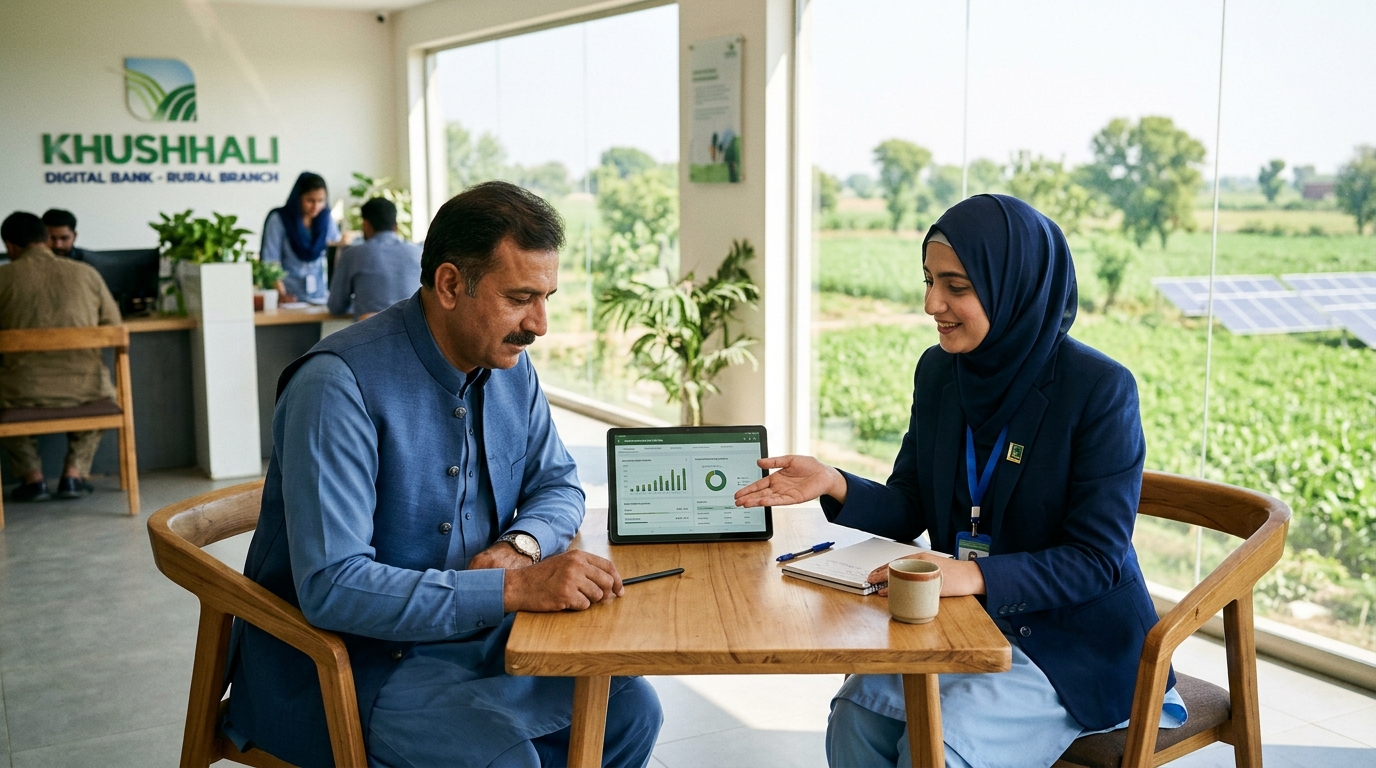
In a concerted move to resolve structural credit delivery bottlenecks in Pakistan’s rural and informal economies, the State Bank of Pakistan (SBP) has officially issued SH&SFD Circular No. 07 of 2026.[1] Notified by the SME, Housing and Sustainable Finance Department, the regulatory directive introduces the Financing Framework for Small Enterprises (SEs) and Small Farmers (SFs) under Wholesale and Agency Arrangements.[1][2]
The framework establishes an enforceable operational structure enabling scheduled commercial banks—categorized as Participating Financial Institutions (PFIs)—to leverage the localized underwriting capabilities and grassroots distribution networks of Microfinance Banks (MFBs), Non-Banking Microfinance Companies (NBMFCs), and Non-Bank Finance Companies (NBFCs) acting as Agent Financial Institutions (AFIs).[1][2]
Dual Intermediary Modalities: Wholesale vs. Agency Arrangements
Under historical lending practices, commercial banks struggled with high operational costs and lack of branch infrastructure when evaluating micro-borrowers, small agricultural holdings, and peri-urban merchants.[2] Conversely, microfinance banks and specialized fintech lenders possessed hyper-local borrower relationships but operated under severe liquidity constraints due to expensive deposit bases.[2]
Circular No. 07 of 2026 bridges this divide by formalizing two statutory operating models:[1]
- Agency Arrangements: The commercial bank (PFI) provides institutional liquidity and books the originated loans directly onto its balance sheet.[1] The intermediary agent (AFI) conducts borrower identification, digital credit scoring, physical site verification, documentation, and ongoing recovery management.[1]
- Wholesale Arrangements: The commercial bank extends institutional credit lines to the intermediary institution, which subsequently disburses financing to end-borrowers on its own balance sheet.[1][2]
| Operating Dimension | Agency Arrangement Structure | Wholesale Arrangement Structure | Regulatory Authority |
|---|---|---|---|
| Balance Sheet Booking | Maintained directly on commercial bank (PFI) books[1] | Maintained on partner intermediary (AFI) books[1] | SBP SH&SFD Regs |
| Credit Risk Exposure | Shared or underwritten via Federal Risk Coverage Schemes[1] | Primary risk absorbed by intermediary entity[1] | SBP Prudential Regs |
| Operational Workflow | AFI manages sourcing, appraisal, and field recovery[1] | AFI independently manages end-to-end portfolio[2] | SBP SH&SFD Regs |
| Technology Mandate | Real-time Core Banking API integration mandatory[1] | Batch telemetry and regulatory reporting APIs[3] | SBP Digital Framework |
Statutory Financing Limits and Borrower Ceilings
To ensure equitable capital distribution and avoid speculative concentration, the central bank has established tiered borrowing ceilings categorized by the regulatory class of the originating intermediary:[1][2]
- Loans Originated via Non-Banking Microfinance Companies (NBMFCs):
- Loans Originated via NBFCs and Microfinance Banks (MFBs):
All credit facilities disbursed under this framework are formally eligible for credit enhancements provided under the Federal Government’s Risk Coverage Schemes for SMEs and Small Farmers (notified through SH&SFD Circular No. 02 of 2024 and ACFID Circular No. 02 of 2025).[1]
Prudential Eligibility Criteria for Intermediary Institutions
To safeguard banking stability and enforce institutional discipline, the SBP has coupled these arrangements with non-negotiable operational benchmarks for prospective AFIs.[1]
Prior to entering into agency or wholesale partnerships, an intermediary must demonstrate:[1][3]
- Operational Self-Sufficiency (OSS): Minimum threshold of 100% or higher.[1]
- Portfolio Quality: Non-Performing Loans (NPLs) across enterprise and agricultural segments capped at 5% or less.[1]
- Audited Financial Track Record: Unqualified, clean audited financial statements for the preceding two fiscal cycles.[1]
- Underwriting Experience: At least 3 years of demonstrable operational experience in small enterprise or agricultural credit underwriting.[1][2]
- Solvency Compliance: Full adherence to statutory Capital Adequacy Ratios (CAR) and minimum capital benchmarks notified by SBP or SECP.[1]
Mandatory API Integration and Digital Audit Trails
A defining pillar of Circular No. 07 of 2026 is the mandatory implementation of Application Programming Interface (API) straight-through processing.[1][3]
Under the framework’s technology stipulations:
- Sponsoring commercial banks must establish encrypted RESTful API gateways connecting directly into intermediary loan origination engines.[1]
- All customer onboarding, NADRA biometric verifications, CIB credit scoring lookups, and fund disbursements must be recorded in immutable, timestamped digital transaction ledgers.[1][3]
- Loan repayments collected by field agents must trigger real-time ledger synchronization with the commercial bank’s Core Banking System (CBS) via Raast or 1Link settlement rails.[3]
Enterprise Sovereign Infrastructure for Digital Banking Integrations
With scheduled banks, microfinance networks, and fintech intermediaries managing mission-critical API switches and sensitive farmer/merchant biometric identity records, regulatory compliance mandates that all host servers operate on Tier-III certified enterprise infrastructure physically deployed within Pakistan’s geographical boundaries.[1][3]
For financial technology developers, Core Banking middleware integrators, and microfinance operators building real-time credit engines, deploying on high-performance dedicated server hosting and localized dedicated Pakistan servers ensures uncompromised data residency compliance, hardware isolation, and sub-millisecond interconnects with national clearing switches.
Deploy Bank-Grade Sovereign Infrastructure
Power your financial APIs, core loan engines, and regulatory reporting platforms on enterprise bare-metal hardware located in Islamabad and Karachi data centers with unmetered local peering.
Sources & Official References
-
State Bank of Pakistan (SBP) — SH&SFD Circular No. 07 of 2026: Financing Framework for Small Enterprises and Small Farmers under Wholesale and Agency Arrangements
Official central bank directive issued on October 28, 2026, establishing legal and prudential requirements for commercial bank credit disbursement via microfinance and NBFC intermediaries.
-
Profit by Pakistan Today — SBP Issues Financing Framework for Small Enterprises and Small Farmers
Comprehensive financial journalism report detailing borrower loan ceilings, risk-sharing structures, and the operational roles of Participating and Agent Financial Institutions.
-
State Bank of Pakistan (SBP) — Digital Banking Regulatory Regime & Supervisory Governance Framework
Core supervisory directives governing API-based straight-through processing, fintech intermediary security benchmarks, and sovereign data localization mandates.
