
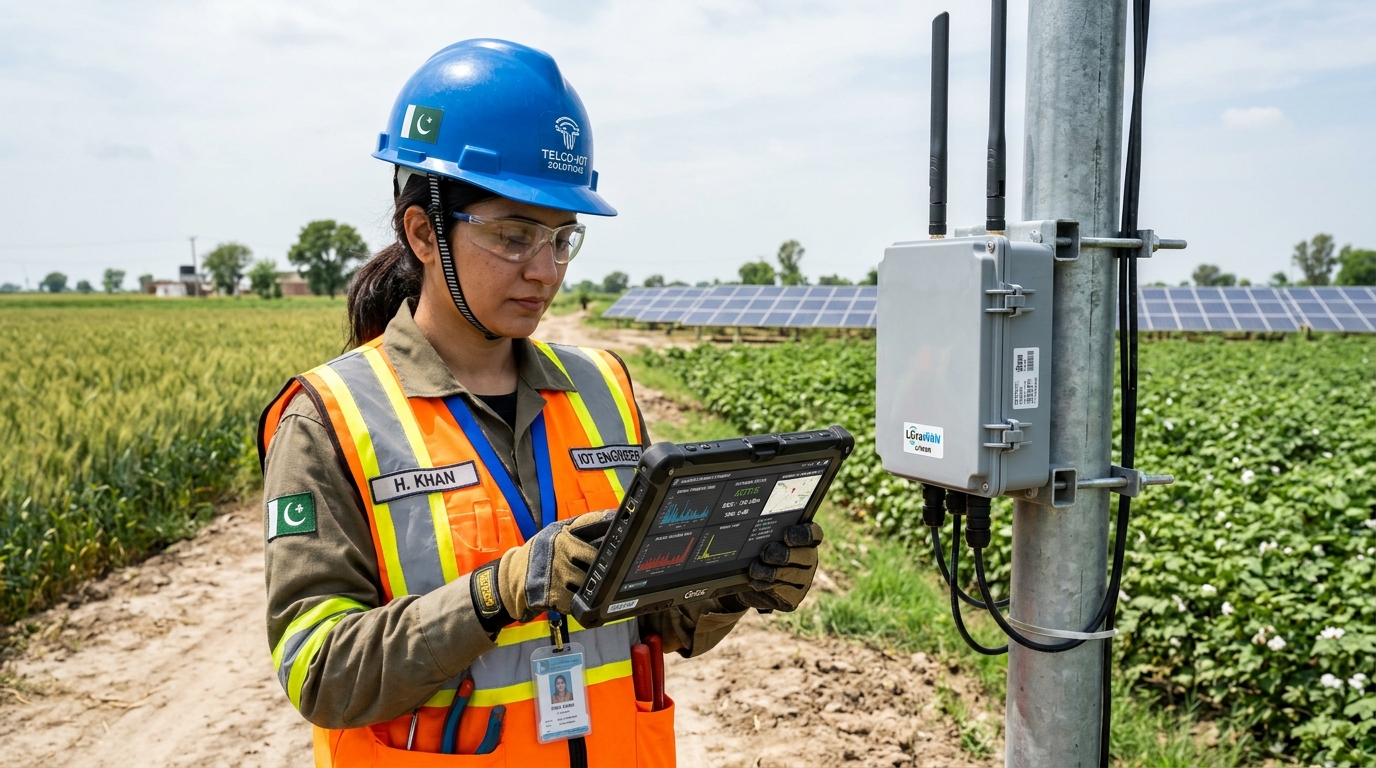
The Pakistan Telecommunication Authority (PTA) has released the Draft Internet of Things and Low Power Wide Area Networks (IoT-LPWAN) Licensing Regulations 2026, introducing an overarching regulatory architecture to govern commercial and private IoT deployments across Pakistan.[1][2] The landmark framework restructures Pakistan’s connected device landscape, replacing fragmented district-level rules with a unified nationwide authorization regime, lowering licensing barriers for technology startups, and enforcing stringent gateway registration requirements.[1][3]
With Pakistan undergoing widespread digitalization across industrial manufacturing, utility metering (smart electricity, gas, and water grids), logistics fleet telematics, and precision agriculture, the demand for unlicensed and licensed spectrum IoT deployments has surged exponentially.[1][4] The central telecommunications regulator designed the 2026 regulations to accelerate capital investment in Low Power Wide Area Networks—including LoRaWAN, Sigfox, and proprietary sensor protocols—while establishing strict regulatory visibility over wireless hardware and data routing paths.[1][2]
Tiered Authorization and Licensing Matrix
To accommodate diverse commercial models—ranging from nationwide enterprise IoT network operators down to academic agricultural testbeds—the draft regulations establish four distinct operational categories:[1][2]
| Licensing / Registration Category | Operational Scope | Term Validity | Initial Fee Structure (PKR) | Annual Renewal / Gateway Fees |
|---|---|---|---|---|
| Commercial LPWAN Operator | Entities deploying LPWAN base stations to offer third-party commercial connectivity.[1] | 5 Years | Rs. 100,000 initial license fee + Rs. 5,000 non-refundable processing fee.[2] | Standard annual regulatory fee; Rs. 0 annual per-gateway charges.[1] |
| Private IoT Network | Single-premise internal networks for factories, university campuses, farms, or private corporate yards.[1] | 5 Years | Rs. 10,000 registration fee + Rs. 5,000 non-refundable processing fee.[2] | No commercial revenue levies; internal telemetry only.[1] |
| IoT Platform & Application Provider | Software and cloud platforms aggregating, processing, and analyzing IoT telemetry data.[1] | 5 Years | Rs. 10,000 registration fee + Rs. 5,000 non-refundable processing fee.[2] | Standard compliance reporting.[1] |
| Regulatory Sandbox (R&D / Trials) | Short-term technological trials, academic research, and prototype evaluation in controlled environments.[1] | 1 Year | Rs. 2,000 trial registration fee + Rs. 1,000 non-refundable processing fee.[2] | Temporary non-commercial status.[1] |
Under the framework, licensed Cellular Mobile Operators (CMOs) operating narrowband cellular IoT services (NB-IoT and LTE-M) within their existing assigned spectrum remain exempt from additional licensing fees.[1][2] Furthermore, standalone devices operating within shared Short Range Device (SRD) and Ultra-Wideband (UWB) bands remain license-exempt, provided they maintain technical compliance with PTA Type Approval regulations.[1]
Mandatory Gateway Registration and Technical Oversight
A central pillar of the draft regulations is the creation of a centralized, online National IoT Gateway Registry.[1] While the PTA eliminated recurring annual gateway fees to minimize operational friction for operators, it established mandatory telemetry registration for every physical gateway deployed in Pakistan:[1]
+--------------------------------------------------------------------------+
|                  PTA IoT Gateway Registration & Verification Flow         |
+--------------------------------------------------------------------------+
       |                                      |                     |
       v                                      v                     v
+-----------------------+          +--------------------+  +--------------+
| Gateway Hardware Data |          | Radio Parameters   |  | Geographic   |
| - Manufacturer & Model|          | - Operating Band   |  | Deployment   |
| - Serial Numbers      |          | - Output Power     |  | - Exact GPS  |
| - PTA Type Approval   |          | - Antenna Gain     |  |   Coordinates|
| - Max Concurrent Nodes|          | - Emission Mask    |  | - Cell Radius|
+-----------------------+          +--------------------+  +--------------+
       |                                      |                     |
       +--------------------------------------+---------------------+
                                  |
                                  v
+--------------------------------------------------------------------------+
| PTA Online Authorization Portal (Automated Certificate Issuance)         |
+--------------------------------------------------------------------------+
Key Technical Reporting Requirements
Before activating any wireless gateway, operators must submit comprehensive hardware specifications through the PTA portal:[1]
- Type Approval Certificate: Verification that the hardware model has been formally certified under PTA Telecommunication Equipment Standards.[1]
- RF Output Parameters: Precise transmission power levels (EIRP) and antenna specifications to prevent out-of-band interference with critical government and aeronautical spectrum.[1]
- Geospatial Coordinates: High-precision GPS latitude and longitude of the deployment mast or rooftop site, including antenna height above ground level and projected coverage radius.[1]
- Transition Timeline: Existing LPWAN operators currently maintaining active field gateways are granted a strict 90-day grace period from the formal gazette notification date to register all legacy infrastructure.[1]
Backend Backhaul Routing and Data Sovereign Mandates
To ensure national cybersecurity resilience and prevent unregulated telecommunications bypass, the PTA introduced strict backhaul routing mandates:[1][3]
- Licensed Local Access Provider (LAP) Routing: Operators connecting remote gateways to central data processing servers via fiber, point-to-point microwave, or satellite links must procure backhaul connectivity exclusively through licensed Local Access Providers (LAPs) or Long Distance International (LDI) carriers.[1][3] Utilizing unauthorized bypass networks or unvetted foreign satellite constellations constitutes grounds for immediate license revocation.[1]
- Data Residency and Privacy: IoT platform operators storing critical telemetry—especially municipal water data, smart grid electricity meters, and citizen health telematics—must adhere to Pakistan’s sovereign cloud and data localization mandates, maintaining secure storage within accredited domestic data centers.[1][4]
- Rollout Timeline: Commercial licensees are required to commercially commence network operations within one year of license issuance and obtain an official Certificate of Commencement from the Authority.[1]
Impact on Pakistan’s Smart Industry and Enterprise Cloud Infrastructure
The release of the draft regulations removes regulatory uncertainty that previously restrained large-scale private sensor rollouts.[1][2] Key industrial sectors expected to benefit immediately include:
- Precision Agriculture: Solar-powered LoRaWAN soil moisture, temperature, and nitrate sensors across Punjab and Sindh, transmitting micro-payloads across kilometers of farmland to optimize irrigation pumps.[1]
- Industrial Smart Manufacturing: Environmental monitoring, vibration analysis, and predictive equipment maintenance inside Karachi and Gujranwala industrial estates.[1]
- Smart Grid Utility Metering: Automated AMI (Advanced Metering Infrastructure) deployment by power distribution companies (DISCOs) to combat electricity theft and line losses.[1][4]
Backend Data Ingestion Demands
As hundreds of thousands of low-power sensors emit telemetry every few seconds, centralized IoT broker platforms (utilizing MQTT, CoAP, EMQX, and Kafka) face unprecedented packet ingestion volumes.[1]
To ensure continuous, real-time message ingestion, low-latency API response times, and compliance with domestic telecom security regulations, IoT platform operators cannot rely on shared virtual hosting.[1] Organizations deploy high-throughput dedicated servers and localized dedicated servers in Pakistan. Enterprise bare-metal infrastructure provides dedicated CPU cores for high-concurrency event brokers, hardware-isolated NVMe storage for time-series databases (TimescaleDB, InfluxDB, ClickHouse), and direct low-latency peering across Pakistani telecom backbones.[1]
Sources & Official References
- Pakistan Telecommunication Authority (PTA). (2026). Consultation Paper: Draft Internet of Things and Low Power Wide Area Networks (IoT-LPWAN) Licensing Regulations 2026. Government of Pakistan. Retrieved from https://www.pta.gov.pk
- ProPakistani. (2026). PTA Introduces Draft IoT and LPWAN Licensing Regulations 2026. Retrieved from https://propakistani.pk/2026/11/11/pta-introduces-draft-iot-and-lpwan-licensing-regulations-2026/
- TechJuice. (2026). PTA Drafts New Framework for Commercial and Private IoT Networks in Pakistan. Retrieved from https://techjuice.pk/pta-drafts-new-framework-for-commercial-and-private-iot-networks-in-pakistan/
- Business Recorder. (2026). PTA Notifies Telecommunication Equipment Standards and IoT Infrastructure Guidelines. Retrieved from https://www.brecorder.com
Power Next-Generation IoT and Smart City Backends with Nextgen
Deliver ultra-fast time-series ingestion, reliable MQTT brokering, and secure telecom-compliant IoT data hosting. Deploy enterprise bare-metal platforms with hardware isolation, dedicated NVMe arrays, and low-latency domestic connectivity across Pakistan.
Disclaimer: This post is for informational and educational purposes only, accurate to the best of our knowledge at publication. It does not constitute advice. We do not guarantee accuracy or completeness and accept no liability for any decisions or losses resulting from reliance on this content.