
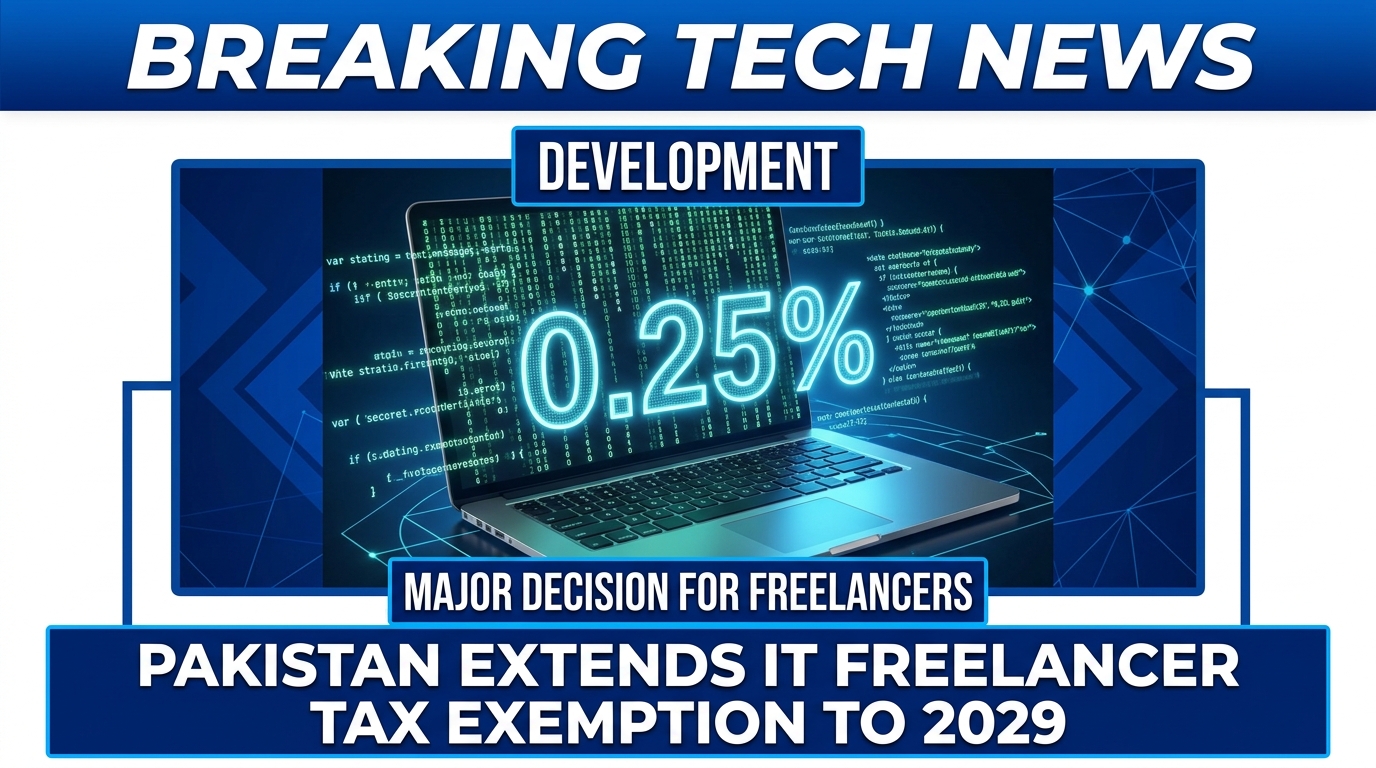
In a massive win for the nation’s digital workforce, the Government of Pakistan has officially decided to extend the Final Tax Regime (FTR) of 0.25% for registered IT exporters and freelancers.
Announced as part of the 2026–27 Federal Budget, this highly favorable tax bracket has now been locked in until June 30, 2029, providing three years of guaranteed stability for the rapidly expanding tech sector.
Encouraging the Digital Inflow
The continuation of the 0.25% FTR applies strictly to freelancers and IT companies registered with the Pakistan Software Export Board (PSEB) who route their foreign earnings through formal banking channels. Unregistered freelancers will continue to face a higher rate, generally hovering around 1%.
The government’s primary motivation behind this extension is twofold:
- To boost foreign exchange reserves by aggressively incentivizing the inflow of IT export dollars into the formal banking system.
- To curb the informal economy by making the legal tax rate far more attractive than the risks associated with gray-market payment channels like Hawala or Hundi.
The Industry Debate: Freelancers vs. Remote Workers
While the 0.25% extension was universally celebrated by independent contractors, it has sparked a fierce lobbying debate led by local software houses and industry associations like P@SHA.
The core of the argument is “Tax Arbitrage.” Local tech executives argue that there needs to be a strict legal distinction between a genuine project-to-project freelancer and a full-time remote employee working exclusively for a foreign corporation. Currently, full-time remote workers are capitalizing on the 0.25% freelancer rate to pay virtually zero income tax, while developers employed locally by Pakistani software houses are subjected to standard, much higher income tax slabs.
Local employers are urging the FBR to reclassify full-time remote salaried workers under standard tax brackets to ensure “fair competition” and prevent brain drain from domestic tech firms.
Building Local IT Businesses
For the local software houses that are bearing the brunt of the standard corporate tax slabs, maintaining an edge in service quality is essential. To compete with individual freelancers and foreign offshore teams, Pakistani agencies must offer enterprise-grade reliability and security to their B2B clients.
Scaling with Nextgen Hosting
Building world-class SaaS products requires world-class infrastructure. Instead of relying on expensive offshore cloud providers, leading Pakistani tech firms are localizing their infrastructure costs by utilizing Nextgen Hosting’s Dedicated Servers.
Whether a software house is deploying large-scale e-commerce platforms or custom ERPs, Nextgen’s enterprise KVM VPS architecture provides the guaranteed uptime and scalable computing power needed to satisfy international clients. By keeping server costs localized in Pakistani Rupees while earning in US Dollars, local agencies can maximize their profit margins despite the challenging tax disparities.
Conclusion
The extension of the 0.25% FTR ensures that Pakistan remains one of the most financially attractive countries in the world for freelance digital workers. However, as the 2026 tech economy matures, the government will inevitably have to address the complex definitions of remote work to keep the playing field level for local businesses.
Related Technical Architecture Guides
- Web Hosting in Islamabad & Rawalpindi: Enterprise Cloud, Low-Latency PkIX & Local Support Guide (2026) – Enterprise implementation details and deployment guide.
- Web Hosting in Peshawar: KPITB Tech Hubs, Software Exporters & Enterprise Cloud Infrastructure Guide (2026) – Enterprise implementation details and deployment guide.
