
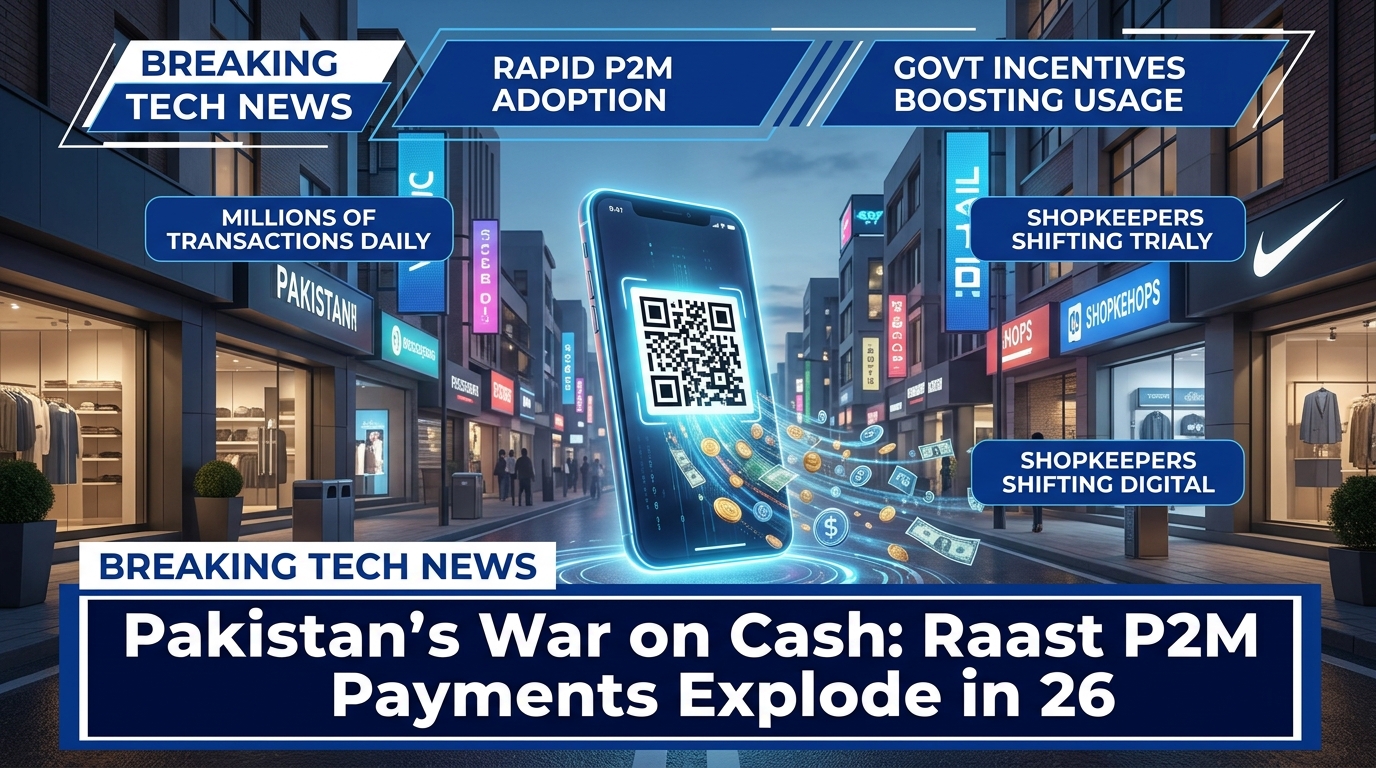
In a dramatic shift toward financial modernization, Pakistan is aggressively phasing out paper currency in favor of digital transactions. At the heart of this transformation is the State Bank of Pakistan’s (SBP) Raast instant payment system, which has seen an explosive surge in adoption throughout 2026.
As the government pushes forward with its “war on cash,” digital channels now account for a staggering 92% of total retail payment volume across the nation.
The Rise of Raast P2M
While Raast initially gained popularity for Person-to-Person (P2P) transfers, 2026 has been the undisputed year of Person-to-Merchant (P2M) payments. By mid-2026, daily Raast P2M transactions skyrocketed past the 1.1 million mark—an astronomical leap from roughly 60,000 transactions per day just a year prior.
This massive growth didn’t happen by accident. It is the direct result of a calculated government strategy designed to make digital payments frictionless and cost-free for small businesses.
The 3.5 Billion PKR Subsidy Factor
Historically, high Point-of-Sale (POS) terminal fees and Merchant Discount Rates (MDR) kept small retailers away from digital banking. To eliminate this barrier, the government allocated PKR 3.5 billion to subsidize P2M transactions. This initiative reimbursed financial institutions directly, ensuring that local shopkeepers, grocers, and street vendors could accept instant QR payments with zero deductions.
The result? Over 2.6 million merchants have been onboarded into the formal digital economy, permanently altering the country’s retail landscape.
Digitizing the Government
Beyond retail, the federal government is leading by example. Through the newly established Government Payments and Receipts Transformation Unit (GPRTU), state departments are entirely digitizing their cash flows. By the end of 2026, all federal pensions, salaries, and vendor payments will be routed natively through Raast, ensuring immediate clearing and eliminating bureaucratic delays.
E-Commerce Demands High-Speed Infrastructure
The normalization of instant digital payments has acted as rocket fuel for Pakistan’s E-commerce sector. However, the expectation of “instant” payments places a heavy burden on the underlying IT infrastructure of E-commerce platforms.
When a customer scans a QR code or authorizes a Raast payment online, the transaction logic requires instantaneous communication between the merchant’s website, the payment gateway, and the banking APIs. If the merchant’s website is hosted on slow, offshore shared hosting, the resulting latency can cause payment timeouts, failed transactions, and massive revenue loss.
Securing Transactions with Nextgen Hosting
For serious E-commerce operators, enterprise-grade hosting is no longer a luxury; it is a prerequisite for handling modern fintech APIs. By hosting your online store on Nextgen Hosting’s Dedicated Servers or localized KVM VPS plans, you eliminate international routing delays.
Local hosting guarantees the sub-millisecond ping required to communicate with local banking gateways efficiently. Furthermore, deploying on Nextgen’s NVMe infrastructure ensures your store remains blazing fast and secure during high-traffic sales events, maximizing your conversion rates in this new digital-first economy.
Conclusion
The explosive success of Raast P2M in 2026 proves that the Pakistani public is ready for a digital-first economy. As the SBP’s “Vision 2028” unfolds, businesses that adapt to seamless, secure, and fast digital payments will dominate the market, while those clinging to cash will inevitably be left behind.
Related Technical Architecture Guides
- 8 Businesses You Can Start After Retirement in 2026: High-Margin, Low-Stress Ventures – Enterprise implementation details and deployment guide.
- Fintech Cybersecurity & SBP Cloud Framework Compliance for Pakistani Platforms (2026) – Enterprise implementation details and deployment guide.
