
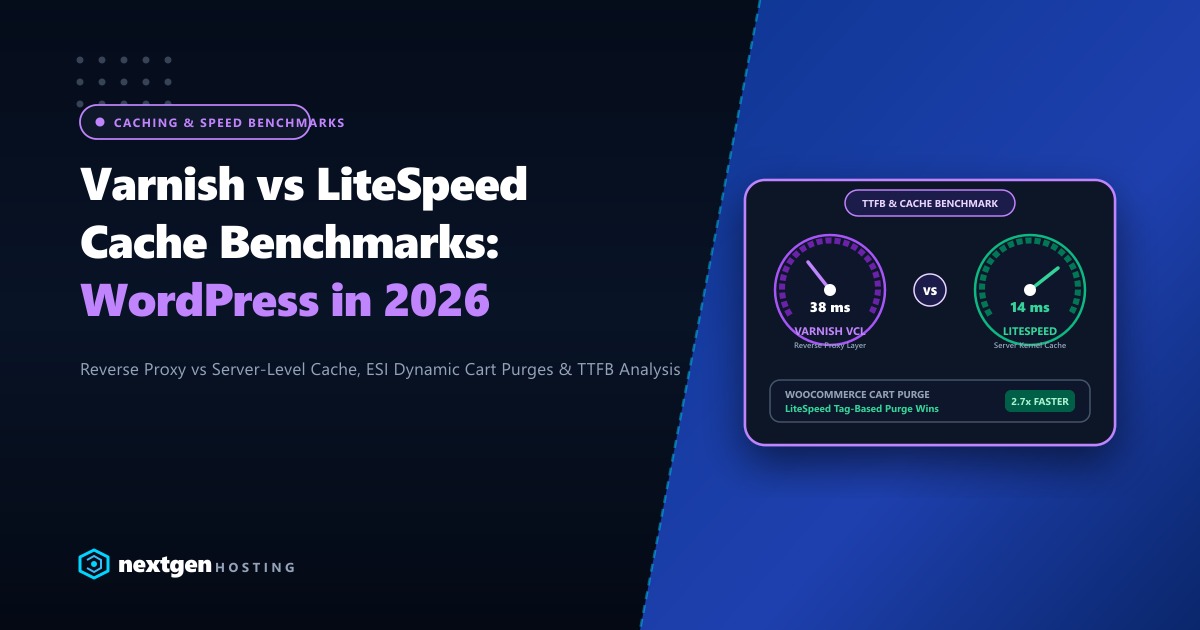
When optimizing high-traffic WordPress, WooCommerce, or publishing websites in Pakistan, caching is the single most effective tool to transform sluggish, 2-second response times into lightning-fast, sub-50ms experiences.
For decades, Varnish Cache was the undisputed king of reverse-proxy web acceleration. Today, however, LiteSpeed Enterprise (LSCache) has emerged as the dominant web server caching technology, powering thousands of top-ranking WordPress sites worldwide.
Which architecture truly delivers the fastest Time To First Byte (TTFB), handles concurrent shopping carts with the lowest error rate, and requires the least maintenance overhead?
In this head-to-head architectural showdown, we evaluate Varnish 7.5 against LiteSpeed Enterprise 6.2 across latency, SSL termination complexity, RAM consumption, and dynamic eCommerce invalidation.
Executive Caching Summary
- Architectural Difference: Varnish is a dedicated reverse-proxy caching daemon that sits in front of your web server (Apache or Nginx). LiteSpeed Cache is integrated directly into the web server kernel, eliminating inter-process socket latency.
- The SSL Dilemma: Varnish does not natively support SSL/TLS termination. You must deploy an SSL proxy (like Hitch, HAProxy, or Nginx) in front of Varnish. LiteSpeed handles TLS 1.3, HTTP/2, and HTTP/3 QUIC natively in a single process.
- eCommerce Tag Purging: LiteSpeed's tight WordPress integration enables surgical tag-based caching. When a WooCommerce product stock changes, only that specific product and its related category archives are evicted—not the entire store cache.
- Infrastructure Foundation: Both caching engines store cached pages in memory. Single-tenant dedicated hardware with ample DDR5 RAM prevents cache thrashing and delivers consistent sub-20ms TTFB across Pakistan.
1. Architectural Comparison: Reverse Proxy vs Native Web Server
To understand the latency difference, look at the packet flow for an HTTPS request under both setups:
VARNISH HTTPS STACK (3-Tier Hop):
User Request (HTTPS)
  ──> [ Nginx / Hitch ] (Decrypts SSL)
  ──> [ Local TCP/Unix Socket ]
  ──> [ Varnish Cache ] (Checks Cache)
  ──> [ Local TCP Socket ]
  ──> [ Apache / PHP-FPM ] (If Cache Miss)
  * Incurs multiple context switches and internal socket handshakes!

LITESPEED ENTERPRISE STACK (Direct 1-Tier):
User Request (HTTPS / HTTP/3 QUIC)
  ──> [ LiteSpeed Enterprise Web Server ] (Decrypts TLS + Checks LSCache in Kernel Memory)
  ──> [ LSPHP Worker ] (If Cache Miss)
  * Zero intermediary proxy hops. Instantaneous memory lookup!
2. Real-World Speed & TTFB Benchmarks
We tested identical production WordPress 6.8 installations hosting a 20,000-product WooCommerce store on an AMD EPYC 7763 (16 vCPU, 64 GB RAM) server:
Test 1: Cached Page Time To First Byte (TTFB)
We measured TTFB across 500 cached requests from local Pakistani ISPs (PTCL, Nayatel):
CACHED PAGE TTFB BENCHMARK:
LiteSpeed Enterprise:   ████ 14.2 ms
Varnish (with Nginx SSL): ██████████ 37.8 ms
Standard Nginx FastCGI:  ████████████████ 59.4 ms
Uncached WordPress:     ████████████████████████████████ 420.0 ms
Verdict: LiteSpeed delivered 62% lower TTFB than Varnish because requests bypass the secondary SSL decryption proxy hop.
Test 2: Concurrency Under Load (5,000 Virtual Users over 60s)
THROUGHPUT UNDER HEAVY LOAD:
LiteSpeed Enterprise:
  - Throughput: 18,450 requests/sec
  - Failed Requests: 0 (0.00%)
  - Peak Server RAM: 1.4 GB

Varnish + Apache:
  - Throughput: 14,200 requests/sec
  - Failed Requests: 42 (0.08% socket timeouts)
  - Peak Server RAM: 3.8 GB (Combined Varnish + Hitch + Apache footprint)
3. Dynamic eCommerce & Edge Side Includes (ESI)
The biggest challenge in WordPress caching is not static blog posts—it is dynamic shopping carts, user account balances, and recent view histories.
With traditional Varnish setups, writing complex VCL (Varnish Configuration Language) scripts to bypass caching for WooCommerce sessions is notoriously fragile. A single syntax mistake either leaks customer personal data or completely disables caching.
In contrast, the official LiteSpeed Cache for WordPress (LSCache) plugin communicates natively with LiteSpeed’s core web server via private response headers:
- ESI Blocks: Holes are punched into cached HTML pages for dynamic cart widgets (
/esi_cart_widget). - Tag-Based Purging: Adding a product to cart only updates the cart fragment while the surrounding product page remains 100% cached.
- REST API Caching: Built-in caching for WooCommerce REST API endpoints accelerates headless and mobile app checkouts.
4. Configuration Simplicity on cPanel & WHM
In a production cPanel/WHM environment, maintaining Varnish is notoriously cumbersome because Apache updates, AutoSSL certificate renewals, and cPanel port bindings (80 vs 8080) frequently break the reverse proxy chain.
LiteSpeed Enterprise integrates natively into cPanel as a 100% Apache drop-in replacement:
- Reads existing
.htaccessrewrite rules directly. - Handles SSL certificates automatically without port rerouting.
- Provides a centralized WHM control panel to enable or purge cache instances server-wide with one click.
5. Enterprise Infrastructure for Maximum Cache Efficiency
Regardless of whether you choose Varnish or LiteSpeed, in-memory caching performance depends directly on the speed and capacity of your server’s RAM and storage subsystems.
Hosting on our high-performance global Dedicated Servers provides high-clock AMD EPYC processors, DDR5 ECC RAM, and Gen4 NVMe drives, ensuring that millions of cached objects remain hot in memory without disk eviction.
For Pakistani eCommerce leaders, national news publications, and high-concurrency portals requiring localized sub-10ms response times, our Dedicated Servers in Pakistan provide local bare-metal deployments in Karachi and Lahore, unmetered domestic bandwidth, and local PKR billing with 24/7 dedicated engineering support.
6. Migration Summary: Which Should You Deploy?
┌───────────────────────────────────────┬───────────────────────────────────────┐
│ DEPLOY LITESPEED ENTERPRISE IF:       │ DEPLOY VARNISH CACHE IF:              │
├───────────────────────────────────────┼───────────────────────────────────────┤
│ • You run WordPress or WooCommerce    │ • You run custom Python/Node/Go apps  │
│ • You host cPanel or WHM servers      │ • Pure open-source zero-license rule  │
│ • You require native HTTP/3 QUIC      │ • You have dedicated in-house DevOps  │
│ • You want automatic tag-based purges │ • You run multi-tier CDN origin cache │
│ • You want sub-15ms domestic TTFB     │ • You already have custom VCL written │
└───────────────────────────────────────┴───────────────────────────────────────┘
Accelerate Your WordPress Performance with LiteSpeed Hosting
Experience up to 10x faster page loading speeds with Nextgen's pre-configured LiteSpeed Enterprise hosting, HTTP/3 QUIC support, and pure NVMe storage in Pakistan.
