
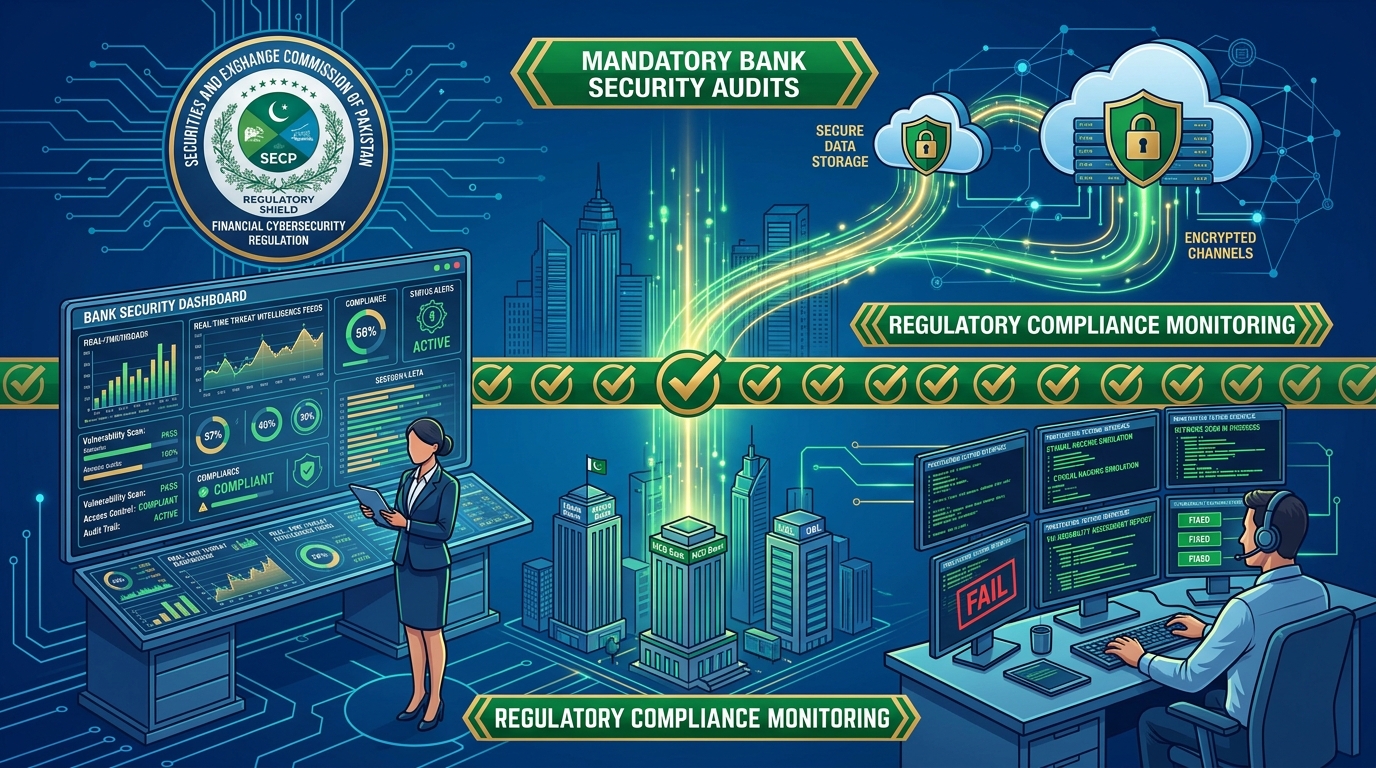
Operating a licensed Electronic Money Institution (EMI), Digital Retail Bank, non-banking financial company (NBFC), or SECP Regulatory Sandbox entity in Pakistan comes with rigorous regulatory oversight. Both the Securities and Exchange Commission of Pakistan (SECP) and the State Bank of Pakistan (SBP) have made comprehensive third-party cybersecurity audits mandatory for all fintech participants.
Failing an audit is not merely an administrative nuisance. Deficiencies in infrastructure hardening, encryption, or access controls can lead to punitive fines, suspension of sandbox privileges, or the revocation of pilot commercial licenses.
Yet, many engineering teams struggle to bridge the gap between high-level compliance policies and concrete, low-level server configurations.
In this practical implementation guide, we provide a step-by-step infrastructure hardening blueprint to ensure your production servers—whether running on Dedicated Servers in Pakistan or high-performance bare metal—pass SECP and SBP technical security audits with zero critical findings.
The Audit Framework: Key Regulatory Pillars
The SECP Cybersecurity Framework and SBP Enterprise Technology Governance directives focus on five core technical domains:
[SECP / SBP Compliance Matrix]
           │
           ├── 1. Boundary & Network Defense (Zero-Trust, Port Isolation, WAF)
           ├── 2. Data at Rest & In-Transit Encryption (AES-256, TLS 1.3)
           ├── 3. Identity & Access Governance (MFA, Principle of Least Privilege)
           ├── 4. Continuous Vulnerability Management (Patch Cadence, SAST/DAST)
           └── 5. Centralized Audit Logging & SIEM Retention (Immutable 1-Year Logs)
Pillar 1: Kernel & Network Boundary Hardening (sysctl.conf)
Inspectors evaluate whether your Linux operating systems are hardened against SYN floods, ICMP redirects, and IP spoofing attacks at the kernel level.
Deploy these directives to /etc/sysctl.d/99-secp-compliance.conf:
# Ignore ICMP echo broadcasts to prevent Smurf attacks
net.ipv4.icmp_echo_ignore_broadcasts = 1

# Disable ICMP redirect acceptance (prevents MITM route poisoning)
net.ipv4.conf.all.accept_redirects = 0
net.ipv4.conf.default.accept_redirects = 0
net.ipv6.conf.all.accept_redirects = 0

# Enable IP spoofing protection (Reverse Path Filtering)
net.ipv4.conf.all.rp_filter = 1
net.ipv4.conf.default.rp_filter = 1

# Mitigate SYN flood attacks
net.ipv4.tcp_syncookies = 1
net.ipv4.tcp_max_syn_backlog = 8192
net.ipv4.tcp_synack_retries = 2

# Log Martian packets (spoofed or impossible source IPs)
net.ipv4.conf.all.log_martians = 1

# Disable packet forwarding unless operating as a router/VPN gateway
net.ipv4.ip_forward = 0
Apply immediately:
sudo sysctl --systemPillar 2: SSH Daemon Hardening for Auditor Inspection
Auditors frequently run automated vulnerability scanners (such as Nessus or Qualys) against administrative ports. A weak SSH configuration will immediately flag high-severity findings.
Ensure /etc/ssh/sshd_config contains the following hardened parameters:
# Move SSH off default port 22 to reduce automated noise
Port 2222

# Strictly forbid root password logins
PermitRootLogin prohibit-password

# Disable password authentication; require ED25519 or RSA-4096 keys
PasswordAuthentication no
PubkeyAuthentication yes

# Disable legacy X11 and agent forwarding
X11Forwarding no
AllowAgentForwarding no

# Enforce modern secure key exchange and MAC algorithms
KexAlgorithms curve25519-sha256,diffie-hellman-group16-sha512
Ciphers [email protected],[email protected]
MACs [email protected]
Test and reload the daemon:
sudo sshd -t && sudo systemctl reload sshdPillar 3: Data at Rest Encryption (LUKS & Transparent Database Encryption)
Under SBP and SECP regulations, all production disks containing customer financial records or transactional logs must be encrypted at rest:
- Bare Metal Disk Encryption: Use Linux Unified Key Setup (LUKS) on physical NVMe arrays. If a drive fails and is physically replaced in the datacenter, customer data cannot be read without the volume key.
- Database TDE: Enable Transparent Data Encryption inside MySQL, MariaDB, or PostgreSQL:
-- In MariaDB /etc/my.cnf.d/server.cnf
[mariadb]
plugin_load_add = file_key_management
file_key_management_filename = /etc/mysql/encryption/keyfile.enc
file_key_management_filekey = FILE:/etc/mysql/encryption/keyfile.key
innodb_encrypt_tables = FORCE
innodb_encrypt_log = ON
innodb_encryption_rotate_key_age = 1
Pillar 4: Centralized Immutable Audit Logging (auditd & SIEM)
A common reason fintech startups fail SECP audits is the inability to prove that logs cannot be tampered with by privileged users. SBP mandates a minimum 365-day immutable retention window for audit logs.
1. Enable Linux Audit Subsystem (auditd)
Configure auditd to track unauthorized permission changes, user logins, and modifications to critical system binaries:
# Install audit daemon
sudo apt-get install auditd audispd-plugins -y

# Configure rules in /etc/audit/rules.d/audit.rules
cat << 'EOF' | sudo tee /etc/audit/rules.d/secp.rules
# Track changes to user and group databases
-w /etc/passwd -p wa -k identity
-w /etc/shadow -p wa -k identity
-w /etc/group -p wa -k identity
-w /etc/sudoers -p wa -k privilege_escalation

# Track privilege escalation attempts
-a always,exit -F arch=b64 -S setuid -S setgid -k priv_escalation
EOF

sudo augenrules --load
2. Forward Logs to Centralized SIEM via Encrypted Rsyslog
Never store logs exclusively on the local machine where an attacker could delete them:
# In /etc/rsyslog.d/50-siem-forward.conf
*.* action(type="omfwd" target="siem.fintech.pk" port="6514" protocol="tcp"
            StreamDriver="gtls" StreamDriverMode="1" StreamDriverAuthMode="anon")
Pillar 5: Sovereign Infrastructure Hosting in Pakistan
No matter how hardened your operating system is, if your production infrastructure is hosted outside Pakistan, your application will fail compliance checks under SBP circulars mandating sovereign data residency.
Deploying on NextGen Dedicated Servers provides:
- Physical hardware located within Pakistani datacenters.
- Certified biometric and dual-factor physical facility access controls.
- 100% compliant data localization for payments, eKYC records, and core banking ledgers.
Audit-Ready Bare Metal Hosting in Pakistan
Eliminate compliance headaches with infrastructure designed specifically for Pakistani financial institutions, EMIs, and fintech startups. Enterprise NVMe hardware, Tier-3 facility security, and dedicated engineering support.
