
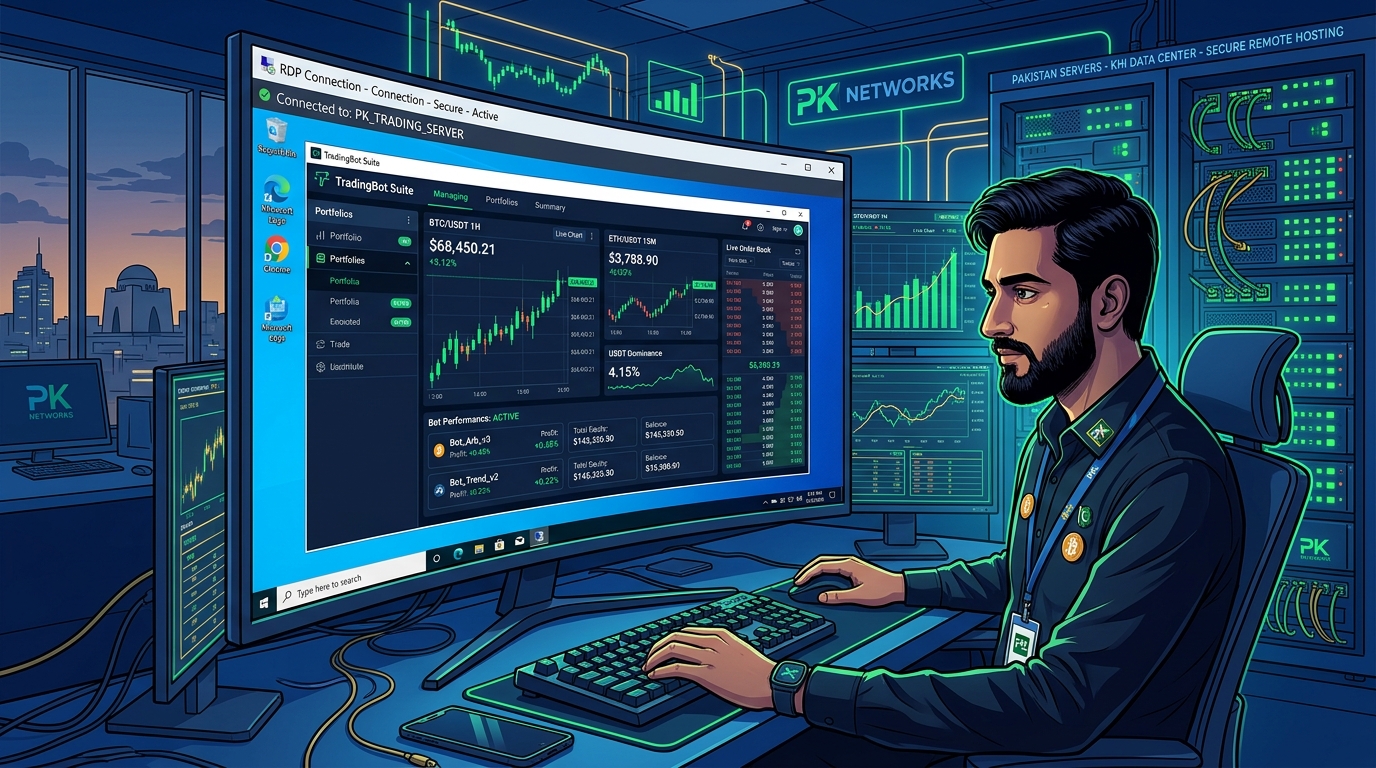
Operating as a professional cryptocurrency trader, algorithmic arbitrageur, or P2P merchant in Pakistan requires navigating severe operational hurdles. Between local ISP firewall routing anomalies, fluctuating residential IP pools, and heightened anti-fraud algorithms on global exchanges like Binance, HTX, KuCoin, and Bybit, one wrong move can trigger an instant compliance freeze or account lockout.
Many traders attempt to protect themselves by using commercial consumer VPN services (such as NordVPN, ExpressVPN, or free browser extensions). This is one of the most dangerous mistakes an active trader can make.
Commercial VPN exit nodes are shared among thousands of concurrent users. When another user on that same VPN subnet attempts credit card fraud or triggers an exchange risk heuristic, the exchange flags the entire IP range. Furthermore, VPN disconnects leak your real Pakistani IP address mid-session, instantly tripping geofencing triggers.
The professional standard is a Dedicated Windows RDP Server or private Cloud VPS. In this guide, we break down why dedicated environments are essential and how to harden your remote crypto trading workstation.
Why Consumer VPNs Fail Crypto Risk Algorithms
Tier-1 crypto exchanges utilize sophisticated behavioral risk engines (such as ThreatMetrix, Sift, and Chainalysis) to monitor user logins. These engines evaluate hundreds of signals:
Connection Attempt
       │
       ▼
[Exchange Risk Scoring Engine]
       │
       ├── TCP Handshake MTU / MSS Check (Detects VPN Tunnel Encap)
       ├── IP Reputation Lookup (Flags Datacenter ASN / Shared VPN Exit)
       ├── WebRTC Local IP Leak Check (Exposes Pakistani ISP Subnet)
       ├── Browser Fingerprint Telemetry (Canvas / WebGL / Audio Context)
       │
       ▼
Risk Score > Threshold? ──► [TRIGGER: 24-Hour Withdrawal Freeze / KYC Reset]
When you use a commercial VPN, you fail almost all of these checks:
- IP ASN Classification: The IP belongs to a known VPN hosting provider (e.g., M247, Datacamp).
- IP Rotation: Your login IP changes from Singapore to Frankfurt to London over a 48-hour period.
- Leaked WebRTC: If your browser leaks your true local ISP IP (PTCL, Nayatel, StormFiber) during a brief VPN blip, the exchange detects concurrent logins from two disparate geographic locations simultaneously.
The Dedicated RDP Architecture: 100% Isolated Trading Station
A dedicated RDP instance provides an isolated virtual or bare-metal environment with a single, static IPv4 address assigned exclusively to your organization.
Trader in Pakistan (Mac / Windows / Mobile)
                 │
                 ▼ (Encrypted RDP via TLS 1.3 / Network Level Authentication)
     [NextGen Dedicated RDP / Cloud VPS]
     (Fixed Static IP in London, Singapore, or Frankfurt)
                 │
                 ▼ (Clean, Consistent Datacenter / Commercial ASN)
    [Binance / HTX / KuCoin / Deribit API]
Key Operational Advantages:
- Zero IP Fluctuation: Your trading terminal always connects from the exact same IPv4 address, establishing a high trust reputation with exchange compliance engines.
- 24/7 Algorithmic Uptime: Trading bots (written in Python, CCXT, or Hummingbot) run uninterrupted even during local load-shedding or ISP maintenance in Pakistan.
- Sub-5ms Execution Latency: By provisioning your RDP in Frankfurt or London, your trading terminal connects to exchange matching engines with sub-millisecond execution speeds.
Step-by-Step Hardening Checklist for Crypto Trading RDP
To ensure maximum security on your trading machine, implement these security measures:
1. Enforce Network Level Authentication (NLA)
NLA requires the user to authenticate to the server before the full RDP desktop session is created, mitigating brute-force and remote code execution vulnerabilities:
# Enable NLA via Windows PowerShell (Run as Administrator)
(Get-WmiObject -class "Win32_TSGeneralSetting" -Namespace "root\cimv2\terminalservices" -Filter "TerminalName='RDP-Tcp'").SetUserAuthenticationRequired(1)
2. Restrict RDP Inbound Access to Your Pakistani Static IP
Never expose RDP port 3389 to the entire Internet. Use Windows Defender Firewall with Advanced Security or your hosting provider’s cloud firewall to permit connections only from your office or home static IP:
# Create custom firewall rule restricting port 3389
New-NetFirewallRule -DisplayName "RDP-Restrict-Trading-NOC" -Direction Inbound -LocalPort 3389 -Protocol TCP -Action Allow -RemoteAddress "202.59.80.12"
3. Browser Isolation & WebRTC Leak Prevention
Inside the RDP session, configure Brave Browser or Firefox for trading exclusively:
- Navigate to
about:configin Firefox and setmedia.peerconnection.enabledtofalseto permanently disable WebSockets/WebRTC IP leaks. - Disable browser password saving; use a dedicated hardware security key (YubiKey 5 FIPS) or KeePassXC database protected by a passphrase.
- Store sensitive cold-wallet seed phrases strictly on offline air-gapped hardware; never type seed phrases into the RDP session!
Scaling to Algorithmic High-Frequency Trading (HFT)
If you are running proprietary market-making bots, arbitrage scripts, or processing real-time order-book WebSocket streams, shared virtual instances may suffer from CPU jitter.
For institutional and prop trading operations, deploying on unthrottled Dedicated Servers with dual 10Gbps uplinks and ECC RAM eliminates noisy neighbor contention, ensuring your orders execute at the top of the book.
Protect Your Capital with Ultra-Low Latency Trading RDP
Trade crypto, forex, and commodities without fear of IP freezes or session drops. NextGen Trading RDP solutions feature 1Gbps unmetered bandwidth, clean dedicated IP addresses, NVMe storage, and 99.99% network reliability.
