
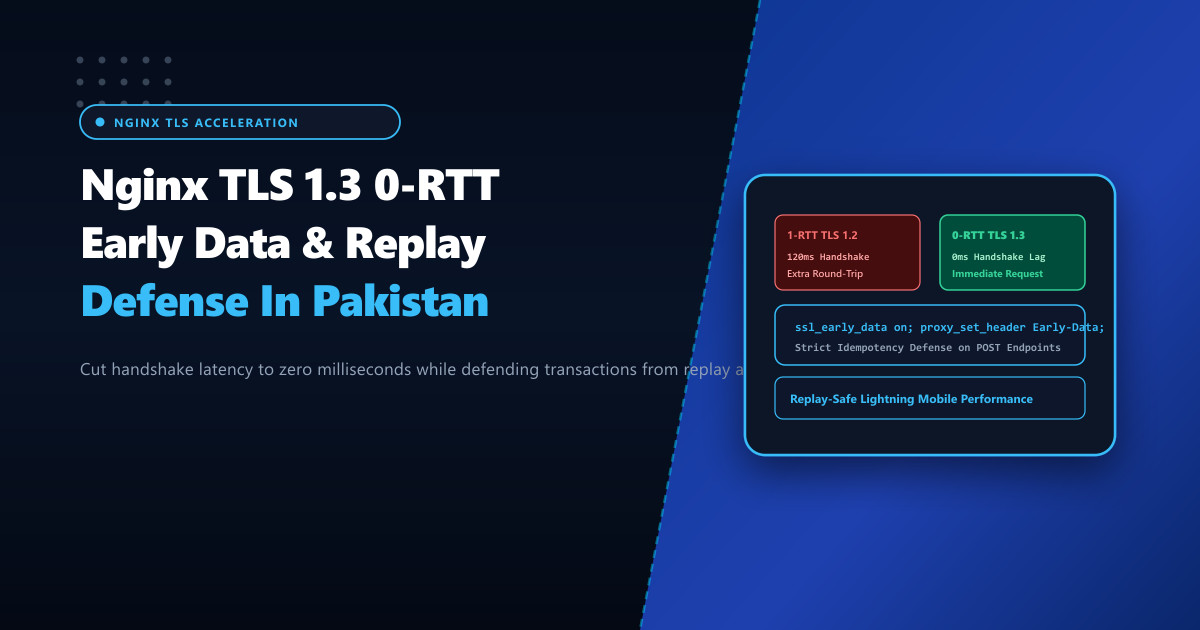
Network latency across cellular carriers (Jazz, Zong, Telenor, Ufone) and regional broadband ISPs in Pakistan typically introduces 40ms to 90ms of round-trip time (RTT). In TLS 1.2, establishing a secure connection required two full round-trips (2-RTT) before an HTTP request could be dispatched. While TLS 1.3 reduced this to 1-RTT, returning visitors can eliminate connection latency entirely using TLS 1.3 0-RTT Early Data.
With 0-RTT, a returning browser transmits its HTTP GET request inside the very first cryptographic packet, cutting page load times significantly. However, 0-RTT introduces a severe architectural security vulnerability: Replay Attacks. If an attacker captures early data packets, they can replay them repeatedly against the server.
Hosting performance-critical applications on bare-metal Dedicated Servers provides the low-latency baseline needed, but system engineers must implement precise Nginx configurations to accelerate safe GET requests while strictly blocking early data replay on sensitive state-changing endpoints.
Understanding TLS 1.3 0-RTT and Replay Vulnerabilities
During a client’s initial visit, the server issues a Pre-Shared Key (PSK) session ticket. On subsequent visits:
- 0-RTT Acceleration: The client uses the stored PSK to encrypt and send early application data (such as
GET /index.html) alongside the initial TLSClientHello. - The Replay Threat: Unlike full TLS handshakes that use mutual random nonces, 0-RTT early data packets do not provide forward secrecy or guaranteed freshness.
- An eavesdropper on a public Wi-Fi hotspot in Lahore or Karachi can record an encrypted
POST /api/v1/transfer-fundsearly data packet and replay it 10 times. - If the server accepts early data on state-changing requests, the transaction could be executed 10 times!
- An eavesdropper on a public Wi-Fi hotspot in Lahore or Karachi can record an encrypted
Legitimate 0-RTT Session:
Client ─────────► [ClientHello + Encrypted GET /] ─────────► Nginx Origin
                       │ (Recorded by Attacker)
                       ▼
Replay Attack:
Attacker ───────► [Replayed ClientHello + Encrypted POST] ─► Vulnerable Server Executes Again!

Nginx Defense Architecture:
Nginx checks $ssl_early_data:
- Safe GET requests: Allowed immediately with 0-RTT speed!
- Unsafe POST/PUT/DELETE requests: Enforce 425 Too Early (Forces 1-RTT handshake completion).
Step 1: Enabling ssl_early_data in Nginx
Ensure Nginx is compiled with OpenSSL 1.1.1 or 3.x and configure session tickets and early data inside /etc/nginx/nginx.conf:
# /etc/nginx/conf.d/tls13-early-data.conf - NextGen 0-RTT Configuration

# Enable modern TLS protocols
ssl_protocols TLSv1.2 TLSv1.3;

# Session caching and tickets are MANDATORY for 0-RTT resumption
ssl_session_cache shared:SSL:50m;
ssl_session_timeout 1d;
ssl_session_tickets on;

# Rotate TLS session ticket encryption keys every 24 hours
ssl_session_ticket_key /etc/nginx/ssl/ticket.key;

# Enable 0-RTT Early Data
ssl_early_data on;
Generate high-entropy session ticket keys:
openssl rand 80 > /etc/nginx/ssl/ticket.key
chmod 600 /etc/nginx/ssl/ticket.key
chown root:nginx /etc/nginx/ssl/ticket.key
Step 2: Mitigating Replay Attacks with $ssl_early_data and HTTP 425
RFC 8470 defines the HTTP 425 Too Early status code, instructing clients to retry the request over a confirmed 1-RTT handshake.
Configure Nginx to inspect the $ssl_early_data variable. If a non-idempotent request (POST, PUT, DELETE, PATCH) arrives via early data, return 425 Too Early:
server {
    listen 443 ssl http2;
    server_name nextgen.pk www.nextgen.pk;

    # SSL Certificate directives...

    # Forward early data status to backend application runtimes
    proxy_set_header Early-Data $ssl_early_data;

    # Global protection: Reject early data on sensitive HTTP methods
    if ($ssl_early_data) {
        set $early_risk 1;
    }
    if ($request_method ~ ^(POST|PUT|DELETE|PATCH)$) {
        set $early_risk "${early_risk}_unsafe";
    }
    if ($early_risk = "1_unsafe") {
        return 425; # Instruct browser to retry after handshake completes
    }

    # Safe static and read-only routes (Full 0-RTT Acceleration)
    location / {
        proxy_pass http://127.0.0.1:8080;
        proxy_set_header Host $host;
        proxy_set_header X-Real-IP $remote_addr;
        proxy_set_header X-Forwarded-For $proxy_add_x_forwarded_for;
        proxy_set_header X-Forwarded-Proto $scheme;
    }

    # Critical transaction endpoints (Enforce 1-RTT Handshake Exclusively)
    location ~* /(checkout|cart|api/v1/payment|login) {
        if ($ssl_early_data) {
            return 425;
        }
        proxy_pass http://127.0.0.1:8080;
        proxy_set_header Host $host;
    }
}
Step 3: Verifying 0-RTT Functionality via OpenSSL CLI
Verify that 0-RTT resumption functions properly using openssl s_client:
# 1. Establish initial TLS 1.3 connection and save session ticket
openssl s_client -connect nextgen.pk:443 -tls1_3 -sess_out /tmp/session.pem < /dev/null

# 2. Reconnect using stored ticket and transmit early data
echo -e "GET / HTTP/1.1\r\nHost: nextgen.pk\r\n\r\n" | \
  openssl s_client -connect nextgen.pk:443 -tls1_3 -sess_in /tmp/session.pem -early_data /dev/stdin
Verify in the output stream:
Reused, TLSv1.3, Cipher is TLS_AES_256_GCM_SHA384
Early data was sent: 37 bytes
Early data was accepted
HTTP/1.1 200 OK
Testing a POST request will properly return:
HTTP/1.1 425 Too EarlyDeploying TLS 1.3 0-RTT architectures on enterprise Dedicated Servers in Pakistan delivers instant mobile web performance while safeguarding online banking, fintech, and ecommerce transactions against sophisticated replay attacks.
Accelerate Mobile Web Speed with NextGen Dedicated Servers
Deliver sub-second mobile page loads with kernel-optimized TLS 1.3, HTTP/3 QUIC, and dedicated NVMe compute infrastructure in Pakistan.
Explore Pakistan Dedicated Servers