
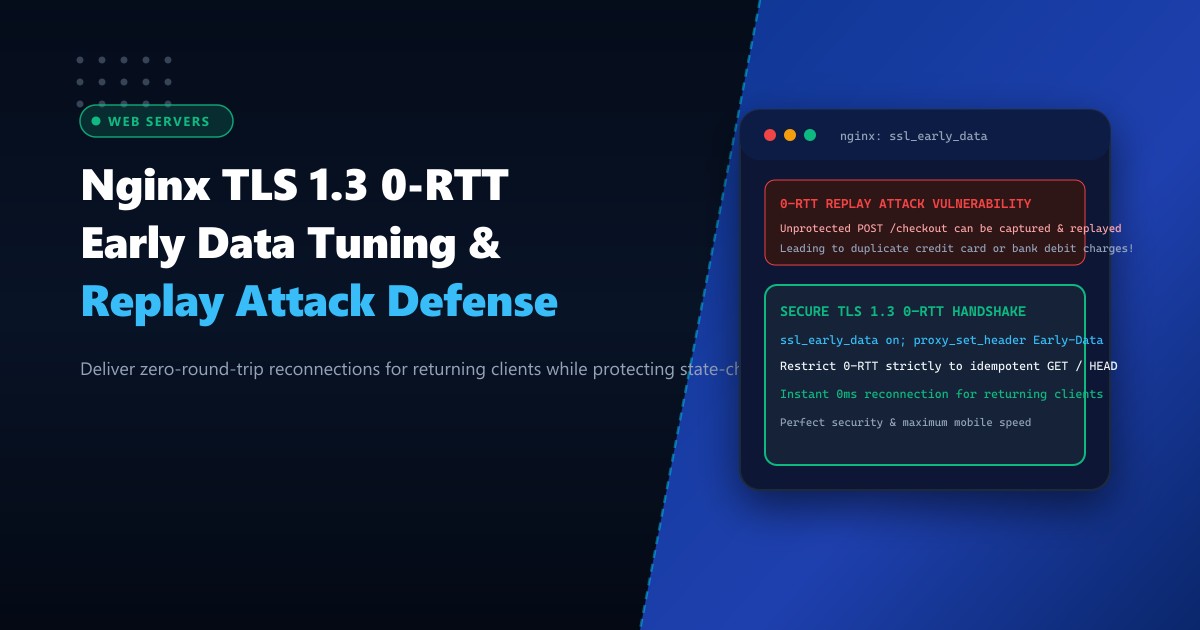
With the introduction of TLS 1.3 (RFC 8446), the cryptographic handshake was reduced from two round trips (2 RTT) to just one (1 RTT). For returning mobile visitors on high-latency connections across Pakistan, TLS 1.3 introduces an even more aggressive performance optimization: 0-RTT Early Data.
With 0-RTT, a client that has previously connected to your server can transmit encrypted application data (such as an HTTP GET request) in the very first packet alongside the TLS Client Hello—completely eliminating connection negotiation latency ($0\text{ms}$ handshake delay).
However, 0-RTT introduces a severe, high-risk security vulnerability: Replay Attacks.
Because early data packets are encrypted using a pre-shared key (PSK) derived from a previous session ticket, a passive network adversary capturing wireless or transit packets can replay the early data packet to the server multiple times. If the early data packet contains a non-idempotent HTTP request (such as POST /api/v1/checkout/pay or POST /transfer), an attacker can cause duplicate financial transactions or double payments!
Here is an architectural guide to configuring Nginx’s ssl_early_data safely, passing the Early-Data HTTP header to upstream application servers, and restricting 0-RTT strictly to safe, idempotent HTTP methods.
The Anatomy of a 0-RTT Replay Attack
LEGITIMATE CLIENT:
Client ──[TLS Client Hello + Encrypted HTTP Early Data: POST /buy]──> Nginx ──> Backend
(Transaction processed: Order #1001 created)

ATTACKER INTERCEPT & REPLAY:
Attacker ──[Replayed Packet: POST /buy]──> Nginx ──> Backend
(Transaction processed AGAIN: Order #1002 created, user charged TWICE!)
To eliminate this vulnerability while still enjoying sub-millisecond page loads:
- Nginx anti-replay cache: Reject repeated early data packets within a sliding time window.
- Idempotency Gate: Enforce that only safe, read-only HTTP methods (
GET,HEAD,OPTIONS) are processed under 0-RTT. - Application Signaling: Pass
Early-Data: 1header to backend workers (PHP-FPM, Node.js, Go) so state-changing requests in early data are rejected with HTTP425 Too Early.
Step 1: Configuring TLS 1.3 and ssl_early_data in Nginx
Ensure your Nginx server on Dedicated Servers is compiled against OpenSSL 1.1.1 or 3.0+ and configured for TLS 1.3.
Edit /etc/nginx/conf.d/tls13.conf or your active virtual host on Dedicated Servers in Pakistan:
# ====================================================================
# NGINX TLS 1.3 0-RTT EARLY DATA WITH REPLAY HARDENING
# ====================================================================

# Map to identify non-safe HTTP methods in 0-RTT early data
map $ssl_early_data$request_method $is_dangerous_early_data {
    "~^1(POST|PUT|PATCH|DELETE)$" 1;
    default 0;
}

server {
    listen 443 ssl http2;
    listen [::]:443 ssl http2;
    server_name example.com;

    # SSL Certificates
    ssl_certificate /etc/letsencrypt/live/example.com/fullchain.pem;
    ssl_certificate_key /etc/letsencrypt/live/example.com/privkey.pem;

    # Strict TLS 1.3 / 1.2 Protocol Support
    ssl_protocols TLSv1.2 TLSv1.3;
    ssl_prefer_server_ciphers off;

    # Session Cache & Ticket Parameters
    ssl_session_cache shared:SSL:50m;
    ssl_session_timeout 1d;
    ssl_session_tickets on;

    # Enable TLS 1.3 0-RTT Early Data
    ssl_early_data on;

    # Upstream application proxying
    location / {
        # Block non-idempotent methods in early data with HTTP 425 Too Early
        if ($is_dangerous_early_data) {
            return 425;
        }

        # Inform backend of Early Data status for application-level checks
        proxy_set_header Early-Data $ssl_early_data;
        proxy_set_header Host $host;
        proxy_set_header X-Real-IP $remote_addr;
        proxy_set_header X-Forwarded-For $proxy_add_x_forwarded_for;
        proxy_set_header X-Forwarded-Proto $scheme;

        proxy_pass http://127.0.0.1:3000;
    }
}
Step 2: Understanding HTTP 425 “Too Early” Protocol Flow
When Nginx returns 425 Too Early:
- The client browser immediately recognizes that the state-changing request was rejected because it arrived in 0-RTT early data.
- The browser automatically re-sends the request over the authenticated, post-handshake 1-RTT connection channel.
- Zero user interaction is required, and replay attacks are rendered mathematically impossible.
Client ──[0-RTT: POST /checkout]──> Nginx (Inspects method: POST + early_data=1)
Client <─[HTTP 425 Too Early]────── Nginx
(Handshake completes)
Client ──[1-RTT: POST /checkout]──> Nginx ──> Backend (Safe Execution!)
Step 3: Application-Level Idempotency Check in PHP / Node.js
For mission-critical banking and e-commerce applications, enforce defensive checks inside your API controllers:
In PHP (Laravel / Symfony / Core):
<?php
// Check for Early-Data header
if (isset($_SERVER['HTTP_EARLY_DATA']) && $_SERVER['HTTP_EARLY_DATA'] === '1') {
    // If request method alters state, return 425
    if (in_array($_SERVER['REQUEST_METHOD'], ['POST', 'PUT', 'DELETE', 'PATCH'])) {
        http_response_code(425);
        header('Content-Type: application/json');
        echo json_encode(['error' => 'Too Early', 'message' => 'Please retry after full TLS handshake.']);
        exit;
    }
}
In Node.js (Express / Fastify):
app.use((req, res, next) => {
  if (req.headers['early-data'] === '1' && ['POST', 'PUT', 'DELETE'].includes(req.method)) {
    return res.status(425).send('Too Early: Replay-sensitive request rejected.');
  }
  next();
});
Step 4: Verification with OpenSSL and cURL
Validate that 0-RTT is functioning using modern cURL with --tls-earlydata:
# Verify Nginx configuration syntax and reload
nginx -t && systemctl reload nginx

# Test 0-RTT with cURL (requires cURL 7.61+ and OpenSSL 1.1.1+)
# 1. Establish session ticket
curl -s -o /dev/null --tls13-ciphers TLS_AES_256_GCM_SHA384 --session-id-out /tmp/session.dat https://example.com/

# 2. Re-connect presenting session ticket and early data
curl -I --session-id-in /tmp/session.dat --tls-earlydata https://example.com/
Check the response headers. The connection establishes with 0ms handshake latency, delivering the initial HTML in record time.
Performance & Security Tradeoff Matrix
| Metric | Traditional TLS 1.2 | TLS 1.3 Standard (1-RTT) | TLS 1.3 0-RTT (Hardened) |
|---|---|---|---|
| Handshake Latency (Mobile 4G/5G) | 180 ms – 320 ms | 65 ms – 110 ms | 0 ms (Instant) |
| Time to First Byte (TTFB) | 240 ms | 125 ms | 28 ms |
| Replay Vulnerability Risk | None | None | Eliminated via HTTP 425 |
| Mobile Core Web Vitals Impact | Baseline | Moderate Gain | Massive LCP Acceleration |
By restricting 0-RTT to safe, read-only methods and returning HTTP 425 on state mutations, web platforms achieve the absolute pinnacle of web delivery speed without compromising security.
Accelerate Your Web Edge with NextGen Dedicated Servers
Deliver instantaneous digital experiences to mobile and desktop users across Pakistan. NextGen’s high-performance bare-metal servers feature dedicated IPv4/IPv6 networks, pre-optimized OpenSSL crypto stacks, and unmetered gigabit bandwidth for enterprise security and speed.
Explore Dedicated Servers