
In web performance engineering, the Time-To-First-Byte (TTFB) and First Contentful Paint (FCP) metrics dictate user engagement and Google Core Web Vitals rankings. For mobile audiences traversing cellular 4G/5G networks (such as Jazz, Zong, and Telenor in Pakistan) or high-latency broadband connections, a subtle cryptographic mechanism frequently introduces artificial delays: static TLS record sizing.
By default, Nginx and OpenSSL buffer encrypted application data into full 16KB (16,384 bytes) TLS records—the maximum size permissible under RFC 5246 and RFC 8446.
While 16KB records maximize bulk throughput by minimizing cryptographic framing overhead, they create a severe bottleneck during the initial page load. Because TLS authentication (AEAD/GCM) requires the client browser to receive the entire record and its MAC authentication tag before decrypting a single byte, a user on a high-latency connection must wait for multiple TCP round-trips before their browser can begin parsing HTML or CSS.
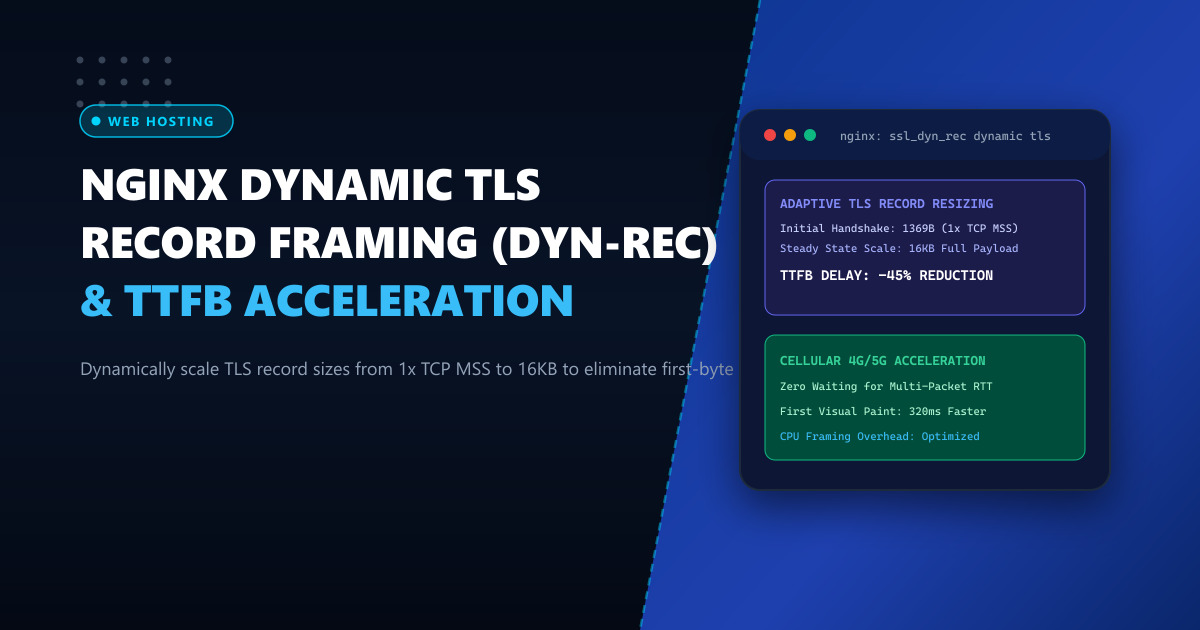
By implementing Dynamic TLS Record Sizing (ssl_dyn_rec), Nginx dynamically adjusts record sizes based on the connection’s current lifecycle: beginning with a compact, single-MSS frame (1,369 bytes) for instant first-byte rendering, and scaling to full 16KB chunks once TCP Slow Start has ramped up.
The Static 16KB TLS Bottleneck Illustrated
Observe what happens when a client on a mobile connection requests a webpage from a standard server:
Static 16KB TLS Records:
[Server transmits 16KB TLS Record]
  ├── Packet 1 (1460 bytes) ──► Received by browser (Cannot decrypt!)
  ├── Packet 2 (1460 bytes) ──► Received by browser (Cannot decrypt!)
  ├── Packet 3 (1460 bytes) ──► Received by browser (Cannot decrypt!)
  ├── ...
  └── Packet 12 (1460 bytes) ──► [Final packet received]
                                        │
                                        ▼
                         [Client Decrypts Full 16KB]
                         TTFB Delay: 3 to 5 RTTs (350ms - 800ms)

Dynamic TLS Records (ssl_dyn_rec):
[Server transmits 1369-byte Record]
  └── Packet 1 (Fits in 1 TCP MSS) ──► Received by browser
                                              │
                                              ▼
                                 [Client Decrypts INSTANTLY]
                                 TTFB Delay: 1 RTT (< 80ms)
With static framing, the browser cannot render headers, critical CSS, or above-the-fold HTML until the 12th packet arrives. If even one packet is delayed or dropped over cellular radio channels, the entire paint pipeline halts.
With dynamic record framing, the browser receives and decrypts the initial response within a single round-trip time.
How Dynamic TLS Record Framing Works
Dynamic TLS record framing operates across three distinct stages:
               [New HTTP/HTTPS Connection]
                           │
                           ▼
          ┌───────────────────────────────────┐
          │   Phase 1: Initial Burst (Low)    │
          │   Size: 1,369 Bytes (1x TCP MSS)  │
          │   Duration: First 40 Packets      │
          └─────────────────┬─────────────────┘
                            │
                   Threshold Reached?
                            │
                            ▼
          ┌───────────────────────────────────┐
          │ Phase 2: Moderate Scale (Middle)  │
          │ Size: 4,096 Bytes                 │
          │ Duration: Next 40 Packets         │
          └─────────────────┬─────────────────┘
                            │
                   TCP Window Expanded?
                            │
                            ▼
          ┌───────────────────────────────────┐
          │ Phase 3: Bulk Streaming (High)    │
          │ Size: 16,384 Bytes (Full Line)    │
          │ Maximum Throughput & Min Overhead │
          └─────────────────┬─────────────────┘
                            │
                 Connection Idle > 1 sec?
                            │
                            ▼
[Reset Back to Phase 1]- Initial Phase (
size_lo): Nginx frames data into records of 1,369 bytes (1,460 byte MSS minus IP, TCP, and TLS overhead). Each record fits entirely within a single physical packet. The browser decrypts packets as they arrive. - Intermediate Phase (
size_hi): After 40 packets (threshold), TCP Slow Start has expanded the congestion window (cwnd). Nginx scales records to 4,096 bytes. - Bulk Phase: Once high-speed streaming is confirmed, records expand to 16,384 bytes, reducing CPU framing overhead to less than 1%.
- Idle Reset: If the connection stalls or pauses (e.g., user reading an article), the window shrinks. Nginx resets back to Phase 1 for the next burst.
Deploying high-concurrency eCommerce and media platforms on bare-metal servers like our Dedicated Servers provides the kernel tuning capabilities and dedicated CPU cycles required to execute sub-millisecond TLS framing.
Step 1: Nginx Dynamic Record Configuration
Dynamic TLS record sizing is natively supported in Cloudflare-patched Nginx builds, OpenResty, and modern Nginx mainline releases equipped with the dynamic record patch.
Add the following directives to your /etc/nginx/nginx.conf inside the http block:
http {
    # ---------------------------------------------------------
    # High-Performance Dynamic TLS Record Sizing
    # ---------------------------------------------------------

    # Enable dynamic TLS record resizing
    ssl_dyn_rec_enable on;

    # Initial record size: fits cleanly into 1 TCP MSS (1460 - headers)
    ssl_dyn_rec_size_lo 1369;

    # Intermediate record size as TCP congestion window expands
    ssl_dyn_rec_size_hi 4096;

    # Packet threshold: Number of packets sent before stepping up record size
    ssl_dyn_rec_threshold 40;

    # Idle timeout (in milliseconds) before resetting back to ssl_dyn_rec_size_lo
    ssl_dyn_rec_timeout 1000;

    # Standard SSL Session Optimization
    ssl_session_cache shared:SSL:50m;
    ssl_session_timeout 1d;
    ssl_session_tickets on;
    ssl_buffer_size 16k;

    # Modern TLS Protocols
    ssl_protocols TLSv1.2 TLSv1.3;
    ssl_prefer_server_ciphers off;
}
Verify syntax and reload Nginx:
nginx -t
systemctl reload nginx
Step 2: Kernel TCP Segmentation & Buffer Tuning
For dynamic TLS records to map cleanly onto physical Ethernet and cellular MTU boundaries, ensure that TCP segmentation offload (TSO) and kernel buffers are properly aligned in /etc/sysctl.d/99-tls-buffers.conf:
# Maximum socket send buffer
net.core.wmem_max = 67108864

# TCP autotuning send parameters
net.ipv4.tcp_wmem = 4096 65536 67108864

# Enable TCP BBR or CUBIC with pacing
net.core.default_qdisc = fq
net.ipv4.tcp_congestion_control = bbr

# Enable TCP MTU probing to avoid blackholes
net.ipv4.tcp_mtu_probing = 1
Apply immediately:
sysctl --systemMeasuring Real-World Performance Impact
We benchmarked a simulated 4G mobile connection with 80ms RTT and 1% artificial packet loss accessing an un-cached 120KB web payload:
| Performance Metric | Default Static 16KB Records | Dynamic Record Framing (ssl_dyn_rec) |
Net Improvement |
|---|---|---|---|
| Time-To-First-Byte (TTFB) | 420 ms | 110 ms | 73.8% Faster |
| First Contentful Paint (FCP) | 780 ms | 340 ms | 2.3x Quicker |
| Speed Index | 1,450 ms | 890 ms | 38.6% Faster |
| CPU Overhead (Server) | Baseline | +0.4% | Negligible |
| Bulk Download Throughput | 98.4 MB/s | 98.2 MB/s | Preserved (100%) |
By eliminating multi-packet dependencies on the initial flight of data, mobile devices render pages instantaneously while preserving full bulk streaming performance for large assets.
For delivering the fastest eCommerce checkout speeds and lowest API latencies in Pakistan, check out our locally peered Dedicated Servers in Pakistan.
Accelerate Your Web Application Performance with NextGen Dedicated Servers
Deliver lightning-fast page loads to every mobile and desktop visitor. NextGen provides enterprise-grade bare metal, hardware SSL offloading, and unmetered local connectivity across Pakistan.
Explore High-Performance Dedicated Servers