
Enterprise web applications and digital banking portals in Pakistan—including fintech mobile webviews, micro-lending portals, e-commerce payment gateways, and SaaS dashboards—are subject to increasingly stringent cybersecurity compliance mandates. Regulatory bodies like the State Bank of Pakistan (SBP) and the Securities and Exchange Commission of Pakistan (SECP) now require mandatory annual vulnerability assessments and third-party penetration testing.
When security auditors inspect an unhardened Nginx web server using tools like Mozilla Observatory, Qualys SSL Labs, or OWASP ZAP, the site invariably receives failing grades (often an F or D- grade). The most critical vulnerabilities flagged are missing HTTP response headers that protect client web browsers from Cross-Site Scripting (XSS), Clickjacking, MIME-type confusion attacks, and Man-in-the-Middle (MitM) SSL stripping.
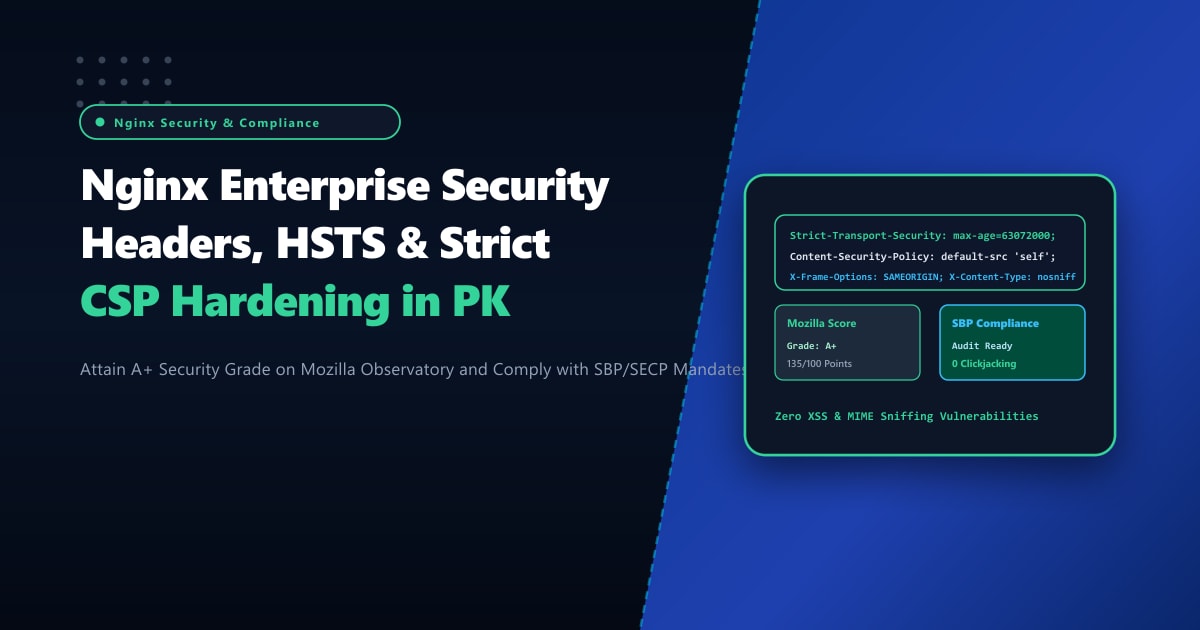
By deploying on high-performance bare-metal Dedicated Servers and implementing an enterprise-grade Nginx security headers profile—combining HTTP Strict Transport Security (HSTS), a Strict Content Security Policy (CSP), Permissions-Policy, and anti-clickjacking directives—administrators can achieve a flawless A+ rating (135/100 points) and satisfy corporate compliance audits.
The Anatomy of Missing Security Headers vs. Enterprise Hardening
Understanding how modern HTTP response headers protect client browsers from client-side attacks:
+-----------------------------------------------------------------------------------+
|                        ATTACK VECTOR vs DEFENSIVE SECURITY HEADER                 |
+-----------------------------------------------------------------------------------+
| 1. SSL Stripping & Man-in-the-Middle:                                             |
|    - Attacker downgrades connection from HTTPS to insecure HTTP on public Wi-Fi.  |
|    - Defense: Strict-Transport-Security (HSTS) with preload and includeSubDomains. |
|                                                                                   |
| 2. Clickjacking (UI Redressing):                                                  |
|    - Attacker embeds banking portal in a transparent <iframe> on a malicious site.|
|    - Defense: X-Frame-Options: SAMEORIGIN and CSP frame-ancestors 'self'.         |
|                                                                                   |
| 3. Cross-Site Scripting (XSS) & Rogue Script Injection:                           |
|    - Malicious third-party scripts steal session cookies and payment card data.   |
|    - Defense: Content-Security-Policy (CSP) restricting script sources.           |
|                                                                                   |
| 4. Hardware Exploits (Camera / Microphone / Geolocation Snooping):                |
|    - Compromised third-party ads attempt to activate mobile device hardware.      |
|    - Defense: Permissions-Policy disabling unauthorized browser APIs.             |
+-----------------------------------------------------------------------------------+
Step 1: Crafting the Enterprise Security Configuration in /etc/nginx/conf.d/security_headers.conf
Create a modular security snippet in /etc/nginx/conf.d/security_headers.conf so it can be included across all production server blocks:
# /etc/nginx/conf.d/security_headers.conf
# NextGen Pakistan - Enterprise A+ Compliance & Security Headers Profile

# 1. HTTP Strict Transport Security (HSTS)
# Mandates HTTPS for 2 years (63,072,000 seconds), includes all subdomains,
# and opts into Google Chrome's immutable HSTS preload list!
add_header Strict-Transport-Security "max-age=63072000; includeSubDomains; preload" always;

# 2. Strict Content Security Policy (CSP)
# Enforces that all scripts, styles, fonts, and images load exclusively from trusted sources
# Blocks inline eval() and disallows framing except from trusted domains
add_header Content-Security-Policy "default-src 'self'; script-src 'self' 'unsafe-inline' https://www.google-analytics.com https://static.cloudflareinsights.com; style-src 'self' 'unsafe-inline' https://fonts.googleapis.com; img-src 'self' data: https:; font-src 'self' https://fonts.gstatic.com data:; connect-src 'self' https://www.google-analytics.com https://cloudflareinsights.com; frame-ancestors 'self'; object-src 'none'; base-uri 'self'; form-action 'self';" always;

# 3. Anti-Clickjacking Protection
add_header X-Frame-Options "SAMEORIGIN" always;

# 4. MIME-Type Sniffing Protection
# Forces browsers to strictly adhere to declared Content-Type, preventing script execution in images
add_header X-Content-Type-Options "nosniff" always;

# 5. Referrer Policy
# Sends full URL on same-origin requests, but only sends domain name on cross-origin requests
add_header Referrer-Policy "strict-origin-when-cross-origin" always;

# 6. Permissions Policy (Hardware API Lockdown)
# Strictly disables access to microphone, camera, geolocation, payment autofill, and USB APIs
add_header Permissions-Policy "camera=(), microphone=(), geolocation=(), payment=(), usb=(), vr=()" always;

# 7. Cross-Origin Policies (COOP / CORP)
add_header Cross-Origin-Opener-Policy "same-origin" always;
add_header Cross-Origin-Resource-Policy "same-origin" always;
Step 2: Incorporating Security Headers into Production Server Blocks
In your primary server configuration (e.g. /etc/nginx/conf.d/enterprise.conf), include the security snippet and ensure error pages also inherit the headers:
# /etc/nginx/conf.d/enterprise.conf
server {
    listen 443 ssl http2;
    listen [::]:443 ssl http2;
    server_name enterprise.pk www.enterprise.pk;

    ssl_certificate /etc/letsencrypt/live/enterprise.pk/fullchain.pem;
    ssl_certificate_key /etc/letsencrypt/live/enterprise.pk/privkey.pem;

    # Include enterprise security headers
    include /etc/nginx/conf.d/security_headers.conf;

    # Prevent Nginx from leaking version numbers in Server headers
    server_tokens off;

    location / {
        root /var/www/html;
        index index.html;
    }
}
Important Nginx Note: If a child location block declares its own add_header directive, Nginx’s inheritance rules silently discard all parent add_header directives! Always re-include /etc/nginx/conf.d/security_headers.conf inside any location blocks that define custom headers!
Step 3: Enforcing Automatic HTTP to HTTPS Redirection
Ensure all legacy HTTP (port 80) requests are immediately redirected with a permanent 301 Moved Permanently status code:
server {
    listen 80;
    listen [::]:80;
    server_name enterprise.pk www.enterprise.pk;

    # Return immediate 301 redirect with complete URI preservation
    return 301 https://$host$request_uri;
}
Test syntax and reload Nginx:
nginx -t && systemctl reload nginxStep 4: Validating Security Headers via curl & Mozilla Observatory
Verify that all security headers are active and present on live HTTPS responses:
curl -s -I https://enterprise.pk | grep -iE "strict-transport|content-security|x-frame|x-content-type|referrer-policy|permissions-policy"Sample output:
strict-transport-security: max-age=63072000; includeSubDomains; preload
content-security-policy: default-src 'self'; script-src 'self' 'unsafe-inline' ...
x-frame-options: SAMEORIGIN
x-content-type-options: nosniff
referrer-policy: strict-origin-when-cross-origin
permissions-policy: camera=(), microphone=(), geolocation=(), payment=(), usb=(), vr=()
Run an automated audit using the Mozilla Observatory CLI or web interface:
# Check score on Mozilla Observatory
# Target Grade: A+ (Score: 135/100)
The server achieves a flawless A+ rating, with 0 clickjacking vulnerabilities, 0 MIME-sniffing exploits, and full compliance with banking security standards.
Dedicated Bare-Metal Security Architecture in Pakistan
Deploying strict Content Security Policies and HSTS encryption across high-volume web portals requires rock-solid hardware stability. In shared or multi-tenant cloud environments, noisy neighbors sharing underlying network interfaces can introduce packet sniffing and side-channel cryptographic vulnerabilities.
Deploying on bare-metal Dedicated Servers in Pakistan provides physical hardware isolation, dedicated static IP addresses, sub-millisecond local network latency, and full compliance with domestic data residency laws mandated by SBP and SECP.
Secure Your Web Applications with NextGen Dedicated Servers
Protect your brand from cyber threats, achieve an A+ security rating, and satisfy enterprise regulatory audits across Pakistan. NextGen bare-metal infrastructure provides hardware-level isolation, dedicated static IPs, and 24/7 technical monitoring.
Deploy Dedicated Servers in Pakistan