
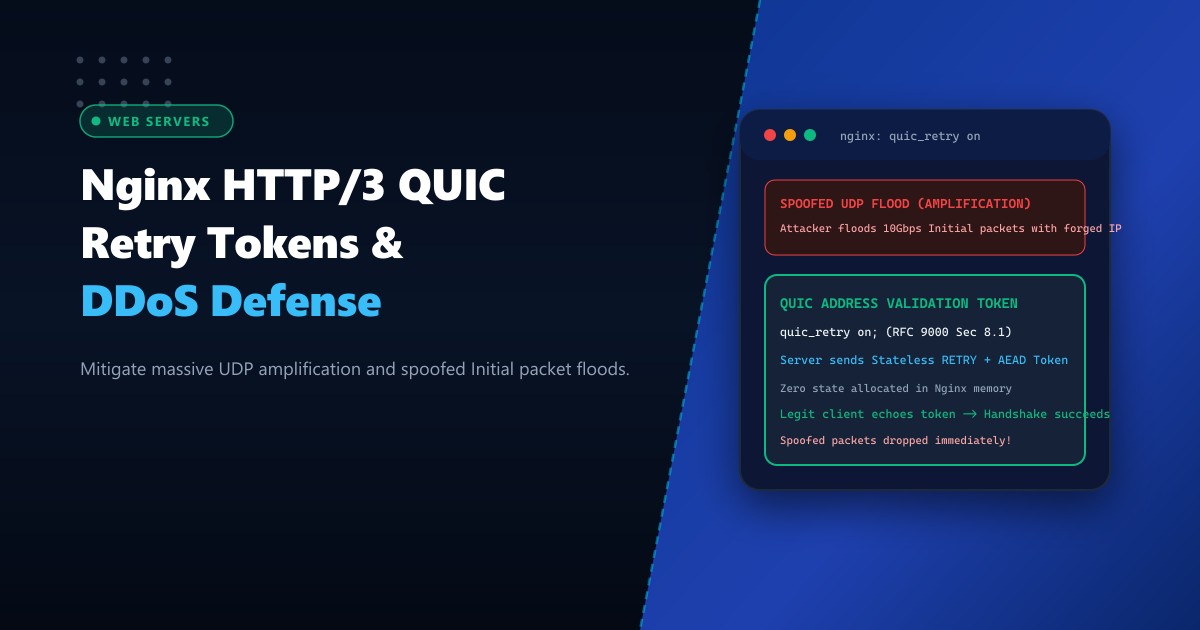
With the widespread adoption of HTTP/3 and QUIC across high-traffic media portals, e-commerce stores, and financial platforms in Pakistan, web servers have transitioned from traditional TCP-based connections to UDP datagrams. While UDP enables 0-RTT handshakes and eliminates head-of-line blocking, it introduces a dangerous attack vector: UDP source IP spoofing and amplification attacks.
In standard TCP, the 3-way handshake (SYN -> SYN/ACK -> ACK) guarantees that the client controls the source IP address before the server allocates resources. Under UDP-based QUIC, however, an attacker can transmit spoofed QUIC Initial packets with a victim’s IP address. If the web server responds with large cryptographic TLS handshake certificates (ServerHello, EncryptedExtensions, Certificate), the server acts as an unwitting DDoS amplifier, blasting amplified traffic back to the spoofed victim while exhausting its own outgoing bandwidth.
To prevent this exploit, RFC 9000 mandates Address Validation using Stateless Retry Packets (Retry Token). By enabling quic_retry on in Nginx, the web server requires incoming clients to prove ownership of their IP address before allocating any internal connection state or transmitting large certificate payloads.
Deploying on high-bandwidth Dedicated Servers with Nginx QUIC address validation ensures that high-volume Pakistani web clusters remain impervious to UDP reflection and amplification floods.
How QUIC Retry Tokens Prevent UDP Amplification Floods
Here is the exact protocol comparison between an unprotected QUIC handshake and the stateless Retry validation mechanism:
+-----------------------------------------------------------------------------------+
|               UNPROTECTED QUIC HANDSHAKE vs. QUIC RETRY VALIDATION                |
+-----------------------------------------------------------------------------------+
| 1. Unprotected QUIC Handshake (Vulnerable to UDP Amplification):                  |
|    Attacker (Spoofing Victim IP)                Nginx Web Server                  |
|       | --- QUIC Initial (1,200 bytes) -------> | (Allocates connection state)    |
|       |                                         | Sends massive TLS Certificate:  |
|       |                                         | 3x Amplification Factor!        |
|       |                                         | ====> Floods VICTIM at 10Gbps!  |
|                                                                                   |
| 2. Protected Flow with `quic_retry on` (RFC 9000 Sec 8.1):                         |
|    Attacker (Spoofing Victim IP)                Nginx Web Server                  |
|       | --- QUIC Initial (1,200 bytes) -------> | (Zero connection state created) |
|       |                                         | Computes encrypted AEAD Token   |
|       |                                         | <--- Sends stateless RETRY ---- |
|       |                                         |      (Token containing client IP)|
|    Victim receives RETRY: Ignores it (no connection pending). Handshake dropped!  |
|                                                                                   |
| 3. Legitimate Client Handshake:                                                   |
|    Legit Client                                 Nginx Web Server                  |
|       | --- QUIC Initial ---------------------> |                                 |
|       | <--- Sends stateless RETRY + Token --- |                                 |
|       | --- QUIC Initial + Valid Token -------> | (Validates cryptographic token) |
|       |                                         | Handshake proceeds securely!    |
+-----------------------------------------------------------------------------------+
Step 1: Verifying Nginx HTTP/3 & QUIC Module Support
Ensure your Nginx installation includes the native QUIC module (ngx_http_v3_module):
nginx -V 2>&1 | grep -o -- '--with-http_v3_module'If compiled with --with-http_v3_module, your server natively supports QUIC token generation and address validation.
Step 2: Configuring Nginx QUIC Retry & UDP Socket Hardening
Edit your production Nginx server configuration (/etc/nginx/conf.d/quic_security.conf):
# Configure upstream rate limits for UDP datagrams
limit_req_zone $binary_remote_addr zone=quic_limit:20m rate=100r/s;

server {
    # Listen on port 443 for both standard TCP and HTTP/3 QUIC (UDP)
    listen 443 ssl;
    listen 443 quic reuseport;
    listen [::]:443 ssl;
    listen [::]:443 quic reuseport;

    server_name nextgen.pk www.nextgen.pk;

    # SSL / TLS configuration (TLS 1.3 is mandatory for QUIC)
    ssl_certificate /etc/letsencrypt/live/nextgen.pk/fullchain.pem;
    ssl_certificate_key /etc/letsencrypt/live/nextgen.pk/privkey.pem;
    ssl_protocols TLSv1.3;

    # Announce HTTP/3 support to visiting browsers via Alt-Svc header
    add_header Alt-Svc 'h3=":443"; ma=86400';

    # 1. Enable QUIC Address Validation via Stateless Retry Packets
    # Enforces RFC 9000 Address Validation, blocking IP spoofing & reflection DDoS
    quic_retry on;

    # 2. Configure Anti-Amplification Limits
    # Limits server response size to 3x incoming datagram size until address is validated
    # (Enforced automatically by Nginx QUIC engine)

    # 3. Optimize QUIC GSO (Generic Segmentation Offload) for 10Gbps line rates
    quic_gso on;

    # 4. Limit active QUIC streams per connection to prevent resource exhaustion
    quic_active_connection_id_limit 4;

    location / {
        limit_req zone=quic_limit burst=200 nodelay;
        root /var/www/nextgen_html;
        index index.html;
    }
}
Test the configuration syntax and reload Nginx:
nginx -t
systemctl reload nginx
Step 3: Hardening Linux Kernel UDP Buffer Limits for High-Speed QUIC
Because QUIC operates entirely over UDP sockets, the Linux kernel’s default UDP receive and transmit buffers must be expanded to prevent packet drops during high-concurrency traffic surges:
Add to /etc/sysctl.d/99-quic-udp-tuning.conf:
# Increase maximum socket receive and send buffer sizes to 32MB
net.core.rmem_max = 33554432
net.core.wmem_max = 33554432
net.core.rmem_default = 1048576
net.core.wmem_default = 1048576

# Expand UDP socket memory pools (pages: min, default, max)
net.ipv4.udp_mem = 65536 131072 262144

# Expand maximum network device backlog for UDP queueing
net.core.netdev_max_backlog = 100000

# Enable BPF socket steering for multi-core QUIC thread affinity
net.core.bpf_jit_enable = 1
Apply immediately:
sysctl --systemStep 4: Validating Address Validation & Packet Inspections with tshark
Verify that Nginx is issuing stateless Retry packets to incoming QUIC handshakes:
# Capture incoming QUIC handshakes on UDP port 443
tshark -i eth0 -f "udp port 443" -Y "quic" -T fields \
  -e ip.src -e ip.dst -e quic.packet_length -e quic.header_form -e quic.long.packet_type
Output during a live connection handshake:
39.44.112.50   103.205.180.25   1200   1   Initial
103.205.180.25 39.44.112.50     180    1   Retry
39.44.112.50   103.205.180.25   1200   1   Initial
103.205.180.25 39.44.112.50     1250   1   Handshake
Observe the sequence:
- Client sends
Initial. - Nginx responds with a tiny 180-byte
Retrycontaining a cryptographically sealed token (zero server memory allocated). - Legitimate client echoes the token in its subsequent
Initialpacket. - Server verifies the token and completes the cryptographic handshake!
- Attackers attempting IP spoofing never receive the
Retrytoken, dropping their packets instantly before consuming server CPU or bandwidth!
Unyielding High-Bandwidth Web Infrastructure on NextGen Bare-Metal
Processing hundreds of thousands of UDP QUIC packets per second while performing real-time AEAD token cryptography requires unthrottled hardware offload engines and dedicated CPU registers. Virtualized cloud droplets frequently suffer packet drop bottlenecks at the vNIC hypervisor boundary under heavy UDP traffic.
Hosting on enterprise Dedicated Servers in Pakistan equips your web cluster with multi-queue 10Gbps/25Gbps hardware NICs featuring UDP RSS hash distribution, hardware GSO offloading, and carrier-grade DDoS shielding directly connected to PKIX.
Defend High-Traffic Web Portals with NextGen Dedicated Servers
Deliver ultra-fast HTTP/3 QUIC speeds, neutralize UDP amplification DDoS attacks, and achieve flawless web performance across Pakistan. NextGen dedicated servers provide dedicated enterprise hardware, unshared multi-gigabit bandwidth, and 24/7 technical administration.
Deploy Dedicated Servers in Pakistan