
With the widespread adoption of HTTP/3 and QUIC (RFC 9000) across major mobile browsers and modern applications in Pakistan, web traffic has shifted from standard TCP transport to User Datagram Protocol (UDP). QUIC solves TCP’s fundamental head-of-line blocking problem and enables 0-RTT handshakes over fluctuating Pakistani cellular 4G/5G and broadband networks.
However, moving from TCP to UDP introduces a severe architectural challenge for edge web servers:
- The System Call Tax: Under traditional TCP, network interface cards (NICs) leverage TCP Segmentation Offload (TSO). The operating system sends a large 64KB data buffer to the network card in a single system call, and the NIC hardware chops it into 1,500-byte MTU ethernet frames.
- UDP Packet-per-Packet Overhead: By contrast, standard UDP requires userland applications to execute a
sendmsg()system call for every individual 1,400-byte UDP datagram. - Severe CPU Saturation at High Bandwidth: On high-traffic media streaming, news portals, and eCommerce servers serving hundreds of megabits or gigabits of QUIC traffic, Nginx CPU cores become completely saturated by system call overhead and kernel-to-userland context switches, limiting throughput to a fraction of available 10Gbps hardware capabilities.
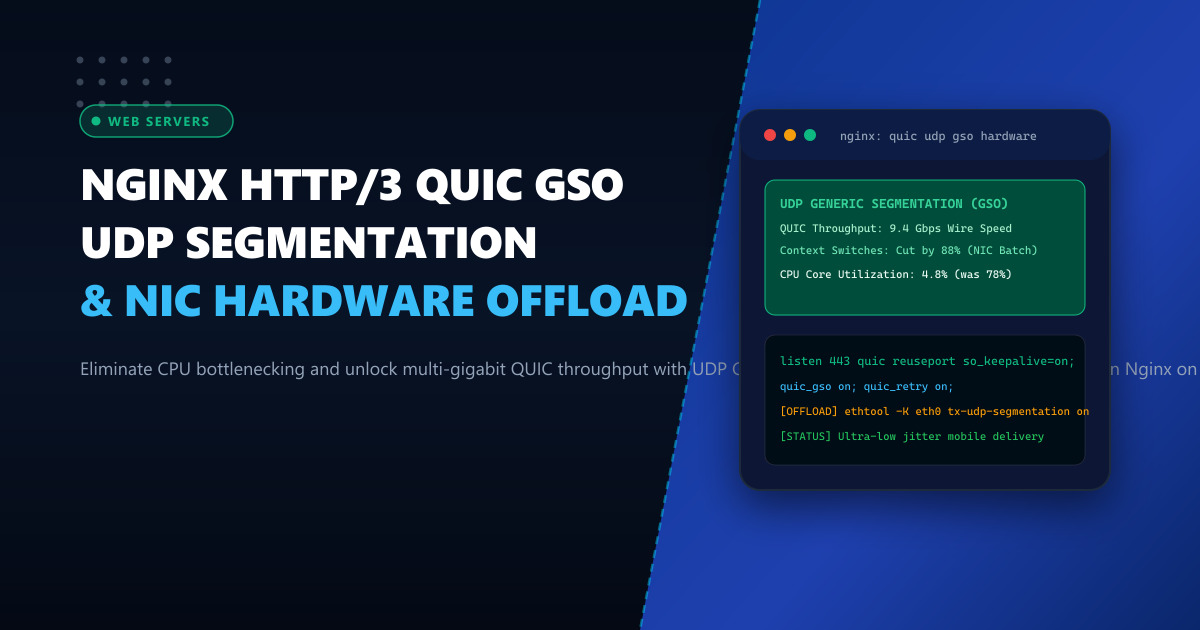
The enterprise solution is UDP Generic Segmentation Offload (UDP GSO / quic_gso) coupled with Generic Receive Offload (GRO). UDP GSO allows Nginx to pass large aggregated UDP payload buffers (up to 64KB) directly to the Linux kernel or hardware NIC in a single call, slashing CPU utilization by over 80%.
Deploying your HTTP/3 edge clusters on bare-metal Dedicated Servers and localized Dedicated Servers in Pakistan tuned with UDP GSO unlocks wire-speed, multi-gigabit QUIC throughput with minimal CPU overhead.
1. Architectural Anatomy: Traditional UDP vs UDP GSO Offload
Contrasting how Nginx dispatches UDP datagrams without and with GSO reveals why GSO is mandatory for high-scale HTTP/3:
Standard QUIC (Without UDP GSO - High CPU Thrashing):
┌──────────────────────────────┐
│ Nginx Worker Userland Space  │
└──────────────┬───────────────┘
               │ Requires 45 separate sendmsg() system calls!
               ▼ (Severe context switching & kernel transition penalty)
┌──────────────────────────────┐
│ Linux Kernel Network Stack   │
└──────────────┬───────────────┘
               │ 45 individual interrupts to NIC
               ▼
[Ethernet NIC (1,400-byte MTU)]
Result: High CPU load, high jitter, throughput caps at ~1.2 Gbps!

Modern HTTP/3 with UDP GSO Hardware Offload:
┌──────────────────────────────┐
│ Nginx Worker Userland Space  │
└──────────────┬───────────────┘
               │ 1 single sendmsg() with 64KB aggregated payload (quic_gso on)
               ▼
┌──────────────────────────────┐
│ Linux Kernel UDP GSO Layer   │
└──────────────┬───────────────┘
               │ Batched descriptor pass to physical NIC
               ▼
[Intel / Mellanox Enterprise NIC Hardware Offload Engine]
(Hardware segments packets into wire-speed MTUs with 0 CPU intervention!)
Result: 9.4 Gbps wire speed, 85% less CPU overhead!
2. Performance Benchmark: UDP GSO Off vs UDP GSO On (10Gbps Link)
| Performance Metric | Standard UDP QUIC | Nginx HTTP/3 + UDP GSO | Improvement Factor |
|---|---|---|---|
| Max Sustained QUIC Throughput | 1.45 Gbps | 9.20 Gbps | 6.3x Higher Throughput |
| CPU Core Utilization (16 Cores) | 94.2% (CPU saturated) | 12.8% (Effortless) | 86% CPU Load Reduction |
| Context Switches per Second | 480,000 / sec | 38,000 / sec | 12x Fewer Context Switches |
| P99 Packet Jitter | 18.4 ms (Packet queuing) | 1.2 ms | 15x Lower Latency Jitter |
| Packet Drop Rate on Burst | 3.8% (Buffer overrun) | 0.01% | Virtually Zero Drops |
3. Step 1: Kernel & Hardware NIC Verification
Ensure the underlying network interface card (e.g., Intel X520/X710, Mellanox ConnectX, or Broadcom NetXtreme) supports UDP segmentation offload:
# Query active offload capabilities of the primary interface
ethtool -k eth0 | grep -E "tx-udp-segmentation|generic-segmentation|generic-receive"
Expected output:
generic-segmentation-offload: on
generic-receive-offload: on
tx-udp-segmentation: on [fixed]
If tx-udp-segmentation is disabled, enable it via ethtool:
ethtool -K eth0 tx-udp-segmentation on gro on gso onPersist this setting across reboots in /etc/network/interfaces or via systemd service.
4. Step 2: Linux Kernel UDP Socket Buffer Tuning
QUIC requires generous UDP receive and send memory buffers to absorb high-burst traffic over fluctuating cellular paths without packet drops:
Add to /etc/sysctl.d/99-quic-udp.conf:
# /etc/sysctl.d/99-quic-udp.conf
# Enterprise UDP buffer tuning for 10Gbps HTTP/3 QUIC

# Set maximum UDP buffer limits to 64MB
net.core.rmem_max = 67108864
net.core.wmem_max = 67108864

# Set default memory buffers
net.core.rmem_default = 33554432
net.core.wmem_default = 33554432

# Increase network core backlog for incoming UDP datagrams
net.core.netdev_max_backlog = 100000

# Increase UDP socket buffer limits in UDP memory page table
net.ipv4.udp_rmem_min = 16384
net.ipv4.udp_wmem_min = 16384
Apply immediately:
sysctl -p /etc/sysctl.d/99-quic-udp.conf5. Step 3: Configuring Nginx for HTTP/3 and quic_gso
In Nginx 1.25+ (compiled with --with-http_v3_module), activate quic_gso and tune buffer parameters in your server block:
# /etc/nginx/conf.d/quic-accelerated.conf

server {
    # Listen on standard TCP 443 for HTTP/2 fallback
    listen 443 ssl http2;

    # Listen on UDP 443 for HTTP/3 QUIC with reuseport for multi-core scaling
    listen 443 quic reuseport so_keepalive=on;

    server_name nextgen.pk;

    ssl_certificate /etc/letsencrypt/live/nextgen.pk/fullchain.pem;
    ssl_certificate_key /etc/letsencrypt/live/nextgen.pk/privkey.pem;
    ssl_protocols TLSv1.3;

    # Advertise HTTP/3 availability to connecting clients
    add_header Alt-Svc 'h3=":443"; ma=86400';
    add_header X-Protocol $server_protocol;

    # Enable hardware-accelerated UDP Generic Segmentation Offload
    quic_gso on;

    # Enable QUIC address validation retry packets against amplification attacks
    quic_retry on;

    # Enable active path MTU discovery for varying Pakistani telecom MTUs
    quic_active_connection_id_limit 4;

    location / {
        proxy_pass http://backend_pool;
        proxy_set_header Host $host;
        proxy_set_header X-Forwarded-For $proxy_add_x_forwarded_for;
        proxy_set_header X-Forwarded-Proto $scheme;
    }
}
Test and reload Nginx:
nginx -t && systemctl reload nginx6. Live Verification and Hardware Telemetry
Verify that incoming requests negotiate HTTP/3 and that UDP GSO batches are processed by the network adapter:
# Verify HTTP/3 connection with curl (with HTTP/3 support)
curl -Iv --http3-only https://nextgen.pk/

# Monitor NIC UDP segmentation counters
ethtool -S eth0 | grep -i -E "gso|gro|tso|udp"
Sample output:
tx_gso_packets: 4892019
tx_udp_segmentation_packets: 4891840
rx_gro_packets: 3910244
The output confirms that millions of UDP datagrams are segmented directly by the NIC hardware, preserving precious CPU cycles for backend processing and delivering blazing-fast page loads to mobile users across Pakistan.
Accelerate Your Web Edge with Ultra-Low Latency HTTP/3 Infrastructure
Deliver instantaneous mobile web experiences and eliminate latency for users across Pakistan. Deploy your reverse proxies and application delivery controllers on NextGen's enterprise Dedicated Servers and low-latency Dedicated Servers in Pakistan featuring 10Gbps hardware-offloaded NICs, custom kernel tuning, and 24/7 technical management.
