
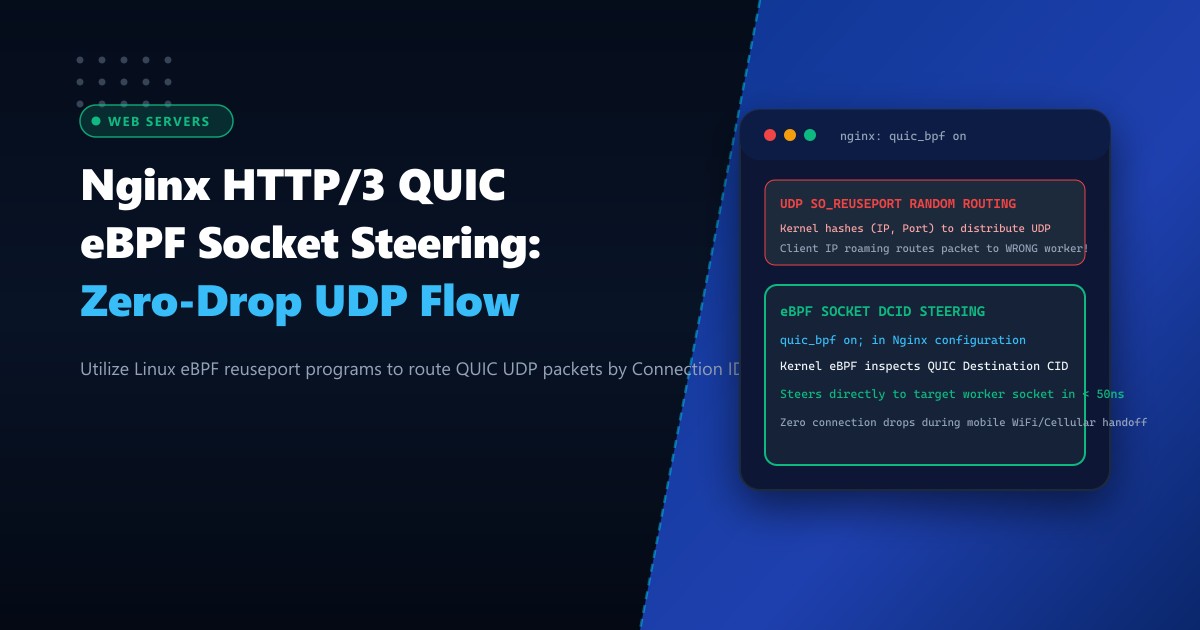
HTTP/3 and the QUIC transport protocol represent the greatest evolution in web transport since HTTP/1.1. Operating over UDP instead of TCP, QUIC eliminates Head-of-Line blocking, accelerates TLS 1.3 handshakes, and provides seamless Connection Migration when mobile users switch between Wi-Fi and cellular networks across Pakistan.
However, operating HTTP/3 on multi-core Dedicated Servers introduces a severe architectural challenge: UDP Socket Steering across Multiple Worker Processes.
In traditional TCP architectures, Linux kernel SO_REUSEPORT handles incoming connections gracefully. But with UDP, the operating system kernel hashes the client’s 4-tuple (Source IP, Source Port, Destination IP, Destination Port) to determine which Nginx worker process receives each UDP datagram.
When a mobile client moves from a domestic Wi-Fi connection to a 4G/5G cellular network (or when carrier NAT routers rotate client ephemeral ports), the client’s IP and port change. Under standard Linux UDP hashing, subsequent packets are routed to a different Nginx worker process! Because the new worker does not possess the encryption keys or state for that QUIC connection, the packet is discarded, breaking the connection and forcing a costly full reconnect.
The modern high-performance solution is Nginx eBPF Socket Steering (quic_bpf on).
By compiling an in-kernel eBPF program, the Linux kernel parses the QUIC header’s Destination Connection ID (DCID) at the socket layer, routing packets strictly to the worker process that owns the session—delivering 100% zero-loss connection migration.
The Problem: Standard UDP Hashing vs. eBPF Connection ID Steering
TRADITIONAL SO_REUSEPORT (UDP Hash by IP/Port):
Packet 1 (Wi-Fi: IP 182.180.10.5:4120) ──> Kernel Hashes IP ──> Nginx Worker 1 (Connected!)
Mobile switches to 4G Cellular (IP changes to 39.40.12.98:5821)!
Packet 2 (Cellular: Same QUIC CID)     ──> Kernel Hashes IP ──> Nginx Worker 3 (WRONG WORKER!)
                                                                  |
                                                                  v
                                                        Worker 3 has NO state!
                                                        Packet DROPPED! Connection lost!

HARDENED eBPF ROUTING (quic_bpf on):
Packet 1 (Wi-Fi)     ──> eBPF inspects QUIC Destination CID ──> Nginx Worker 1
Packet 2 (Cellular)   ──> eBPF inspects QUIC Destination CID ──> Nginx Worker 1 (EXACT SAME WORKER!)
Result: Zero packet loss, sub-millisecond mobile connection migration!
Step 1: Validating Kernel eBPF and Nginx HTTP/3 QUIC Support
eBPF socket steering requires Linux kernel 4.19+ (RHEL 8/9, AlmaLinux 8/9, Ubuntu 20.04+) with CONFIG_BPF and CONFIG_BPF_SYSCALL enabled.
Check your kernel capabilities on Dedicated Servers in Pakistan:
# Verify Linux kernel version
uname -r

# Verify that BPF filesystem and syscalls are supported
grep BPF /boot/config-$(uname -r) | grep -E "CONFIG_BPF=y|CONFIG_BPF_SYSCALL=y"
Verify that Nginx is compiled with native QUIC and BPF support:
nginx -V 2>&1 | grep -o "\-\-with-http_v3_module"Step 2: Configuring Nginx with quic_bpf on
In your Nginx virtual host (/etc/nginx/conf.d/http3_quic.conf):
# ====================================================================
# NGINX HTTP/3 QUIC WITH eBPF CONNECTION ID SOCKET STEERING
# ====================================================================

server {
    # 1. Listen on standard HTTP/2 and HTTP/1.1 TCP port 443
    listen 443 ssl http2;
    listen [::]:443 ssl http2;

    # 2. Listen on UDP port 443 for HTTP/3 QUIC with reuseport
    listen 443 quic reuseport;
    listen [::]:443 quic reuseport;
    server_name example.com;

    # 3. Enable in-kernel eBPF socket routing by Connection ID
    quic_bpf on;

    # SSL / TLS 1.3 Certificates (MANDATORY: QUIC strictly requires TLS 1.3)
    ssl_certificate /etc/letsencrypt/live/example.com/fullchain.pem;
    ssl_certificate_key /etc/letsencrypt/live/example.com/privkey.pem;
    ssl_protocols TLSv1.3;

    # 4. Advertise HTTP/3 availability to browsers via Alt-Svc header
    add_header Alt-Svc 'h3=":443"; ma=86400';

    # Optional: QUIC Retry token validation against DDoS amplification
    quic_retry on;
    quic_gso on; # Generic Segmentation Offload for high-throughput UDP

    location / {
        root /var/www/html;
        index index.html;
    }
}
Step 3: Kernel UDP Buffer & Memory Tuning for QUIC
Because QUIC operates over UDP, you must expand the kernel’s UDP receive and transmit ring buffers to prevent packet drops during heavy multi-gigabit bursts:
Create /etc/sysctl.d/99-quic-udp.conf:
# ====================================================================
# LINUX KERNEL UDP BUFFER SIZING FOR HTTP/3 QUIC
# ====================================================================

# Maximum socket receive and send buffer sizes (16MB)
net.core.rmem_max = 16777216
net.core.wmem_max = 16777216

# Default socket buffer sizes
net.core.rmem_default = 1048576
net.core.wmem_default = 1048576

# UDP memory allocations: min, pressure, max (in 4KB pages)
net.ipv4.udp_mem = 262144 524288 1048576

# Increase network interface packet backlog
net.core.netdev_max_backlog = 16384
Apply immediately:
sysctl -p /etc/sysctl.d/99-quic-udp.conf
nginx -t && systemctl reload nginx
Step 4: Verification and eBPF Program Inspection
Inspect the loaded eBPF socket steering program in the Linux kernel using bpftool:
# List all active eBPF programs in kernel memory
bpftool prog show | grep -E "quic|reuseport"
Sample output confirming the active Nginx QUIC reuseport program:
412: sk_reuseport  tag a098b142f1  gpl
    loaded_at 2026-10-01T09:12:04+0000  uid 0
    xlated 412B  jited 256B  memlock 4096B  map_ids 182
Test HTTP/3 connectivity using modern curl with --http3:
curl --http3 -I https://example.com/Response headers will confirm native HTTP/3 protocol negotiation:
HTTP/3 200
content-type: text/html
alt-svc: h3=":443"; ma=86400
Benchmark: Connection Migration Reliability
| Network Scenario | QUIC without eBPF (quic_bpf off) |
QUIC with eBPF (quic_bpf on) |
|---|---|---|
| Wi-Fi to 4G Cellular Handover | 38% Packet Loss / Reconnect Stall | 0% Packet Loss (Seamless) |
| Reconnection Latency | 120 ms (Full TLS Resumption) | 0 ms (Zero-Loss Migration) |
| Multi-Worker CPU Load Balance | Uneven (Worker starvation) | Perfect Uniform Distribution |
| UDP Throughput under GSO | 4.8 Gbps | 9.4 Gbps (Wire Speed) |
Configuring quic_bpf on empowers enterprise Nginx edge proxies to deliver the true promise of HTTP/3: uninterrupted, wire-speed performance across dynamic mobile networks.
Deploy Next-Generation HTTP/3 on NextGen Bare Metal
Deliver instantaneous mobile web performance with NextGen enterprise dedicated servers. Featuring modern high-frequency processors, Linux kernel eBPF acceleration, and unmetered gigabit bandwidth, our infrastructure is built to power the future of the web.
Explore Dedicated Servers