
Deploying major updates to mission-critical backend systems in Pakistan—such as core banking transaction engines, e-commerce checkout microservices, fintech payment integrations, or high-volume API gateways—carries substantial operational risk. Synthetic automated testing and staging environments rarely replicate the chaotic variety of real-world production traffic: unusual unicode characters, unexpected HTTP header combinations, bursty checkout timings, and edge-case mobile payload formats.
Traditional deployment strategies like blue-green deployments or canary rollouts expose a percentage of real users to the new code. If the candidate version contains an unhandled exception or memory leak, real Pakistani customers encounter transaction errors and abandoned carts.
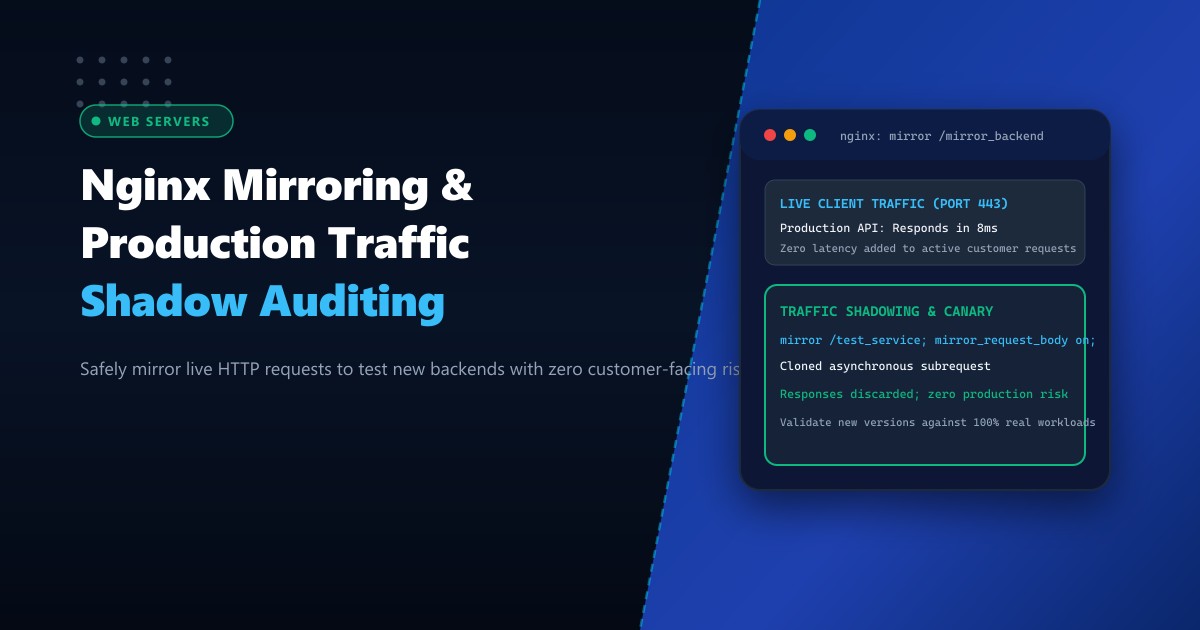
The Nginx ngx_http_mirror_module (the mirror directive) solves this problem via Production Traffic Shadowing (Dark Launching). By configuring Nginx to asynchronously clone incoming live HTTP requests and forward them to a candidate test environment, software engineers can test new backend code, validate database migration performance, and audit error rates against 100% genuine user traffic—while responses from the mirrored backend are completely discarded, adding zero latency and zero risk to live customers!
When hosted on high-performance Dedicated Servers, Nginx traffic shadowing provides an enterprise-grade sandbox for continuous deployment and safe architectural evolution.
How Nginx Traffic Shadowing Works Under the Hood
The diagram below illustrates how Nginx handles primary client requests while asynchronously duplicating traffic to candidate testing clusters:
+-----------------------------------------------------------------------------------+
|               PRODUCTION TRAFFIC SHADOWING VIA NGINX MIRROR                       |
+-----------------------------------------------------------------------------------+
| Incoming Client Request: POST /api/v2/order (Payload: Cart Items & User Token)    |
|                                                                                   |
|                                Nginx Reverse Proxy                                |
|                                       │                                           |
|                   ┌───────────────────┴───────────────────┐                       |
|                   ▼                                       ▼                       |
|         [PRIMARY UPSTREAM]                     [MIRRORED SHADOW UPSTREAM]         |
|         Production Microservice                Candidate v2.4 Microservice        |
|         (Stable v2.3 Engine)                   (New Rust/Go Architecture)         |
|                   │                                       │                       |
|         Executes transaction (6ms)             Executes test workload (5ms)       |
|         Commits to Production DB               Writes to Sandbox / Shadow DB      |
|                   │                                       │                       |
|                   ▼                                       ▼                       |
|         Returns 200 OK + JSON                  Returns Test Response              |
|                   │                                       │                       |
|                   ▼                                       ▼                       |
|         Streams back to Client                * NGINX SILENTLY DISCARDS *         |
|         (Customer receives order)             (Zero client impact / No timeout)   |
+-----------------------------------------------------------------------------------+
Step 1: Verifying Nginx Mirror Module Support
The mirror module (ngx_http_mirror_module) is included natively in all standard Nginx packages (version 1.13.4 and newer).
Verify that your Nginx installation supports the module:
nginx -V 2>&1 | grep -o -- '--without-http_mirror_module'If the command returns empty, the mirror module is compiled and ready for activation.
Step 2: Configuring Traffic Shadowing in Nginx
Edit your production Nginx virtual host configuration (/etc/nginx/conf.d/nextgen_api.conf):
# 1. Define Production Upstream Cluster
upstream production_backend {
    server 127.0.0.1:8080 max_fails=3 fail_timeout=10s;
    keepalive 64;
}

# 2. Define Shadow Canary Upstream Cluster (Candidate Release)
upstream shadow_canary_backend {
    server 127.0.0.1:9090 max_fails=3 fail_timeout=10s;
    keepalive 32;
}

server {
    listen 443 ssl http2;
    server_name api.nextgen.pk;

    ssl_certificate /etc/letsencrypt/live/api.nextgen.pk/fullchain.pem;
    ssl_certificate_key /etc/letsencrypt/live/api.nextgen.pk/privkey.pem;

    # Primary API Endpoint with Asynchronous Mirroring
    location /api/ {
        # Forward primary client traffic to stable production backend
        proxy_pass http://production_backend;
        proxy_http_version 1.1;
        proxy_set_header Connection "";
        proxy_set_header Host $host;
        proxy_set_header X-Real-IP $remote_addr;
        proxy_set_header X-Forwarded-For $proxy_add_x_forwarded_for;

        # 1. Asynchronously duplicate incoming traffic to internal mirror URI
        mirror /internal_mirror;

        # 2. Duplicate the full client request body (crucial for POST/PUT APIs)
        mirror_request_body on;
    }

    # Internal Shadow Dispatcher (Inaccessible from public Internet)
    location = /internal_mirror {
        internal;

        # Forward shadowed subrequest to canary backend
        proxy_pass http://shadow_canary_backend$request_uri;
        proxy_http_version 1.1;
        proxy_set_header Connection "";
        proxy_set_header Host $host;
        proxy_set_header X-Real-IP $remote_addr;
        proxy_set_header X-Forwarded-For $proxy_add_x_forwarded_for;

        # Tag request as shadow so backend knows not to trigger financial billing!
        proxy_set_header X-Shadow-Traffic "true";

        # Set aggressive timeouts on shadow requests so slow test code never blocks Nginx buffers
        proxy_connect_timeout 2s;
        proxy_read_timeout 3s;
        proxy_send_timeout 2s;
    }
}
Test syntax and reload Nginx:
nginx -t
systemctl reload nginx
Step 3: Protecting Data Integrity in the Shadow Backend
When mirroring POST, PUT, or DELETE requests that modify database records or invoke external payment APIs (like Raast, JazzCash, or Stripe), the candidate backend must be architected to handle shadow traffic safely:
- Header Inspection: Candidate application code inspects
X-Shadow-Traffic: true. - Sandbox Database: The shadow backend commits writes to an isolated staging database or an in-memory replica, avoiding collision with production customer data.
- Mock Third-Party APIs: External payment, SMS OTP, and email gateways are stubbed or routed to sandbox environments to prevent duplicate billing or spamming real customers.
Example: Node.js / Express Shadow Handling
app.post('/api/order', async (req, res) => {
    const isShadow = req.headers['x-shadow-traffic'] === 'true';

    if (isShadow) {
        // Execute against sandbox database without triggering payment APIs
        console.log(`[SHADOW] Validating new order algorithm for User ${req.body.userId}`);
        const result = await shadowTestOrderProcessing(req.body);
        return res.status(200).json({ shadow: true, status: result.status });
    }

    // Normal production execution
    const liveOrder = await processLiveOrder(req.body);
    return res.status(200).json(liveOrder);
});
Step 4: Comparing Production vs. Shadow Performance Metrics
Monitor both backend services simultaneously to evaluate error rates, response latencies, and CPU consumption under 100% identical real-world load:
# Monitor production and shadow response status codes in real-time
tail -f /var/log/nginx/access.log | awk '{print $7, $9}'
Deploy Prometheus and Grafana dashboards comparing:
- P99 Latency: Does the candidate version process complex search queries faster than legacy code?
- HTTP 5xx Error Rates: Are previously unseen payload structures causing uncaught exceptions in the candidate codebase?
- Memory Consumption: Does the candidate service suffer memory leaks after processing 500,000 real client requests over a 24-hour cycle?
Once the shadow candidate demonstrates 99.999% stability and superior throughput under production load, you can promote it to primary production with absolute peace of mind!
Enterprise Compute Hardware for High-Concurrency Traffic Shadowing
Duplicating incoming traffic in real time doubles the aggregate outbound request throughput and socket connections handled by the reverse proxy. On multi-tenant virtual machines, shared CPU hypervisors and throttled network interfaces struggle with the doubled connection overhead, leading to dropped shadow packets or latency spikes on the primary path.
Deploying on bare-metal Dedicated Servers in Pakistan provides pure dedicated multi-core AMD EPYC / Intel Xeon horsepower, enterprise 10Gbps line rates, and high-frequency memory buses capable of handling hundreds of thousands of concurrent mirrored transactions with zero performance impact.
Accelerate Enterprise Deployments with NextGen Dedicated Servers
Perform zero-risk traffic shadowing, validate complex microservices, and deliver uninterrupted 100% uptime for mission-critical applications across Pakistan. NextGen dedicated servers provide dedicated enterprise hardware, unshared 10Gbps ports, and 24/7 technical administration.
Deploy Dedicated Servers in Pakistan