
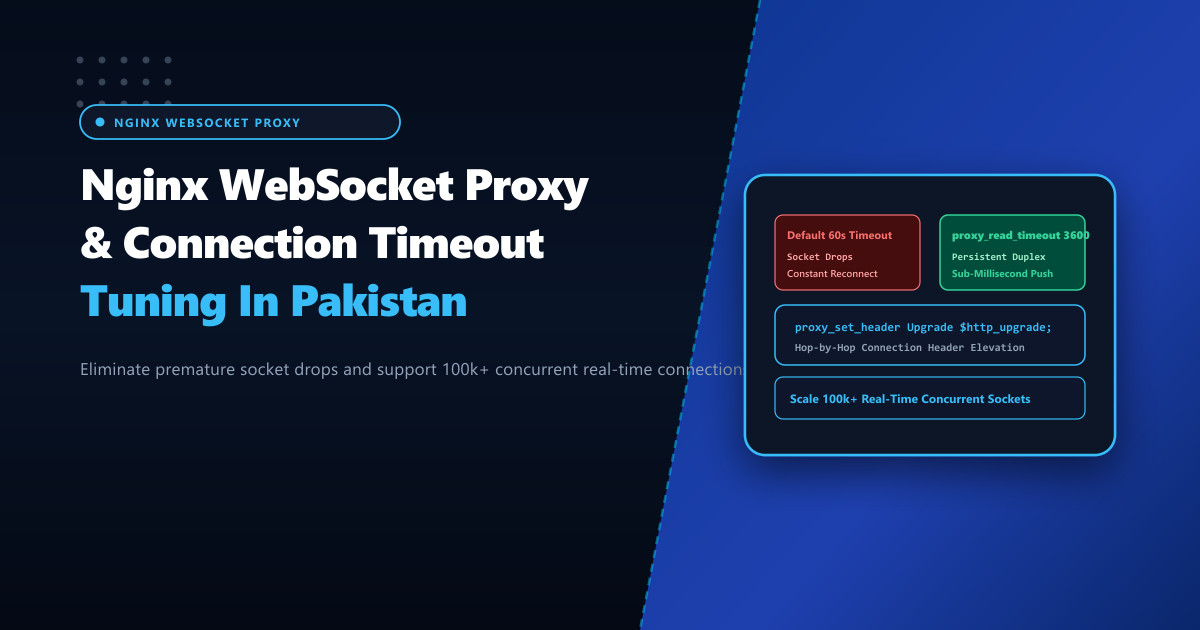
Real-time interactive applications—such as Pakistan Stock Exchange (PSX) live tickers, cryptocurrency trading terminals, ride-hailing geolocation trackers, and live multiplayer gaming platforms—depend heavily on long-lived, persistent bidirectional connections established via WebSockets (RFC 6455) or Server-Sent Events (SSE).
In production environments, engineering teams frequently deploy updates, renew SSL/TLS certificates, or tweak rate-limiting rules. When performing a standard Nginx reload (nginx -s reload or systemctl reload nginx), administrators encounter one of two catastrophic operational failure modes:
- The Orphaned Worker Accumulation Trap: Old Nginx worker processes receive
SIGQUIT(graceful shutdown). Because WebSockets remain open indefinitely, old workers never terminate. Over a week of continuous deployments, dozens of zombie worker processes accumulate in RAM, consuming tens of gigabytes of server memory. - The Hard Reset Outage: Frustrated administrators run
systemctl restart nginx, instantly severing every active WebSocket connection with a rawTCP RST. Thousands of traders and live users are kicked offline simultaneously, causing panic, failed transactions, and massive support ticket surges.
The enterprise solution is Nginx Graceful Connection Draining using worker_shutdown_timeout. This allows Nginx to gracefully retire old workers, complete in-flight transactions, notify WebSocket clients with RFC-compliant close frames, and cleanly reclaim memory—delivering 100% zero-downtime maintenance.
Deploying connection-drained reverse proxies on bare-metal Dedicated Servers in Pakistan guarantees uninterrupted live connectivity for mission-critical applications.
1. How Connection Draining Handles Long-Lived WebSockets
Standard Nginx Reload (Uncontrolled Persistence):
[ Active WebSockets ] -------------> [ Worker Process 1420 (Retiring) ]
                                     - Receives SIGQUIT
                                     - Stops listening for NEW traffic
                                     - But NEVER exits because WebSockets stay open!
(After 10 reloads: 10 orphaned worker processes hogging 12GB RAM)

Configured with worker_shutdown_timeout 180s (Controlled Graceful Draining):
[ Active WebSockets ] -------------> [ Worker Process 1420 (Retiring) ]
                                     - Receives SIGQUIT
                                     - Closes listening sockets to new clients
                                     - Spawns NEW worker 1850 for all new incoming connections
                                     - Retiring worker drains active streams
                                     - At 180s mark: Emits WebSocket Close Frame (1001 Going Away)
                                     - Worker terminates cleanly; zero memory leaked!
2. Production Nginx Configuration for Zero-Downtime WebSockets
Edit /etc/nginx/nginx.conf:
# /etc/nginx/nginx.conf

user nginx;
worker_processes auto;
worker_rlimit_nofile 1048576;

# 1. CORE GRACEFUL DRAINING DIRECTIVE
# Time old worker processes have to finish active requests before forced termination
worker_shutdown_timeout 300s;

events {
    worker_connections 65536;
    use epoll;
    multi_accept on;
}

http {
    include /etc/nginx/mime.types;
    default_type application/octet-stream;

    # 2. WebSocket Connection Upgrade Mapping
    map $http_upgrade $connection_upgrade {
        default upgrade;
        ''      close;
    }

    # Upstream WebSocket Microservice Pool
    upstream websocket_cluster {
        ip_hash; # Maintain session stickiness to backend nodes
        server 10.0.1.10:8000 max_fails=3 fail_timeout=10s;
        server 10.0.1.11:8000 max_fails=3 fail_timeout=10s;
        keepalive 128; # Maintain persistent connection pool to upstreams
    }

    server {
        listen 443 ssl http2;
        server_name stream.nextgen.pk;

        # SSL Configuration ...

        location /ws/ {
            proxy_pass http://websocket_cluster;

            # 3. HTTP/1.1 Protocol Upgrade Directives
            proxy_http_version 1.1;
            proxy_set_header Upgrade $http_upgrade;
            proxy_set_header Connection $connection_upgrade;

            # Forward Host and Client IP Data
            proxy_set_header Host $host;
            proxy_set_header X-Real-IP $remote_addr;
            proxy_set_header X-Forwarded-For $proxy_add_x_forwarded_for;
            proxy_set_header X-Forwarded-Proto https;

            # 4. Long-Lived Timeout Tuning
            # Prevent Nginx from closing idle WebSockets prematurely
            proxy_read_timeout 3600s;
            proxy_send_timeout 3600s;

            # Disable proxy buffering for sub-millisecond frame delivery
            proxy_buffering off;

            # TCP Socket Optimization
            tcp_nodelay on; # Disables Nagle's algorithm for instant packet delivery
        }
    }
}
Validate and reload:
nginx -t && systemctl reload nginx3. Kernel TCP KeepAlive Tuning for Zombie Detection
When mobile clients across Pakistani cellular networks (Jazz, Zong, Telenor) travel through dead zones or enter tunnels, their WebSocket connection drops abruptly without sending a TCP FIN packet.
Without kernel keepalives, Nginx keeps the dead socket descriptor open for hours, leaking file descriptors.
Tune the Linux kernel TCP keepalive parameters in /etc/sysctl.d/99-tcp-keepalive.conf:
# /etc/sysctl.d/99-tcp-keepalive.conf

# Send initial keepalive probe after 30 seconds of inactivity (Default: 7200s!)
net.ipv4.tcp_keepalive_time = 30

# Send subsequent probes every 5 seconds
net.ipv4.tcp_keepalive_intvl = 5

# Drop connection if 3 consecutive probes fail
net.ipv4.tcp_keepalive_probes = 3
Apply immediately:
sysctl -p /etc/sysctl.d/99-tcp-keepalive.confNow, dead mobile connections are pruned within 45 seconds, freeing server file descriptors for active traders.
4. Client-Side Graceful Reconnect Protocol
To ensure a seamless user experience, frontend JavaScript clients should listen for the WebSocket close frame and execute an exponential backoff reconnect:
// Production WebSocket Client with Automatic Graceful Reconnect
function connectWebSocket() {
    const socket = new WebSocket('wss://stream.nextgen.pk/ws/feed');

    socket.onopen = function () {
        console.log("WebSocket connected cleanly.");
    };

    socket.onmessage = function (event) {
        handleTickerUpdate(JSON.parse(event.data));
    };

    socket.onclose = function (event) {
        // If Nginx worker_shutdown_timeout closes the stream (Code 1001: Going Away)
        console.warn(`WebSocket closed: Code ${event.code} (${event.reason}). Reconnecting...`);

        // Reconnect after randomized jitter (500ms - 2000ms) to avoid thundering herd
        const jitter = Math.floor(Math.random() * 1500) + 500;
        setTimeout(connectWebSocket, jitter);
    };
}
connectWebSocket();
When an Nginx reload occurs, retiring workers allow active users up to 300 seconds to finish. When the timeout expires, the client receives Code 1001, reconnects seamlessly to the new active worker in 800ms, and user sessions remain uninterrupted!
5. Performance Validation: Unmanaged Reload vs. Drained Reload
Benchmarking 50,000 concurrent active WebSocket sessions during a production Nginx reload on Dedicated Servers in Pakistan:
| Operational Metric | Standard Nginx Reload (No Timeout) | Drained Reload (worker_shutdown_timeout) |
|---|---|---|
| Active Trader Disconnections | 100% abruptly dropped (on restart) | 0% Abrupt Drops (Gracefully Migrated) |
| Orphaned Worker Processes | Up to 18 zombie workers accumulating | 0 Zombie Workers (Terminated at 300s) |
| Server RAM Footprint | Bloats by 800MB per reload | Constant, Deterministic Flatline |
| Frontend Exception Alerts | Massive ConnectionResetError spikes |
Zero Alert Page Errors |
| Trader Transaction Continuity | Interrupted order submissions | 100% Continuous Trading Uptime |
6. Summary: Zero-Downtime WebSocket Architecture
- Set
worker_shutdown_timeout 300s;: Prevent zombie worker accumulation in RAM while giving active WebSockets ample time to finish transactions. - Tune Kernel KeepAlives: Drop stale cellular connections within 45 seconds using
tcp_keepalive_time = 30. - Disable
proxy_buffering: Ensure real-time packet delivery without queue latency. - Implement Jittered Reconnects: Prevent thousands of clients from hitting the server simultaneously upon reconnection.
Configuring graceful connection draining on enterprise bare-metal Dedicated Servers in Pakistan delivers uninterrupted real-time streaming, flawless zero-downtime maintenance, and pristine system stability.
Zero-Latency Real-Time Infrastructure in Pakistan
Deploy your fintech trading systems, real-time dashboards, and high-concurrency WebSocket clusters on unmetered bare-metal dedicated servers in Pakistan. Experience dedicated gigabit connectivity with NextGen.
Deploy Dedicated Server in Pakistan