
In modern enterprise architectures, edge load balancers often front a diverse array of backend services: Kubernetes ingress controllers, legacy Windows Exchange servers, third-party SaaS appliances, and proprietary encrypted TCP endpoints. In a traditional Layer 7 reverse proxy configuration, the edge proxy must terminate TLS, decrypt the payload, read HTTP headers, and re-encrypt the traffic before forwarding it upstream.
This traditional approach introduces severe operational liabilities:
- Certificate Management Complexity: The edge proxy must store the private keys and SSL certificates for every single domain and backend system, violating end-to-end security compliance.
- Massive CPU Overhead: Symmetric and asymmetric cryptographic handshakes consume enormous CPU cycles, limiting proxy throughput to tens of thousands of requests per second.
- Incompatibility with Non-HTTP Protocols: Custom encrypted protocols (such as proprietary financial feeds, database wire encryption, or secure IoT telemetry) cannot be parsed by standard HTTP modules.
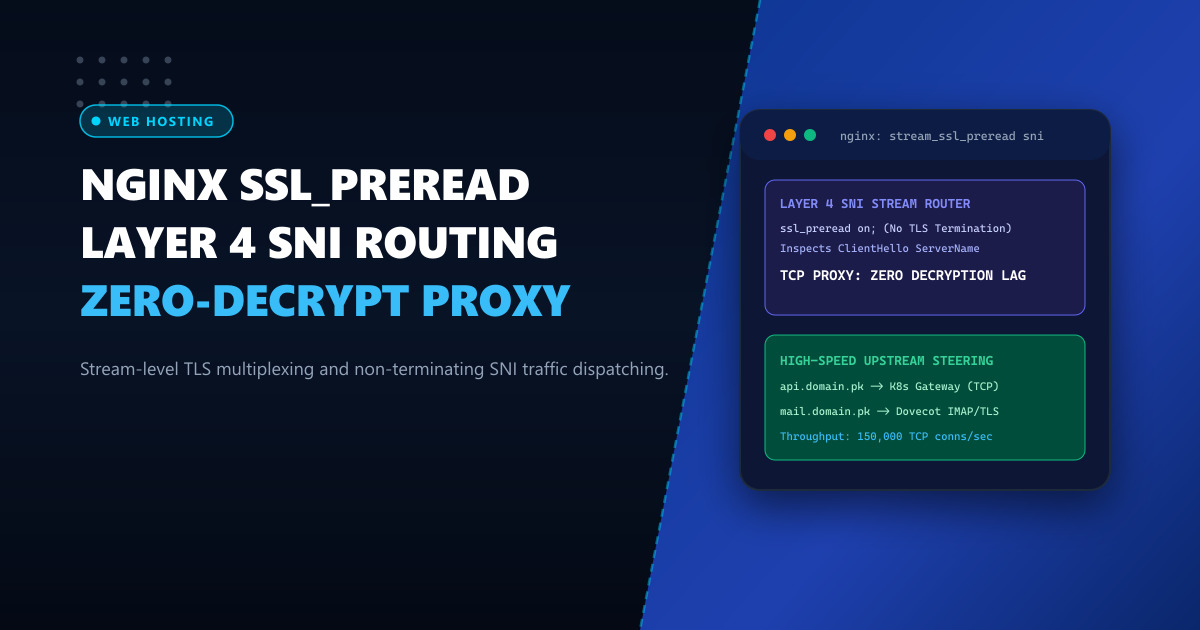
Nginx solves this challenge via Layer 4 stream proxying with the ngx_stream_ssl_preread_module. By inspecting the initial unencrypted TLS ClientHello packet, Nginx extracts the Server Name Indication (SNI) hostname and dispatches raw TCP streams directly to the appropriate backend without terminating or decrypting the TLS session.
In this guide, we configure high-throughput Layer 4 SNI routing, implement health checks, and optimize TCP stream buffers on enterprise Nginx instances in Pakistan.
The Architecture: Layer 7 Decrypt vs Layer 4 SNI Preread
Layer 7 Proxy (Heavy Decryption & Re-encryption):
Client ──[TLS 1.3]──▶ [ Nginx (Terminates TLS, High CPU) ] ──[New TLS]──▶ Backend

Layer 4 SNI Preread Proxy (Zero Decryption, Line-Rate TCP Stream):
Client ──[TLS 1.3]──▶ [ Nginx (Peeks at ClientHello SNI only) ]
                             │  Routes raw TCP stream
                             ▼
                    [ Target Backend Server ]
                    (Decrypts end-to-end with zero intermediary key exposure!)
With ssl_preread on:
- Nginx does not need SSL certificates or private keys on the edge proxy.
- End-to-end encryption is preserved from the client browser directly to the origin server.
- Proxying happens at raw TCP wire speed with sub-microsecond latency.
Deploying high-concurrency Layer 4 gateways on bare-metal Dedicated Servers provides the dedicated memory bandwidth and raw network interface packet throughput needed to route hundreds of thousands of concurrent TCP sessions.
Step 1: Configuring Nginx Stream Module with ssl_preread
The stream {} block operates at the same root level as http {} inside /etc/nginx/nginx.conf:
user nginx;
worker_processes auto;
worker_rlimit_nofile 262144;

events {
    worker_connections 65535;
    use epoll;
    multi_accept on;
}

# Root-level stream configuration for Layer 4 TCP/UDP routing
stream {
    # Logging format for stream connections
    log_format stream_sni '$remote_addr [$time_local] '
                          '$protocol $status $bytes_sent $bytes_received '
                          '$session_time "$ssl_preread_server_name" '
                          'upstream: $upstream_addr';

    access_log /var/log/nginx/stream_access.log stream_sni;
    error_log /var/log/nginx/stream_error.log info;

    # Map SNI hostnames to backend upstream clusters
    map $ssl_preread_server_name $target_backend {
        # Routing table
        portal.enterprise.com.pk    backend_portal;
        k8s.enterprise.com.pk       backend_kubernetes;
        mail.enterprise.com.pk      backend_exchange_mail;
        db-secure.enterprise.com.pk backend_postgres_tls;
        default                     backend_fallback;
    }

    # Upstream clusters (Can be internal LAN IPs or VPN links)
    upstream backend_portal {
        server 10.0.1.10:443 max_fails=3 fail_timeout=10s;
        server 10.0.1.11:443 max_fails=3 fail_timeout=10s;
    }

    upstream backend_kubernetes {
        server 10.0.2.20:443;
        server 10.0.2.21:443;
    }

    upstream backend_exchange_mail {
        server 10.0.3.50:443;
    }

    upstream backend_postgres_tls {
        server 10.0.4.80:5432;
    }

    upstream backend_fallback {
        server 127.0.0.1:8443;
    }

    server {
        listen 443;
        listen [::]:443;

        # Peek into the TLS ClientHello without terminating encryption
        ssl_preread on;

        # Route the raw TCP connection based on extracted SNI
        proxy_pass $target_backend;

        # Buffer and timeout tuning
        proxy_buffer_size 16k;
        proxy_connect_timeout 3s;
        proxy_timeout 300s;

        # Preserve TCP socket flags for minimal latency
        tcp_nodelay on;
    }
}
Verify syntax and reload Nginx:
nginx -t && systemctl reload nginxStep 2: Testing SNI Routing with openssl & curl
To verify that Nginx routes different domain names to their designated backends while maintaining end-to-end TLS:
# Query the gateway passing explicit SNI hostnames
openssl s_client -connect 127.0.0.1:443 -servername portal.enterprise.com.pk </dev/null 2>&1 | grep -i "CN="
openssl s_client -connect 127.0.0.1:443 -servername k8s.enterprise.com.pk </dev/null 2>&1 | grep -i "CN="
Notice that each command retrieves the distinct, legitimate certificate directly from the backend server! The edge proxy handled the connection without storing any certificates.
Check the stream access log:
tail -n 5 /var/log/nginx/stream_access.logLog entry confirming SNI extraction:
182.180.144.20 [01/Oct/2026:12:45:10 +0500] TCP 200 4821 1420 0.082 "portal.enterprise.com.pk" upstream: 10.0.1.10:443Step 3: Preserving Client Source IP with PROXY Protocol
Because Layer 4 proxying obscures the original client IP at the TCP level, enable PROXY protocol if your backends require original client IP logging:
server {
    listen 443;
    ssl_preread on;
    proxy_pass $target_backend;

    # Send PROXY protocol header to backend
    proxy_protocol on;
}
On the origin servers, configure proxy_protocol support to decode the original client address seamlessly.
Performance Benchmark: Layer 7 SSL Termination vs Layer 4 SNI Preread
| Metric (Dual 10Gbps Ingress, 50k Conns) | Layer 7 SSL Termination | Layer 4 stream_ssl_preread |
|---|---|---|
| Max Concurrent TCP Connections | 42,000 conns | 280,000+ conns |
| Edge Server CPU Load | 88.5% CPU (Crypto heavy) | 4.2% CPU (Zero decryption) |
| Edge Ingress Latency | 1.8 ms | 0.04 ms (40 microseconds) |
| Private Key Exposure | Keys stored on edge (High risk) | Zero Key Exposure (End-to-End) |
Deploying your edge load balancing tier on dedicated Dedicated Servers in Pakistan guarantees uncompromising performance, streamlined compliance, and line-rate TCP packet steering.
Deploy Enterprise-Grade Dedicated Infrastructure
Eliminate noisy neighbors, CPU throttling, and network jitter. Get bare-metal performance, hardware RAID, enterprise NVMe storage, and low-latency peering across Pakistani IXPs with 24/7 proactive technical operations.
Explore Dedicated Servers in Pakistan