
For digital agencies, freelance web developers, and IT consultancies in Pakistan, managing multiple client websites is a routine reality.
However, many agencies take a dangerous shortcut to save a few thousand rupees: they purchase a single shared hosting plan with “Unlimited Addon Domains” and pile 15, 25, or even 40 disparate client websites into one single cPanel account.
While this appears cost-effective on paper, it creates a ticking architectural time bomb.
If a single neglected WordPress plugin on Client A’s website gets compromised with a PHP backdoor web shell, the attacker gains read/write access to the entire /home/username/ root directory—instantly infecting Client B, Client C, and Client D in a catastrophic cross-contamination breach.
Here is the comprehensive technical comparison between Addon Domains and Multiple Independent cPanel Accounts to help Pakistani agencies build secure, scalable hosting operations in 2026.
Executive Architectural Summary
- Cross-Contamination Vulnerability: Addon domains share the same Linux user ID (UID). A security compromise in one addon directory exposes database passwords, configuration files, and mailboxes across all other websites on the account.
- Shared Resource Quotas: Under CloudLinux, an entire cPanel account shares a single LVE (Lightweight Virtual Environment) allocation. If one client experiences a traffic spike, all other client sites throw
508 Resource Limit Reachederrors. - Client Offboarding Nightmare: When a client requests access or departs your agency, separating their database, files, and email accounts from a shared cPanel account requires complex, error-prone manual exports.
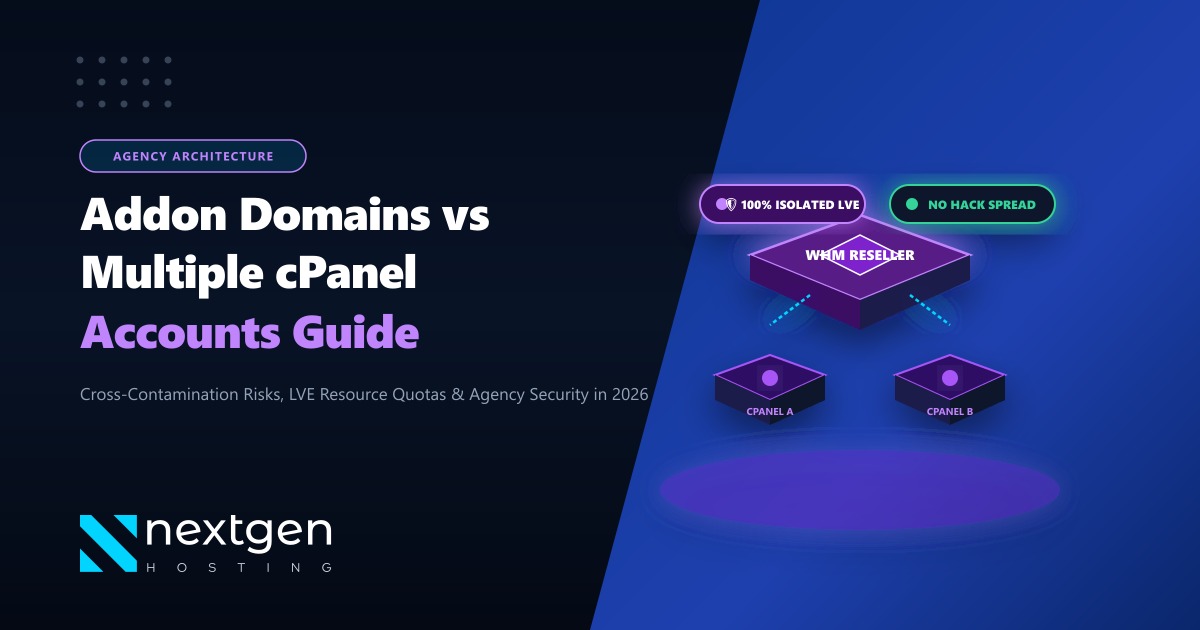
- The Reseller / WHM Solution: Deploying independent cPanel accounts via WebHost Manager (WHM) isolates each client into their own secure sandbox, complete with dedicated LVE quotas, independent SSL certificates, and isolated backup cycles.
1. Architectural Comparison: How the Two Models Work
Understanding the Linux permission model reveals why Addon Domains pose severe operational risks:
MODEL 1: ADDON DOMAINS (SINGLE CPANEL)
+---------------------------------------------------------------+
|  Linux User: 'agencyusr' (UID: 1042)                          |
|  Shared CloudLinux LVE: 2 vCPU / 2GB RAM / 30 Entry Processes |
+---------------------------------------------------------------+
  |--> /home/agencyusr/public_html/            (Main Agency Site)
  |--> /home/agencyusr/client-a.pk/            (Client A Store)
  |--> /home/agencyusr/client-b.com/           (Client B Portal)
  [!] If client-a is hacked, malicious script reads /home/agencyusr/

MODEL 2: SEPARATE CPANEL ACCOUNTS (VIA WHM)
+---------------------------------------------------------------+
|  MASTER WHM RESELLER / DEDICATED SERVER                       |
+---------------------------------------------------------------+
  |--> [cPanel 1] User: 'clienta' (UID: 1045) -> Isolated 2GB RAM
  |--> [cPanel 2] User: 'clientb' (UID: 1046) -> Isolated 2GB RAM
  |--> [cPanel 3] User: 'agency'  (UID: 1047) -> Isolated 2GB RAM
  [✓] Complete CageFS isolation. Hacks and traffic spikes cannot spread!
2. Direct Feature & Risk Comparison
| Evaluation Metric | Addon Domains (Single cPanel) | Separate cPanel Accounts (WHM) |
|---|---|---|
| Security Isolation | ❌ Zero Isolation. Shared file ownership (chmod 755). |
✅ 100% Isolated. CageFS chroot jails per account. |
| Resource Allocation | ❌ All sites compete for 1 shared CPU/RAM pool. | ✅ Dedicated LVE limits (CPU, RAM, I/O) per client. |
| Malware Containment | ❌ Hack spreads automatically across all domains. | ✅ Confined strictly to the single affected cPanel account. |
| Email Deliverability | ❌ If 1 site sends spam, all sites share the blacklisted IP. | ✅ Separate DKIM signatures, SPF records, and rate limits. |
| Client Portal Access | ❌ Cannot provide cPanel login without revealing all sites. | ✅ Individual, branded cPanel login credentials for client. |
| Migration / Offboarding | ❌ Painstaking manual extraction of DB and maildir. | ✅ 1-Click native cPanel backup pkg (cpmove-user.tar.gz). |
3. The Performance Trap: CloudLinux LVE Contention
When you host 15 client websites under a single cPanel account, CloudLinux treats them as a single collective entity:
- Entry Processes (EP): If Client A launches a Facebook Ad campaign and receives 25 simultaneous visitors, they consume all 20–30 allowed entry processes.
- Immediate Cascading Downtime: Clients B, C, and D will instantly see
508 Resource Limit Reachederrors, even though their websites received zero traffic! - Email Backlogs: If Client B’s contact form is exploited to send bulk spam, the cPanel account’s hourly outbound email quota (e.g., 200 emails/hour) is exhausted, preventing your other clients from sending business emails.
Separating clients into distinct accounts assigns each business their own independent LVE sandbox, guaranteeing uninterrupted uptime regardless of neighboring client activities.
4. Hardware Scaling: Dedicated Reseller & Bare-Metal Stacks
As your Pakistani agency scales past 30 to 50 active clients, hosting all accounts on standard shared reseller infrastructure introduces hypervisor contention and storage I/O bottlenecks.
To deliver true white-label agency hosting with custom nameservers (ns1.youragency.pk), automated WHMCS billing, and dedicated resources, infrastructure sovereignty is essential.
For digital agencies managing international clients, e-commerce brands, and high-traffic portals, deploying on global Dedicated Servers provides AMD EPYC processors, hundreds of gigabytes of ECC memory, and hardware RAID arrays capable of hosting hundreds of high-speed cPanel accounts.
For agencies operating domestically that host Pakistani corporate portals, medical billing systems, or government tenders subject to local data governance, deploying on Dedicated Servers in Pakistan ensures ultra-low domestic latency across PTCL, Nayatel, and StormFiber fiber routes with local PKR billing and 24/7 priority enterprise support.
5. Agency Best Practices Checklist for 2026
- Use Addon Domains ONLY for: Staging environments, dev test sites, or secondary landing pages belonging to the exact same business entity.
- Never Mix Client Owners: Never place two different legal entities or paying clients into the same cPanel user account.
- Automate Client Provisioning: Connect WHMCS to your WHM backend so new clients automatically receive their own isolated cPanel account upon invoice payment.
- Enforce CageFS & Imunify360: Ensure your host runs CloudLinux CageFS to virtualize the
/homedirectory and prevent cross-account directory traversal.
Scale Your Agency with High-Performance Reseller Hosting
Deliver ultra-fast, isolated cPanel hosting to your clients with Nextgen Hosting. White-label WHM, pure NVMe storage, free SSL certificates, and 24/7 technical support in Pakistan.
