
In modern high-speed Linux networking across Pakistan—supporting multi-gigabit content delivery, real-time banking webhooks, API microservices, and mobile 4G/5G client access—precise measurement of round-trip time (RTT) is fundamental to TCP congestion control algorithms like BBR, CUBIC, and Reno. Without accurate RTT feedback, the kernel cannot properly compute retransmission timeouts (RTO), modulate congestion windows (cwnd), or distinguish between genuine network packet loss and temporary routing delays.
Under standard TCP headers without options, RTT can only be sampled once per window of data (Karn’s Algorithm), and samples must be completely discarded if a packet is retransmitted to avoid mathematical ambiguity. On high-speed 10Gbps or multi-gigabit connections, this coarse measurement causes sluggish congestion response and bufferbloat.
Furthermore, on links operating at multi-gigabit throughput, 32-bit TCP sequence numbers can wrap around in less than 17 seconds (Protect Against Wrapped Sequences - PAWS).
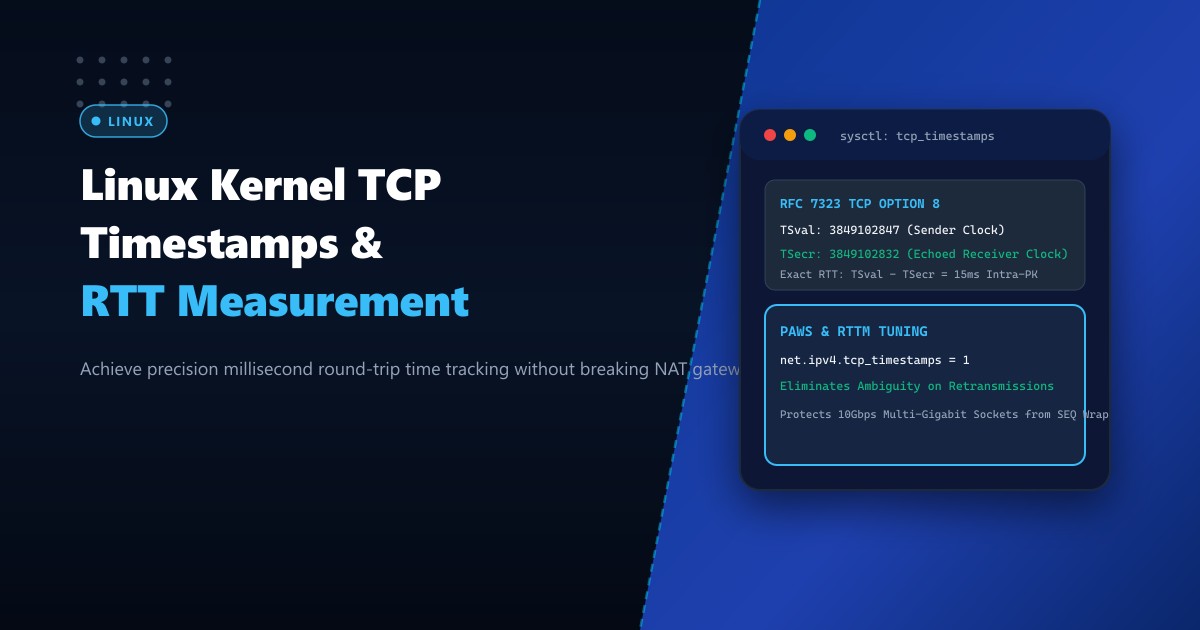
The solution is TCP Timestamps (RFC 7323, updating RFC 1323) via the 12-byte TCP Option 8 (TSval and TSecr). By enabling and fine-tuning TCP timestamps on high-performance Dedicated Servers, Linux network stacks obtain continuous, per-packet RTT precision and total cryptographic immunity to old duplicate segments.
Anatomy of RFC 7323 TCP Timestamps: TSval and TSecr
Here is how TCP Timestamps calculate exact round-trip latency for every single acknowledged packet without clock synchronization:
+-----------------------------------------------------------------------------------+
|               RFC 7323 TCP OPTION 8 (TIMESTAMPS & PAWS MECHANISM)                 |
+-----------------------------------------------------------------------------------+
| TCP Header Option 8 Format (12 Bytes):                                            |
| +--------+--------+--------------------+--------------------+                    |
| | Kind=8 | Len=10 |   TSval (4 Bytes)  |   TSecr (4 Bytes)  |                    |
| +--------+--------+--------------------+--------------------+                    |
|                                                                                   |
| Operational Exchange:                                                             |
| Client (Karachi Broadband)                       Server (Lahore Data Center)      |
|    | --- SYN [TSval = 1000, TSecr = 0] --------> | (Receives TSval 1000)          |
|    | <--- SYN/ACK [TSval = 5000, TSecr = 1000] - | (Echoes client's TSval)        |
|    |                                             |                                |
|    | --- ACK [TSval = 1015, TSecr = 5000] -----> | (Receives echoed TSval 5000)   |
|    |                                             | Current Server Clock = 5015    |
|    |                                             | Server RTT = 5015 - 5000 = 15ms|
|                                                                                   |
| PAWS (Protect Against Wrapped Sequences):                                         |
| - High-speed 10Gbps link wraps 32-bit Sequence numbers rapidly.                   |
| - A delayed stale packet arrives with a valid sequence number.                   |
| - Receiver inspects packet's TSval: It is OLDER than the latest validated TSval!   |
| - Result: Packet is instantly discarded as a ghost duplicate! Zero data corruption.|
+-----------------------------------------------------------------------------------+
Step 1: Checking and Auditing Kernel TCP Timestamp States
Verify your current Linux kernel settings governing TCP timestamps:
sysctl net.ipv4.tcp_timestampsDefault Linux values:
0: Timestamps disabled completely.1: Timestamps enabled globally (RFC 7323 format).2: Timestamps enabled with random per-connection offsets (RFC 7323 Sec 5.2 security enhancement introduced in Linux kernel 4.10+).
In modern kernels, value 2 is recommended: it generates randomized initial timestamp values per TCP connection, eliminating side-channel uptime fingerprinting while retaining full microsecond RTT measurement benefits.
Step 2: Optimizing Sysctl Parameters for Intra-Pakistan & Global Peering
Configure /etc/sysctl.d/99-tcp-timestamps.conf for maximum accuracy, low overhead, and NAT compatibility:
# 1. Enable TCP Timestamps with randomized clock offsets (Security + High Precision)
net.ipv4.tcp_timestamps = 2

# 2. Enable Window Scaling (RFC 7323) to support large BDP (Bandwidth-Delay Product)
net.ipv4.tcp_window_scaling = 1

# 3. Enable Selective Acknowledgments (RFC 2018)
net.ipv4.tcp_sack = 1

# 4. Enable Duplicate SACK (RFC 2883) for CWND Undo detection
net.ipv4.tcp_dsack = 1

# 5. Disable legacy TCP metric caching to prevent stale RTT entries on dynamic mobile ISPs
net.ipv4.tcp_no_metrics_save = 1

# 6. Ensure low-latency TCP socket behavior
net.ipv4.tcp_low_latency = 1
Apply the updated configuration immediately:
sysctl --systemVerify that the active kernel parameters are loaded:
sysctl -a | grep -E "tcp_timestamps|tcp_window_scaling|tcp_no_metrics_save"Step 3: Inspecting Socket-Level TSval & RTT Statistics with ss
To verify that active client connections are negotiating timestamp options and reporting precise RTT metrics, inspect sockets using ss:
# Query active HTTPS sockets with detailed TCP internals
ss -ti '( sport = :https or sport = :http )'
Inspect output fields:
ESTAB 0 0 103.205.180.25:443 39.44.112.50:51284
     bbr wscale:7,7 rto:200 rtt:14.25/1.82 ato:40 mss:1460 rcvspace:65536
     rcv_ssthresh:64120 snd_ssthresh:48 snd_cwnd:42 bytes_acked:2451000
     bytes_received:3420 segs_out:1850 segs_in:1210
     ts sack ecn rcv_ooopack:0
Notice:
ts: Confirms that TCP Timestamps (Option 8) was successfully negotiated during the SYN handshake.rtt:14.25/1.82: The kernel calculates a smoothed RTT of 14.25ms with a mean deviation of 1.82ms on every single incoming packet!bbr: The BBR congestion controller uses these continuous millisecond RTT samples to calculate max bottleneck bandwidth (BtlBw) and minimum RTT (RTprop) with pinpoint accuracy.
Step 4: Troubleshooting Asymmetric NAT & Firewalls
In rare scenarios across certain legacy Pakistani cellular base stations or poorly configured multi-WAN NAT gateways, packets from multiple clients behind a shared public IP may have out-of-order timestamps, causing the server’s PAWS mechanism to drop packets if tcp_tw_recycle is erroneously active.
[!IMPORTANT] Ensure that
net.ipv4.tcp_tw_recycleis completely removed or disabled. Modern Linux kernels (4.12+) have deprecated and removedtcp_tw_recyclespecifically to prevent NAT-related PAWS packet drops when timestamps are active.
Verify that your system has clean TCP connection termination:
# Verify no packet drops due to PAWS on active interfaces
netstat -s | grep -i "PAWSPassive"
nstat -z "TcpExtPAWSEstab" "TcpExtPAWSPassive"
Counters should show minimal or zero drops under normal production traffic.
Dedicated Bare-Metal Networking for Enterprise Pakistani Workloads
High-velocity socket handling, millisecond RTT tracking, and hardware timestamping require deterministic physical execution. In multi-tenant cloud virtual machines, CPU hypervisor virtualization steals clock cycles, introducing artificial timestamp jitter and skewing TCP RTT calculations.
Deploying on bare-metal Dedicated Servers in Pakistan equips your production infrastructure with dedicated Intel/AMD physical processors, enterprise 10Gbps/25Gbps hardware NICs with hardware timestamping offload, and direct low-latency peering at PKIX.
Optimize Network Latency with NextGen Dedicated Servers
Deliver ultra-responsive API responses, maximize data throughput, and eliminate bufferbloat across Pakistani networks. NextGen dedicated hosting provides pure bare-metal hardware, unshared 10Gbps connectivity, and 24/7 proactive technical management.
Deploy Dedicated Servers in Pakistan