
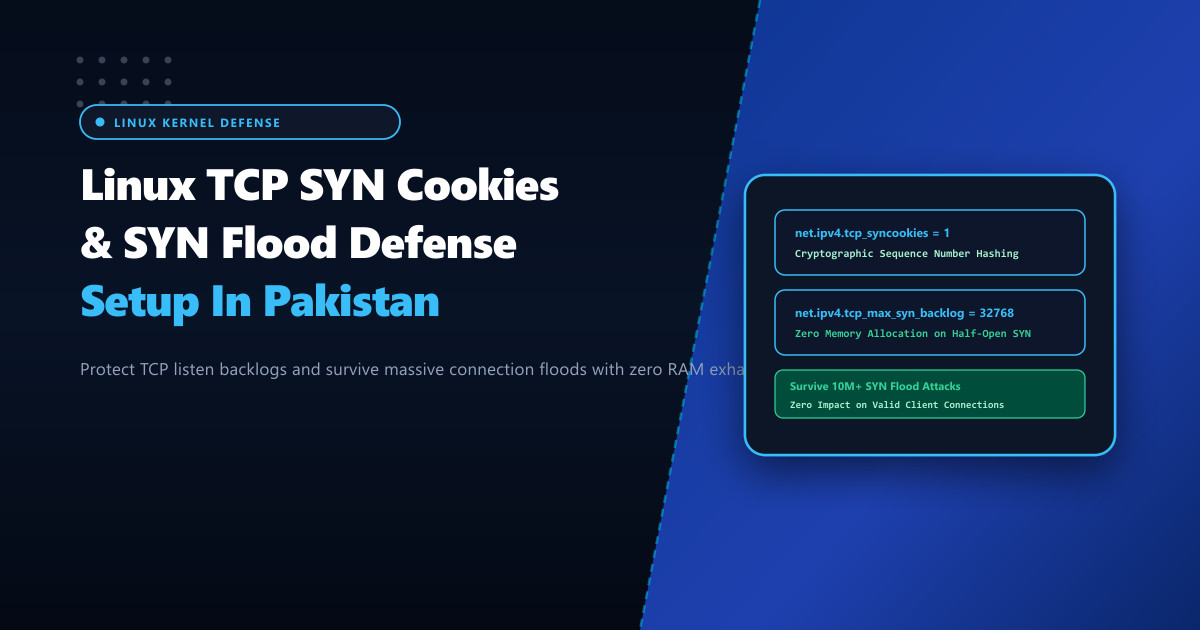
Among layer-4 network denial-of-service vectors targeting internet service providers, financial exchanges, and ecommerce platforms in Pakistan, the TCP SYN Flood remains the most ubiquitous.
In a standard SYN flood, attackers spoof thousands of arbitrary source IP addresses, flooding the server with hundreds of thousands of TCP SYN packets per second. Because the server responds with a SYN-ACK to spoofed IPs that never reply with the concluding ACK, the server’s embryonic connection queue (SYN backlog) fills to capacity. Within seconds, the Linux kernel rejects new connection requests, locking out legitimate shoppers and users across Pakistan with Connection timed out.
Hosting production workloads on bare-metal Dedicated Servers provides the baseline CPU and network bandwidth required, but surviving severe volumetric attacks demands precise tuning of the Linux kernel’s TCP SYN Cookies (tcp_syncookies) and socket backlog hierarchies.
The Anatomy of SYN Backlog Starvation
During standard TCP 3-way handshakes:
- Client sends
SYN. - Linux kernel allocates a Transmission Control Block (
struct tcp_request_sock) in kernel memory, places it in the embryonic SYN backlog table, and responds withSYN-ACK. - Client returns
ACK. The kernel transfers the connection to the fully established accept queue (listen()backlog) where user-space daemons (Nginx, MariaDB) canaccept()the socket.
Under a Volumetric SYN Flood:
- Attackers send 500,000 SYN packets per second from randomized fake IPs.
- The kernel allocates memory for each half-open connection.
- The SYN backlog table (
net.ipv4.tcp_max_syn_backlog) saturates completely. - The kernel begins dropping incoming SYN packets indiscriminately. Real users are locked out.
Standard Handshake (Allocates Memory in SYN Backlog):
SYN ──► Kernel Allocates 300 Bytes RAM ──► Stored in Backlog ──► SYN-ACK Sent
(Flood of 100k SYN/sec exhausts table memory immediately)

TCP SYN Cookies (Stateless Cryptographic Handshake):
SYN ──► Kernel ALLOCATES ZERO MEMORY! ──► Generates Cryptographic Cookie (ISN) ──► SYN-ACK
ACK Arrives with (ISN + 1) ──► Kernel Re-computes Hash: Valid! ──► Socket Created on the Fly!
Result: Server survives infinite SYN floods without dropping a single real user!
How TCP SYN Cookies Eliminate State Allocation
Invented by Daniel J. Bernstein, TCP SYN Cookies eliminate half-open state storage in kernel RAM:
- When the SYN backlog overflows, the kernel activates SYN cookies.
- Instead of allocating memory for incoming
SYNpackets, the kernel calculates a cryptographic Initial Sequence Number (ISN):- Encodes a secret counter that rotates every 60 seconds.
- Encodes the Maximum Segment Size (MSS) requested by the client.
- Cryptographically hashes the 4-tuple (Source IP, Source Port, Dest IP, Dest Port) using a kernel key.
- The server transmits
SYN-ACKusing this cryptographic ISN as its sequence number and discards all memory of the connection immediately. - When a legitimate client sends back an
ACKcontainingacknowledgment_number = ISN + 1, the kernel extracts the ISN, recomputes the cryptographic hash, verifies the client, and instantiates the fully established connection on the fly!
Step 1: Kernel Sysctl Tuning for SYN Flood Immunity
Configure defensive sysctl parameters in /etc/sysctl.d/99-synflood-defense.conf:
# /etc/sysctl.d/99-synflood-defense.conf - NextGen Hardened TCP Handshake Stack

# Enable TCP SYN Cookies (1 = Activated when SYN backlog overflows)
net.ipv4.tcp_syncookies = 1

# Maximum queued embryonic connections in SYN backlog before activating cookies
# Default is 128 or 1024; expand to 65535 on high-traffic nodes
net.ipv4.tcp_max_syn_backlog = 65535

# Maximum listen accept queue backlog for established sockets waiting for accept()
net.core.somaxconn = 65535

# Reduce SYN-ACK retry count from 5 to 2
# Prevents wasting retransmission resources on non-existent spoofed IPs
net.ipv4.tcp_synack_retries = 2

# Reduce SYN retry count for outbound requests
net.ipv4.tcp_syn_retries = 2

# Increase network interface card driver packet backlog
net.core.netdev_max_backlog = 32768

# Enable TCP Fast Open with cookie verification
net.ipv4.tcp_fastopen = 3
Apply the parameters immediately:
sysctl -p /etc/sysctl.d/99-synflood-defense.confVerify active parameters:
cat /proc/sys/net/ipv4/tcp_syncookies
cat /proc/sys/net/ipv4/tcp_max_syn_backlog
Step 2: Nginx & Web Server Socket Backlog Alignment
Kernel sysctl values define the operating system’s maximum capacity, but web daemons like Nginx must explicitly request deep backlogs in their listen directives.
Update your Nginx server blocks:
# /etc/nginx/conf.d/production.conf

server {
    # Match somaxconn ceiling in listen socket backlog
    listen 80 backlog=65535 reuseport;
    listen 443 ssl http2 backlog=65535 reuseport;
    server_name nextgen.pk www.nextgen.pk;

    # SSL and upstream configuration...
}
Step 3: Monitoring Real-Time SYN Cookie Activation Telemetry
Inspect kernel SNMP counters to monitor whether SYN cookies are actively defending your server during a flood:
# Query TCP SYN Cookie telemetry
nstat -az | grep -i "Syncookie"
Evaluate these critical telemetry lines:
TcpExtSyncookiesSent: Total SYN-ACK cookies transmitted when backlog was full.TcpExtSyncookiesRecv: Valid ACK packets returned by real clients and successfully unpacked.TcpExtSyncookiesFailed: Malformed or invalid ACK packets dropped (indicative of spoofed botnet traffic).
Check for listen backlog overflow drops:
# Count dropped listen connections
netstat -s | grep -i "listen"
# Or via nstat
nstat -az | grep -i "ListenDrops"
When deployed on bare-metal Dedicated Servers in Pakistan, combining deep kernel backlogs with stateless TCP SYN cookies ensures that your websites, APIs, and trading platforms stay 100% online even during multi-gigabit volumetric SYN flood attacks.
Defend Your Mission-Critical Servers with NextGen
Protect your online enterprise against layer-4 volumetric DDoS attacks. Experience kernel-hardened TCP stacks, unmetered network ports, and dedicated infrastructure in Pakistan.
Explore Pakistan Dedicated Servers