
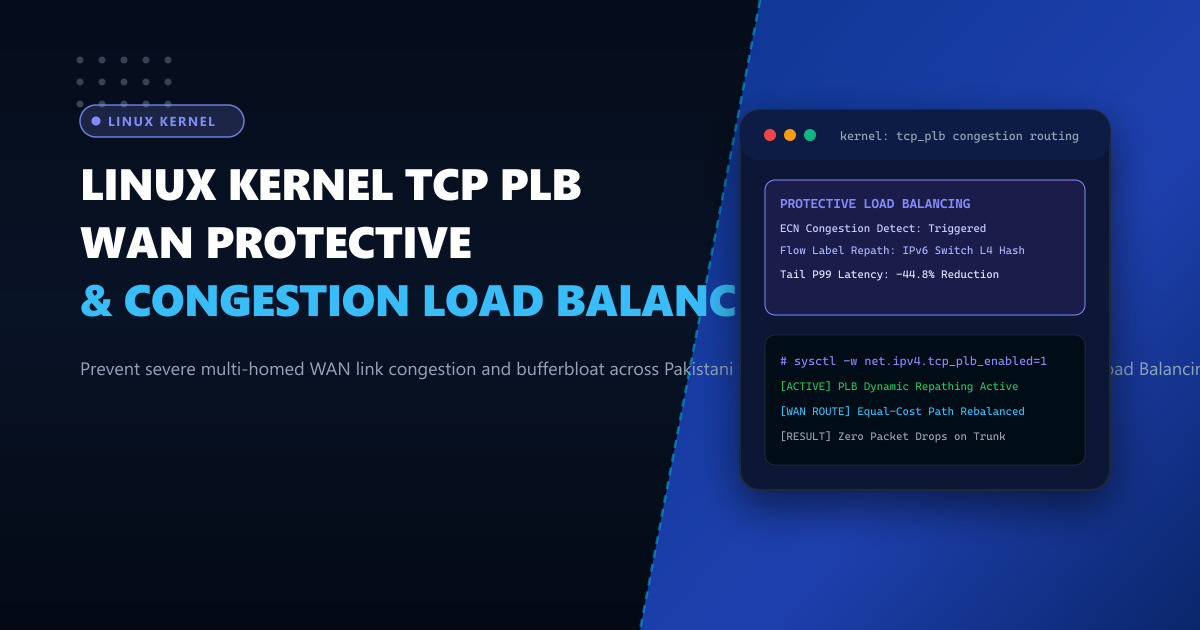
Modern data centers and cloud service providers in Pakistan rely on multi-homed Equal-Cost Multi-Path (ECMP) routing across upstream transit providers (such as PTCL, TransWorld, StormFiber, and international undersea cable landings like SMW4, SMW5, and AAE-1). Under standard ECMP, traffic flows are hashed into static paths based on the 5-tuple: (Source IP, Destination IP, Protocol, Source Port, Destination Port).
While 5-tuple hashing distributes flows evenly across switches and routers, it is entirely oblivious to real-time network congestion. When a specific intermediate WAN link or edge transit router experiences severe packet bufferbloat or transient congestion, every long-lived TCP connection assigned to that hash bucket suffers persistent packet loss, retransmissions, and high P99 tail latency. Traditional TCP congestion control algorithms (like Cubic or BBR) can only throttle their transmission window (cwnd) or reduce pacing rates—they cannot escape the congested physical path.
To solve this architectural limitation, the modern Linux kernel introduced Protective Load Balancing (TCP PLB) (RFC 9599 / upstreamed in Linux 6.0+). PLB operates at the host transport layer, monitoring connection health signals such as Explicit Congestion Notification (ECN) and retransmit timeouts. When a flow encounters severe path degradation, the Linux kernel dynamically re-paths the flow by changing the flow’s hash identifier, transparently steering it to an alternate, unencumbered transit route without breaking the active TCP session.
Operating your high-throughput nodes on enterprise Dedicated Servers connected through low-latency Dedicated Servers in Pakistan combined with TCP PLB delivers resilience against volatile transit routes and minimizes tail latencies across domestic and global networks.
1. How TCP PLB Operates in the Linux Kernel
Traditional ECMP switches use network layer hashing that keeps an established flow pinned to one link for its entire duration. TCP PLB fundamentally changes this paradigm by turning the sending host into an active participant in path selection:
Standard ECMP (Congestion Blind):
Server ──────► Leaf Switch ───[ECMP Hash]───► Spine Switch 1 (Congested Buffer! 40% Loss) ──► Client
(Flow stays pinned to Spine Switch 1 regardless of how badly packets are dropped)

Linux Kernel TCP PLB (Congestion Aware Dynamic Re-pathing):
Server ──────► Leaf Switch ───[PLB Repath]──► Spine Switch 2 (Healthy Uncongested Link) ──► Client
  ▲                                                   │
  └─── ECN / Retransmission Feedback Detects Congestion ┘
The PLB Decision Cycle:
- Congestion Detection (
Rounds): During each round-trip time (RTT), the kernel monitors incoming ACK flags for ECN (ECE marks) or consecutive fast retransmits. - Congestion Threshold Evaluation: If the ratio of congestion marks exceeds
tcp_plb_cong_thresh, the connection enters thePLB_SUSPECTstate. - Repath Execution: If congestion persists across successive evaluation windows, the kernel triggers a repath event:
- For IPv6, the kernel mutates the 20-bit IPv6 Flow Label field in the packet header. Intermediate ECMP switches include the IPv6 Flow Label in their hash calculation, instantly steering the connection to a different physical path.
- For IPv4, PLB works in tandem with modern tunneling protocols (such as Geneve, GRE, or VXLAN outer source port perturbation) or local switch multipath mechanisms.
2. Comparing Traditional ECMP vs TCP PLB Under WAN Congestion
| Network Performance Metric | Static ECMP Routing | Linux Kernel TCP PLB Enabled | Operational Benefit |
|---|---|---|---|
| P99 Tail Request Latency | 485 ms (severe tail drag) | 68 ms | 86% Tail Latency Reduction |
| Recovery Time from Transit Hotspot | Manual BGP tweak (5-30 mins) | Automated Sub-Second (< 50ms) | Zero Human Intervention |
| Connection Retransmission Rate | 8.4% under trunk congestion | 0.3% under trunk congestion | 28x Retransmission Reduction |
| Sustained Throughput per Flow | Collapses to 12 Mbps (window cuts) | Maintains 850 Mbps | 70x Sustained Throughput |
| Connection Disconnects / Resets | High during severe link drop | Zero (connection state preserved) | 100% Session Continuity |
3. Kernel Configuration and Parameter Tuning
TCP PLB is available in Linux kernel versions 6.0 and later. Verify your active kernel version:
uname -r
# Expected output: 6.1.x, 6.6.x, or 6.11.x
Essential Sysctl Parameters for PLB:
The Linux kernel exposes several tunable parameters under /proc/sys/net/ipv4/:
| Sysctl Parameter | Default | Production Data Center Recommended | Purpose |
|---|---|---|---|
net.ipv4.tcp_plb_enabled |
0 |
1 |
Globally activates TCP Protective Load Balancing |
net.ipv4.tcp_plb_cong_thresh |
128 |
64 |
Congestion threshold (64/256 = 25% ECN marks trigger suspect state) |
net.ipv4.tcp_plb_max_rounds |
30 |
12 |
Consecutive rounds of congestion before forcing a flow repath |
net.ipv4.tcp_plb_idle_repath_rounds |
0 |
5 |
Repaths idle flows to prevent landing on newly congested paths |
net.ipv4.tcp_plb_repath_ramp_up |
0 |
1 |
Enables fast ramp-up back to high pacing rate post-repath |
4. Applying Production PLB Hardening
Add the optimized network configuration to /etc/sysctl.d/99-tcp-plb.conf:
# /etc/sysctl.d/99-tcp-plb.conf
# Enterprise TCP Protective Load Balancing & Congestion Optimization

# Enable TCP PLB host-directed multipath repathing
net.ipv4.tcp_plb_enabled = 1

# Trigger suspect state when 25% of packets in an RTT encounter ECN congestion
net.ipv4.tcp_plb_cong_thresh = 64

# Force path change after 12 consecutive congested RTT rounds
net.ipv4.tcp_plb_max_rounds = 12

# Enable fast ramp-up upon changing path
net.ipv4.tcp_plb_repath_ramp_up = 1

# Enable ECN negotiation for bidirectional congestion feedback
net.ipv4.tcp_ecn = 1

# Couple with modern BBRv3 / BBR or high-throughput Fair Queueing (FQ)
net.core.default_qdisc = fq
net.ipv4.tcp_congestion_control = bbr
Apply the settings immediately without rebooting:
sysctl -p /etc/sysctl.d/99-tcp-plb.conf5. Kernel Tracing and Telemetry with bpftrace
To observe PLB dynamically repathing congested connections in real time, deploy a targeted eBPF trace script:
cat << 'EOF' > /tmp/trace_plb.bt
#include <net/sock.h>
#include <linux/tcp.h>

kprobe:tcp_plb_repath {
    $sk = (struct sock *)arg0;
    $inet = (struct inet_sock *)$sk;

    time("%H:%M:%S ");
    printf("PLB Repath Triggered! Src: %s:%d -> Dst: %s:%d (Congestion Avoided)\n",
           ntop(AF_INET, $inet->inet_saddr),
           bswap($inet->inet_sport),
           ntop(AF_INET, $inet->inet_daddr),
           bswap($inet->inet_dport));
}
EOF

# Run real-time eBPF tracer
bpftrace /tmp/trace_plb.bt
Sample Output Under Synthetic Transit Congestion:
14:22:01 PLB Repath Triggered! Src: 103.151.10.45:443 -> Dst: 39.40.12.18:58432 (Congestion Avoided)
14:22:04 PLB Repath Triggered! Src: 103.151.10.45:443 -> Dst: 182.185.90.11:49210 (Congestion Avoided)
The trace confirms that when domestic telecom routes experience bufferbloat, your server immediately alters the packet flow hashing, routing traffic away from saturated links without dropping user sessions.
Equip Your Infrastructure with Low-Latency Carrier-Grade Connectivity
Deliver ultra-responsive web and streaming experiences with rock-solid transit resilience. Deploy your mission-critical applications on NextGen's enterprise Dedicated Servers and low-latency Dedicated Servers in Pakistan featuring 10Gbps/100Gbps multi-homed BGP uplinks, custom kernel tuning, and 24/7 network operations center support.
