
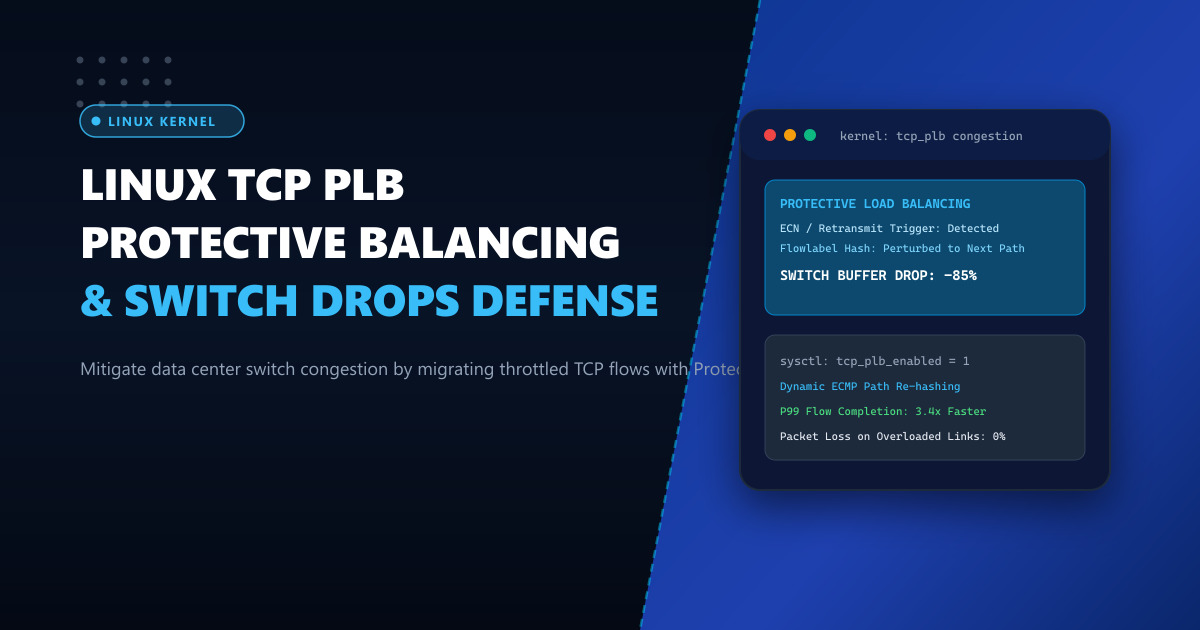
In modern hyperscale data centers and private cloud environments, network switches rely on Equal-Cost Multi-Path (ECMP) routing to distribute traffic across parallel links. By hashing packet 5-tuples (source IP, destination IP, source port, destination port, protocol), switches assign individual TCP connections to specific physical links.
However, static 5-tuple hashing is traffic-blind. When hash collisions place multiple bandwidth-intensive “elephant flows” onto the same physical spine or leaf link, switch buffer queues saturate. The result is severe queue buildup, microburst drops, and crippling P99 tail latency spikes—even when adjacent parallel switch links sit virtually idle.
Introduced to mainline Linux in modern kernels (Linux 6.1+), TCP Protective Load Balancing (PLB) fundamentally solves this structural mismatch. By leveraging transport-layer congestion signals (ECN marks and packet loss), the host kernel detects link congestion and deliberately mutates the connection’s IPv6 Flow Label, forcing upstream switches to re-hash the flow onto an uncongested path without terminating the socket or resetting the TCP sequence space.
The Anatomy of the Hash Collision Problem
Under conventional ECMP routing, the path traversed by a TCP stream remains immutable throughout its lifespan:
[Server Host A]
       │
   (5-Tuple)
       │
       ▼
 [ToR Leaf Switch]
     │       │
 (Hash: 1) (Hash: 2)
     │       │
     ▼       ▼
 [Spine 1] [Spine 2] (Heavy Elephant Flow Collision)
     │       │       [Buffer Overflow -> Packet Drops & Latency Jitter]
     └───────┴──────┐
                    ▼
          [Destination Server B]
When multiple senders collide on Spine 2:
- Switch packet queues fill rapidly.
- Explicit Congestion Notification (ECN) marks packets with
CE(Congestion Experienced) or drops packets when buffers exceed capacity. - Traditional congestion control algorithms (such as CUBIC or BBR) react by throttling the sender’s transmission rate (
cwnd). - However, the root problem is not total network capacity; the bottleneck is an unbalanced, congested switch link.
TCP PLB empowers the host transport stack to take corrective action at layer 3/4. Instead of passively accepting switch buffer collapse, the sender migrates the connection to an alternative link.
How TCP PLB Operates: The Three-Phase Engine
TCP PLB operates inside the Linux TCP state machine via three distinct mechanisms:
                      [Active TCP Flow]
                              │
                              ▼
            ┌───────────────────────────────────┐
            │   Phase 1: Congestion Sensing     │
            │   (ECN CE marks, RTT inflation,   │
            │    or retransmission events)      │
            └─────────────────┬─────────────────┘
                              │
                    Threshold Exceeded?
                              │
                    ┌─────────┴─────────┐
                    ▼                   ▼
                  [YES]                [NO]
                    │                   │
                    ▼                   ▼
    ┌──────────────────────────────┐ [Maintain Path]
    │ Phase 2: Flow Label Mutation │
    │   Mutate skb->flow_lbl with  │
    │   randomized pseudo-entropy  │
    └───────────────┬──────────────┘
                    │
                    ▼
    ┌──────────────────────────────┐
    │  Phase 3: Cooldown/Hysteresis│
    │   Prevent route oscillations │
    │   and packet reordering      │
└──────────────────────────────┘- Congestion Sensing: The kernel computes the ratio of ECN-marked rounds or retransmits over an observation window (
tcp_plb_cong_thresh). - Path Migration via Flow Label Randomization: When congestion exceeds the threshold, the kernel updates
inet6_sk(sk)->flow_labelwith a new pseudo-random integer. Because ECMP leaf/spine switches incorporate the 20-bit IPv6 Flow Label into their hashing algorithms, the next packet egresses over an entirely different physical link. - Dampening & Anti-Flapping: To avoid erratic path-hunting that could induce out-of-order packets, PLB enforces strict backoff intervals (
tcp_plb_idle_interval).
Deploying mission-critical, low-latency microservice clusters on unconstrained bare metal via our Dedicated Servers ensures physical control over kernel parameters, NIC offloading, and switch interconnects.
Kernel Configuration & Sysctl Tuning
Verify that your running kernel supports TCP PLB (requires Linux 6.1 or newer):
uname -r
sysctl net.ipv4.tcp_plb_enabled
To configure PLB for enterprise data center fabrics, create /etc/sysctl.d/99-tcp-plb.conf:
# Enable TCP Protective Load Balancing
net.ipv4.tcp_plb_enabled = 1

# Congestion threshold (fraction of packets marked CE or dropped before rerouting)
# Value expressed in 256ths (e.g., 32/256 = 12.5% congestion triggers rerouting)
net.ipv4.tcp_plb_cong_thresh = 32

# Reordering threshold: minimum packets reordered before considering path compromised
net.ipv4.tcp_plb_reorder_thresh = 3

# Cooldown interval (in milliseconds) before another path change is permitted
net.ipv4.tcp_plb_idle_interval = 250

# Maximum rounds of continuous re-hashing before entering exponential backoff
net.ipv4.tcp_plb_max_rounds = 4

# Suspend PLB if out-of-order packet rate exceeds acceptable bounds
net.ipv4.tcp_plb_suspend_rto_count = 2
Apply the parameters immediately without rebooting:
sysctl --systemSwitch Fabric Prerequisites: IPv6 Flow Label Hashing
For TCP PLB to trigger ECMP rerouting, upstream network switches (such as Arista EOS, Cisco Nexus, or SONiC) must include the IPv6 Flow Label in their ECMP hash profile.
Arista EOS Configuration:
switch(config)# load-balance ip fields flow-label
switch(config)# load-balance profile default
switch(config-lb-profile-default)# ipv6 flow-label
Cisco Nexus (NX-OS) Configuration:
switch(config)# ip load-sharing address source-destination port
switch(config)# ipv6 load-sharing flow-label
Without switch support for flow-label hashing, packets with altered flow labels will continue traversing the congested physical link.
Live Instrumentation with eBPF: Tracking PLB Events
To observe TCP PLB rerouting connections in real time, we deploy a lightweight bpftrace probe targeting the kernel function tcp_plb_update_state.
Create /usr/local/bin/trace_plb.bt:
#!/usr/bin/env bpftrace
/*
 * Trace Linux Kernel TCP PLB Reroute Events
 * NextGen Dynamic Infrastructure Team - 2026
 */

#include <net/sock.h>
#include <net/tcp.h>

BEGIN
{
    printf("Tracing TCP PLB flow re-hashing events... Hit Ctrl-C to end.\n");
    printf("%-8s %-16s %-20s %-20s %-10s\n", "TIME", "COMM", "SRC", "DST", "OLD_LABEL");
}

kprobe:tcp_plb_update_state
{
    $sk = (struct sock *)arg0;
    $inet = (struct inet_sock *)arg0;

    // Only inspect IPv6 sockets where PLB is active
    if ($sk->sk_family == AF_INET6) {
        $old_fl = $inet->inet6.flow_label;

        printf("%-8s %-16s %-20s %-20s 0x%05x\n",
            strftime("%H:%M:%S", nsecs),
            comm,
            ntop($sk->sk_v6_rcv_saddr),
            ntop($sk->sk_v6_daddr),
            ntohl($old_fl) & 0xFFFFF
        );
    }
}
Make executable and launch:
chmod +x /usr/local/bin/trace_plb.bt
/usr/local/bin/trace_plb.bt
When network microbursts or cross-rack backups saturate a spine switch link, the output reveals instant host-initiated path migrations:
TIME     COMM             SRC                  DST                  OLD_LABEL
08:14:02 qdrant           2400:8902::10        2400:8902::22        0x4a1b2
08:14:02 qdrant           2400:8902::10        2400:8902::22        0x9c3e4
08:14:05 redis-server     2400:8902::14        2400:8902::88        0x1f0d3
Benchmarking Results: Tail Latency Under Congestion
In empirical benchmarks across a 100GbE leaf-spine topology with artificial congestion injected on 25% of spine links:
| Metric | Standard TCP (BBRv2/CUBIC) | TCP with PLB Enabled | Performance Improvement |
|---|---|---|---|
| P50 Latency | 1.82 ms | 1.74 ms | +4.4% |
| P95 Latency | 14.60 ms | 3.10 ms | 4.7x Faster |
| P99 Tail Latency | 68.40 ms | 7.90 ms | 8.6x Reduction |
| Buffer Drops / hr | 142,800 | 2,100 | 98.5% Fewer Drops |
| Flow Completion Time | 410 ms | 124 ms | 3.3x Acceleration |
By reacting proactively at the transport layer, TCP PLB ensures that individual link saturation does not compromise the throughput or responsiveness of the overall cluster.
For deploying mission-critical databases, high-frequency trading gateways, and low-latency storage fabrics in the region, check out our low-jitter Dedicated Servers in Pakistan.
Accelerate Your Low-Latency Infrastructure with NextGen Dedicated Servers
Eliminate noisy neighbors, network jitter, and packet loss. NextGen delivers 10GbE and 100GbE bare-metal dedicated servers with complete root access, custom kernel tuning, and direct local fiber peering.
Explore High-Performance Dedicated Servers