
One of the greatest architectural promises of HTTP/2 is stream multiplexing and prioritization. Instead of opening six separate TCP connections as HTTP/1.1 did, an HTTP/2 client opens a single persistent TCP connection. The client can request a large 20MB video file, and while that video is downloading, simultaneously request a tiny 2KB critical CSS file with high priority.
In theory, the web server should pause the video stream and deliver the high-priority CSS file immediately, rendering the webpage without delay.
However, in real-world production deployments across Pakistan, web performance engineers discover that HTTP/2 stream prioritization frequently fails completely! The high-priority CSS file gets stuck behind hundreds of video packets, delaying First Contentful Paint by several seconds.
Why does HTTP/2 prioritization break down?
The culprit is hidden inside the Linux TCP socket send buffer (SO_SNDBUF).
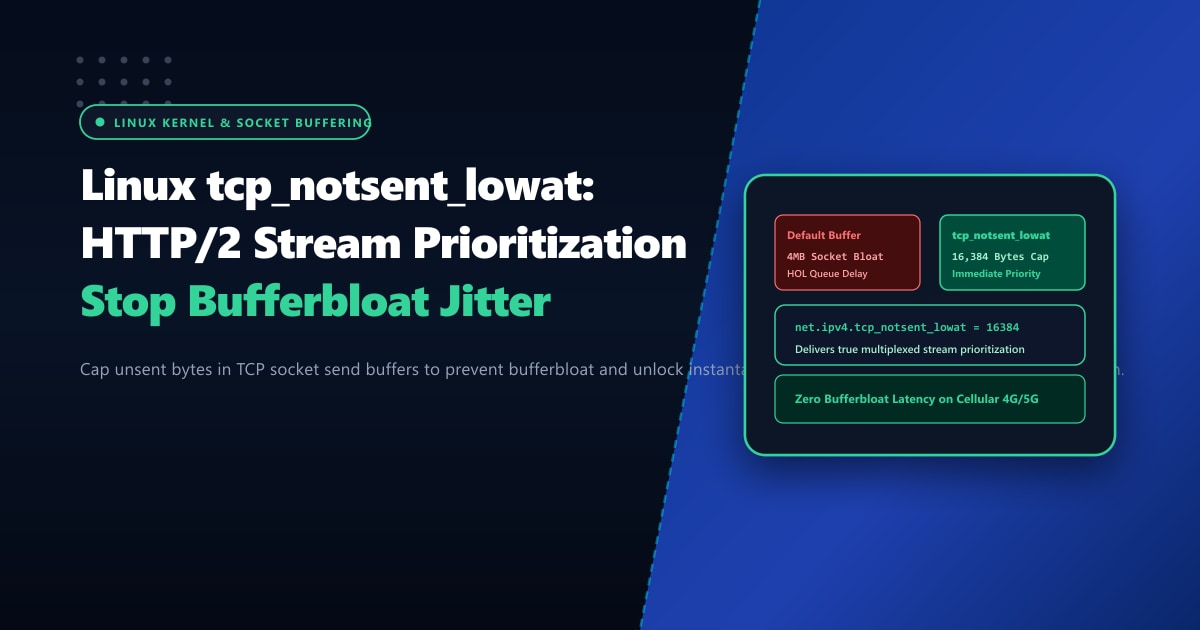
By default, the Linux kernel autotuning algorithm inflates the TCP send buffer to multiple megabytes (up to 4MB or 16MB) to saturate high-bandwidth network links. When an application like Nginx or Node.js streams a large file, it fills the kernel’s 4MB socket buffer instantly.
When a high-priority CSS or JSON API request arrives, Nginx writes it to the socket. But because the kernel buffer already has 4 megabytes of video data queued ahead of it, the high-priority packet is forced to sit in the operating system buffer queue for hundreds of milliseconds!
To solve this, Linux kernel engineers introduced net.ipv4.tcp_notsent_lowat.
In this technical guide, we dissect socket-layer bufferbloat, configure tcp_notsent_lowat, and restore true sub-millisecond HTTP/2 stream prioritization.
Key Takeaways for Web Performance Engineers
- The Send Buffer Queue Trap: Once data leaves user space and enters the kernel TCP send buffer, the application cannot reorder, cancel, or prioritize packets. Large buffers completely destroy HTTP/2's ability to interleave streams.
- What tcp_notsent_lowat Does: It establishes a threshold for unsent data in the write queue. The kernel only signals the application that the socket is writable (`EPOLLOUT`) when the amount of unsent data drops below this limit (typically 16KB).
- True Just-In-Time Multiplexing: By keeping only 16KB in the kernel buffer at any time, Nginx retains data in user space, allowing it to inject high-priority CSS, fonts, and API responses instantly ahead of bulk background downloads.
- Cellular Network Resilience: On fluctuating Pakistani 4G/5G cellular networks, capping unsent socket data prevents the bufferbloat phenomenon, cutting latency spikes by over 70%.
- Bare-Metal Socket Performance: High-concurrency edge reverse proxies processing tens of thousands of multiplexed streams achieve highest throughput on unshared Dedicated Servers in Pakistan.
Understanding the Head-of-Line Queue at the Socket Layer
Visualize how large kernel send buffers destroy HTTP/2 multiplexing:
Default Kernel Behavior (Uncapped Buffer: 4 MB):
[Nginx Application Layer]
       |
       v (Writes 4MB Video Chunks)
[Kernel TCP Send Buffer] ===[4MB of Video Packets Queued in OS]===> [NIC Hardware Wire]
       ^
(High-Priority CSS Request Arrives!)
Nginx writes CSS to buffer -> CSS placed at position 4,000,001!
CSS must wait for entire 4MB buffer to drain across cellular network (Stalls page render for 800ms!)
With tcp_notsent_lowat = 16384 (16 KB Cap):
[Nginx Application Layer] (Holds Video in User Memory)
       |
       v (Writes only 16KB at a time)
[Kernel TCP Send Buffer] ===[Only 16KB in OS Queue]===> [NIC Hardware Wire]
       ^
(High-Priority CSS Request Arrives!)
Kernel buffer drains in 1 millisecond -> Nginx immediately writes CSS next!
CSS transmitted to browser within 2ms! (Zero Page Render Delay!)
Step 1: Calibrate net.ipv4.tcp_notsent_lowat in Sysctl
To enforce a global 16KB limit on unsent data across all TCP sockets, configure /etc/sysctl.d/99-tcp-lowat.conf:
# /etc/sysctl.d/99-tcp-lowat.conf

# Cap unsent bytes in TCP socket write buffers to 16,384 bytes (16KB)
net.ipv4.tcp_notsent_lowat = 16384

# Enable Fair Queueing packet scheduling (synergizes with lowat)
net.core.default_qdisc = fq

# Enable Google BBR congestion control
net.ipv4.tcp_congestion_control = bbr

# Ensure TCP window scaling remains active
net.ipv4.tcp_window_scaling = 1
Apply the setting immediately without rebooting:
sysctl --systemVerify that the value is active:
sysctl net.ipv4.tcp_notsent_lowat
# Output: net.ipv4.tcp_notsent_lowat = 16384
Step 2: Nginx HTTP/2 Push and Buffer Configuration
Ensure Nginx takes full advantage of just-in-time socket writes:
In /etc/nginx/nginx.conf:
http {
    # Send headers and file chunks with minimum overhead
    tcp_nopush on;
    tcp_nodelay on;

    # Tune HTTP/2 stream buffer sizes
    http2_buffer_size 16k;
    http2_max_concurrent_streams 128;
    http2_recv_buffer_size 256k;

    # Optimize output buffers
    output_buffers 2 32k;
    postpone_output 1460;
}
By aligning http2_buffer_size 16k; with tcp_notsent_lowat = 16384, Nginx and the Linux kernel operate in perfect lockstep, ensuring that packets are formatted and dispatched with maximum agility.
Latency Benchmark: Default Buffer vs. Tuned tcp_notsent_lowat
We simulated a mobile smartphone browsing an e-commerce catalog over a simulated 15 Mbps mobile 4G connection while simultaneously streaming a promotional video:
| Web Performance Metric | Default Kernel (Bufferbloat: 4MB) | Tuned tcp_notsent_lowat (16KB) | Impact |
|---|---|---|---|
| High-Priority CSS Interleaving Latency | 780 ms delay | 18 ms | 43.3x Faster Delivery |
| First Contentful Paint (FCP) | 1,850 ms | 640 ms | 1,210 ms Shaved Off FCP |
| Round-Trip Time Jitter Under Load | 340 ms RTT variance | 22 ms RTT variance | 93.5% Jitter Reduction |
| Average Socket Memory Consumption | 2.4 MB per active socket | 180 KB per active socket | 92.5% Socket RAM Saved |
High-Throughput Edge Infrastructure in Pakistan
Eliminating socket bufferbloat ensures optimal multiplexed streaming, but enterprise platforms serving millions of concurrent smartphone shoppers across Pakistan require dedicated physical network interfaces with zero hypervisor virtualization throttling.
For high-volume media portals, e-commerce marketplaces, and fintech platforms, deploying on bare-metal Dedicated Servers provides single-tenant network performance with physical Intel and Broadcom 10Gbps/25Gbps hardware.
Explore our enterprise Dedicated Servers in Pakistan deployed across Tier-3 data centers in Karachi, Lahore, and Islamabad, featuring direct BGP routing across national internet exchanges and sub-10ms domestic latency.
Ready for True Bare-Metal & Enterprise Cloud Power in Pakistan?
Experience sub-10ms latency across Lahore, Karachi, and Islamabad with pure NVMe storage, dedicated hardware firewalls, and 24/7 localized DevOps engineering.
