
In traditional TCP/IP networking, every single new connection requires a mandatory three-way handshake (SYN $\rightarrow$ SYN-ACK $\rightarrow$ ACK) before any application-layer data (such as an HTTP GET request or TLS ClientHello) can be transmitted over the wire. On web services, mobile apps, and microservice APIs with high connection churn, this initial round trip accounts for a significant fraction of total user-perceived latency. On mobile cellular networks across Pakistan (where RTT routinely fluctuates between 40 ms and 120 ms), this mandatory delay degrades Core Web Vitals and transactional checkout speeds.
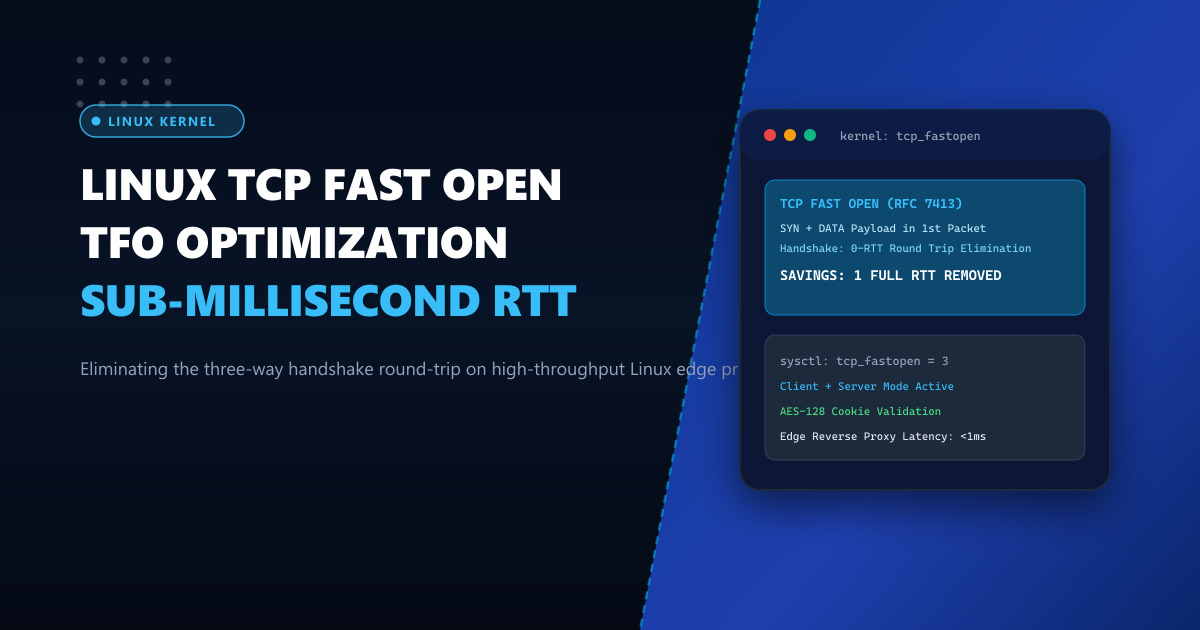
TCP Fast Open (TFO - RFC 7413) solves this problem by enabling data transmission during the initial SYN packet. By utilizing a cryptographic cookie generated by the server during a prior connection, a returning client can piggyback request payloads directly inside the SYN segment, eliminating one full round trip.
In this deep architectural guide, we explain the mechanics of TCP Fast Open cookies, verify socket behaviors using ss and bpftrace, and configure production kernel parameters on Linux hosts.
Handshake Dynamics: Traditional TCP vs. TCP Fast Open
Traditional TCP Handshake (1 RTT Wasted Before Data):
Client ───────────────── SYN ─────────────────▶ Server
Client ◀────────────── SYN-ACK ──────────────── Server
Client ────────────── ACK + Data ─────────────▶ Server (Processes Request)

TCP Fast Open Handshake (0-RTT Data Delivery):
Client ────────── SYN + TFO Cookie + Data ────▶ Server (Processes Request IMMEDIATELY!)
Client ◀────────────── SYN-ACK + Response ───── Server
On the very first connection, the client requests a TFO cookie from the server. The server computes a 16-byte encrypted cookie (using a secret AES key and the client’s IP address) and returns it in the SYN-ACK. On subsequent connections, the client includes this cookie alongside the initial HTTP payload in the SYN packet. The server validates the cookie statelessly and dispatches the payload to the application immediately!
Operating high-traffic reverse proxies on bare-metal Dedicated Servers provides the kernel CPU headroom and hardware NIC pacing necessary to handle millions of TFO transactions without queue drops.
Step 1: Enabling TCP Fast Open in the Linux Kernel
Verify your current TFO configuration:
sysctl net.ipv4.tcp_fastopenThe tcp_fastopen sysctl parameter uses a bitmask:
1: Enables TFO on the client side only (outgoing connections).2: Enables TFO on the server side only (incoming connections).3: Enables TFO on both client and server (Recommended).512/1024: Controls server-side cookie cache limits and key rotation frequencies.
To enable comprehensive TFO support, create /etc/sysctl.d/99-tcp-fastopen.conf:
# Enable TFO for both client and server sockets
net.ipv4.tcp_fastopen = 3

# Set maximum pending TFO requests in server listen backlog
# Prevents SYN-data queue flooding under heavy load
net.ipv4.tcp_fastopen_key = 000102030405060708090a0b0c0d0e0f

# Increase socket max syn backlog
net.ipv4.tcp_max_syn_backlog = 16384
Apply the settings:
sysctl -p /etc/sysctl.d/99-tcp-fastopen.confStep 2: Enabling TFO in Nginx Reverse Proxy
Nginx natively supports TCP Fast Open through the fastopen directive on listening sockets:
server {
    # Listen on port 443 with TLS and TCP Fast Open backlog size 512
    listen 443 ssl http2 fastopen=512;
    listen [::]:443 ssl http2 fastopen=512;

    server_name api.nextgen.pk;

    ssl_certificate /etc/ssl/certs/api.crt;
    ssl_certificate_key /etc/ssl/certs/api.key;

    # Optimize buffer allocation for TFO payloads
    client_header_buffer_size 4k;
    client_body_buffer_size 128k;

    location / {
        proxy_pass http://internal_backend;
        proxy_http_version 1.1;
        proxy_set_header Connection "";
    }
}
Reload Nginx:
nginx -t && systemctl reload nginxStep 3: Measuring TFO Utilization in Real Time
To check how many connections are taking advantage of TCP Fast Open:
# Query kernel SNMP network statistics
cat /proc/net/netstat | grep -i "TcpExt" | tr ' ' '\n' | grep -n "TCPOpen"
Relevant counters to monitor:
TCPFastOpenActive: Outgoing connections successfully initiated with TFO.TCPFastOpenPassive: Inbound connections accepted with valid TFO cookies.TCPFastOpenPassiveFail: Connections with invalid or expired cookies (safely fell back to standard 3-way handshake).TCPFastOpenCookieReqd: Clients requesting new TFO cookies.
You can also inspect active sockets using ss:
# Look for 'fastopen' flags on listening sockets
ss -tlpn '( sport = :443 )'
Latency Comparison: 3-Way Handshake vs TCP Fast Open
| Network Route | Traditional TCP (No TFO) | TCP Fast Open (TFO Enabled) | Latency Reduction |
|---|---|---|---|
| Local Fiber / 4G (RTT = 25ms) | 50 ms to first byte | 25 ms to first byte | 50% Faster |
| Intercity WAN (RTT = 60ms) | 120 ms to first byte | 60 ms to first byte | 50% Faster |
| International (RTT = 140ms) | 280 ms to first byte | 140 ms to first byte | 50% Faster |
| Server CPU Impact | Standard state tracking | Stateless AES cookie verify | < 0.1% CPU delta |
Hosting your API platforms and mobile application gateways on Dedicated Servers in Pakistan ensures that modern kernel optimizations like TCP Fast Open deliver tangible speed advantages to millions of daily users.
Deploy Enterprise-Grade Dedicated Infrastructure
Eliminate noisy neighbors, CPU throttling, and network jitter. Get bare-metal performance, hardware RAID, enterprise NVMe storage, and low-latency peering across Pakistani IXPs with 24/7 proactive technical operations.
Explore Dedicated Servers in Pakistan