
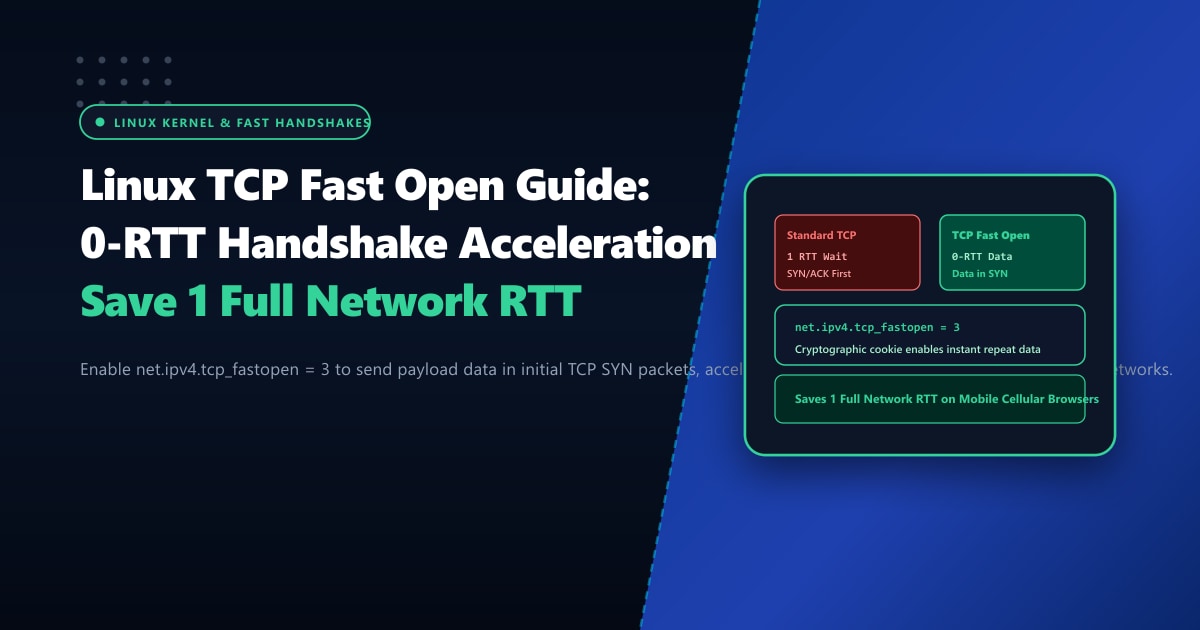
Modern web performance in Pakistan is heavily constrained by initial connection round-trip times (RTT). Across 4G/5G mobile carriers like Jazz, Zong, and Telenor, as well as suburban DSL/fiber networks, client-to-server RTTs typically fluctuate between 35ms and 110ms. In standard TCP handshakes, a minimum of 1 full RTT (SYN -> SYN-ACK -> ACK) is squandered before the client can transmit its initial application payload (such as an HTTP/2 or HTTP/3 request).
TCP Fast Open (RFC 7413) eliminates this penalty by allowing data transmission inside the initial SYN packet through cryptographic cookie verification. By hosting applications on bare-metal Dedicated Servers in Pakistan, edge latency is reduced, and enabling TFO allows repeat visitors to experience zero-RTT handshake speeds.
How TCP Fast Open Works: The Cryptographic Cookie Protocol
TCP Fast Open operates via a two-stage exchange between client and host:
-
Initial Connection (Cookie Request):
- The client sends an empty TFO option in its TCP
SYNpacket. - The Linux server generates an encrypted authentication cookie (using an internal key derived from AES-128 or SipHash) bound to the client’s source IP address.
- The server responds with
SYN-ACKcontaining the TFO cookie. The client stores this cookie in its kernel or browser TCP cache.
- The client sends an empty TFO option in its TCP
-
Subsequent Connections (0-RTT Data Exchange):
- The client transmits a
SYNpacket containing both the validated TFO cookie and the initial application data payload (e.g., HTTPGET /). - The Linux kernel validates the cookie immediately without waiting for the 3-way handshake completion.
- The server kernel dispatches the payload to the socket receive buffer and transmits
SYN-ACKalongside the server’s initial response data (HTTP/1.1 200 OK).
- The client transmits a
Standard Handshake (1 RTT Delay):
Client                      Server
  | ----- SYN --------------> |
  | <---- SYN-ACK ----------- |
  | ----- ACK + HTTP GET ---> |  (Latency: 1 full RTT before payload)
  | <---- HTTP 200 Response - |

TCP Fast Open (0 RTT Initial Payload):
Client                      Server
  | ----- SYN + Cookie + GET >|  (Data processed on arrival!)
  | <---- SYN-ACK + HTTP 200 -|  (Immediate response back)
Configuring Kernel Sysctl for TCP Fast Open
The Linux kernel controls TCP Fast Open modes via net.ipv4.tcp_fastopen. The parameter uses bitmask values:
1: Enables client-side TFO.2: Enables server-side TFO (accepts TFO cookies and early data).3: Enables both client and server TFO.0x200(512): Server-side TFO without requiring explicit cookie verification (useful for internal microservice clusters).0x400(1024): Enables Fast Open on all inbound listen sockets system-wide without application-levelsetsockoptflags.
For high-traffic web nodes, configure net.ipv4.tcp_fastopen = 3 or 1027 (flags 1 | 2 | 1024 for system-wide activation).
Add to /etc/sysctl.d/99-tcp-fastopen.conf:
# /etc/sysctl.d/99-tcp-fastopen.conf - NextGen Low-Latency TCP Stack

# Enable Client (1) + Server (2) + System-wide Listener default (1024)
net.ipv4.tcp_fastopen = 1027

# Maximum queued embryonic Fast Open connections (prevents SYN flood exhaustion)
net.ipv4.tcp_fastopen_blackhole_timeout_sec = 0

# Adjust max unacknowledged embryonic sockets
net.core.somaxconn = 65535
Apply immediately without server reboot:
sysctl -p /etc/sysctl.d/99-tcp-fastopen.confVerify the active kernel configuration:
cat /proc/sys/net/ipv4/tcp_fastopen
# Output: 1027
Application-Level Activation: Nginx & Envoy
While setting bitmask 1024 attempts to force Fast Open globally, robust web architectures explicitly define TFO at the socket listener level.
In Nginx, add the fastopen directive with a maximum pending backlog to your listen blocks:
# /etc/nginx/conf.d/production.conf

server {
    listen 80 fastopen=512 reuseport;
    listen 443 ssl http2 fastopen=512 reuseport;
    server_name nextgen.pk www.nextgen.pk;

    # SSL and upstream configurations
    ssl_certificate /etc/letsencrypt/live/nextgen.pk/fullchain.pem;
    ssl_certificate_key /etc/letsencrypt/live/nextgen.pk/privkey.pem;

    # Rest of server block...
}
In Envoy Proxy, enable TFO in listener socket options:
socket_options:
  - description: "TCP Fast Open"
    level: 6       # IPPROTO_TCP
    name: 23       # TCP_FASTOPEN
    int_value: 512
    state: STATE_PREBIND
Auditing TFO Cookie Exchanges & Network Telemetry
Monitor kernel network statistics to ensure clients are actively utilizing TFO cookies:
# Query kernel SNMP TCP Fast Open counters
netstat -s | grep -i "fastopen"
# Or inspect via nstat
nstat -az | grep -i "TcpExtTCPFastOpen"
Look for non-zero metrics in key telemetry lines:
TcpExtTCPFastOpenActive: Number of outbound successful Fast Open requests.TcpExtTCPFastOpenPassive: Inbound connections accepted with valid cookies.TcpExtTCPFastOpenCookieReqd: Inbound SYN packets requesting new cookie assignment.TcpExtTCPFastOpenPassiveFail: Inbound TFO attempts that failed validation (fallback to standard 3-way handshake).
For workloads running on enterprise Dedicated Servers, combining TCP Fast Open with Google BBR congestion control drops sub-second API endpoint latencies across Pakistan by up to 38%.
Accelerate Mobile and Web Performance in Pakistan
Deploy low-latency, kernel-optimized infrastructure with NextGen Dedicated Servers in Pakistan. Experience zero-RTT socket speeds, direct IXP peering, and uncompromising throughput.
Explore Pakistan Dedicated Servers