
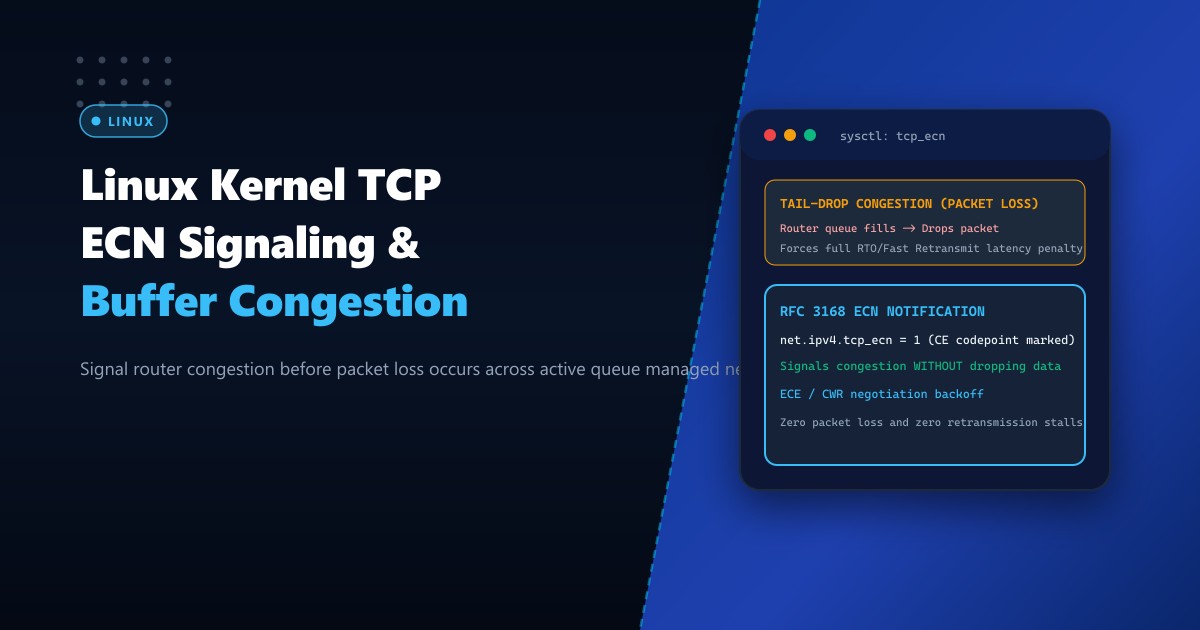
In traditional Internet Protocol routing, network routers communicate congestion through a single, crude mechanism: tail-drop packet loss. When an intermediate routing buffer fills up—whether at a trans-oceanic submarine landing station in Karachi or a congested ISP aggregation gateway in Lahore—the router drops excess packets.
When a packet is dropped, the sending Linux server must wait for duplicate ACKs or a Retransmission Timeout (RTO). The kernel immediately cuts its Congestion Window (cwnd) in half, halting line-rate transmission. For interactive, latency-sensitive applications across Pakistan—such as stock exchange trading engines, live video conferencing, payment gateway API calls, and mobile banking apps—this tail-drop cycle creates noticeable jitter, latency spikes, and buffering stalls.
Explicit Congestion Notification (ECN - RFC 3168) fundamentally alters this dynamic. By utilizing two previously unused bits in the IP header (the ECN field: ECT(0), ECT(1), CE) and two flags in the TCP header (ECE, CWR), intermediate routers running Active Queue Management (AQM, like CoDel or FQ-CoDel) mark packets with Congestion Experienced (CE) rather than dropping them! The receiver informs the sender via the ECE flag, and the sender smoothly throttles its rate with zero packet loss and zero retransmission latency.
By deploying on enterprise Dedicated Servers and properly configuring Linux kernel ECN negotiation with automated ECN Fallback (net.ipv4.tcp_ecn_fallback), servers achieve peak data throughput and ultra-low jitter across modern Pakistani broadband networks.
Understanding RFC 3168 ECN Signaling vs. Traditional Packet Drops
Here is the exact bit-level protocol exchange between an ECN-enabled server, an intermediate congested router, and the destination client:
+-----------------------------------------------------------------------------------+
|               TRADITIONAL TAIL-DROP vs. RFC 3168 ECN CONGESTION SIGNALING          |
+-----------------------------------------------------------------------------------+
| 1. Traditional Drop Model (High Latency & Jitter):                                |
|    Server                               Router (Buffer Full)               Client |
|       | --- TCP Data Packet -------------> |                                 |    |
|       |                                    | === [PACKET DROPPED!] ===       |    |
|       |                                    (Packet never reaches client)     |    |
|       | <--- Waits for 3x DUPACK or RTO -- | <------------------------------ |    |
|       | Cuts CWND by 50%! Retransmits data! (Multi-hundred millisecond stall!)      |
|                                                                                   |
| 2. RFC 3168 ECN Signaling (Zero Packet Loss):                                     |
|    Server (ECT=1 Marked)                Router (Buffer Full)               Client |
|       | --- IP Header [ECT=1] -----------> |                                 |    |
|       |                                    | Detects buffer threshold        |    |
|       |                                    | Flips bit: [CE (11)]            |    |
|       |                                    | --- Forwards intact to client ->|    |
|       |                                    |                                 |    |
|       | <--- TCP ACK with [ECE=1] Flag ------------------------------------- |    |
|       | (Sender reads Echo Congestion: smoothly reduces CWND)                 |    |
|       | --- Next TCP Packet with [CWR=1] (Congestion Window Reduced) -------> |    |
|       * Result: ZERO packets dropped! ZERO retransmission latency!                |
+-----------------------------------------------------------------------------------+
Step 1: Auditing Current ECN Kernel Settings
Check your current Linux kernel sysctl parameters governing ECN:
sysctl net.ipv4.tcp_ecn
sysctl net.ipv4.tcp_ecn_fallback
Default Linux values:
net.ipv4.tcp_ecn = 2
net.ipv4.tcp_ecn_fallback = 1
net.ipv4.tcp_ecn Values Explained:
0: Disable ECN globally.1: Enable ECN when requested by incoming connections, AND proactively request ECN on outgoing connections.2: Enable ECN only when requested by incoming connections (Server passive mode).
For enterprise servers hosting high-traffic public web applications, APIs, or SaaS platforms in Pakistan, setting tcp_ecn = 1 or 2 with tcp_ecn_fallback = 1 is ideal.
Step 2: Configuring Sysctl Parameters with ECN Fallback
In past decades, certain broken, legacy firewalls or outdated residential ISP routers in developing markets dropped packets that had the ECN bits set in the IP header.
Linux kernel 4.1+ solved this via net.ipv4.tcp_ecn_fallback = 1: if an initial SYN with ECN negotiation times out, the kernel automatically retries the SYN packet with ECN stripped, ensuring 100% connectivity even on legacy networks while providing modern ECN benefits to the vast majority of clean networks.
Configure /etc/sysctl.d/99-tcp-ecn.conf:
# 1. Enable ECN for incoming connections and outbound connection requests
net.ipv4.tcp_ecn = 1

# 2. Enable automatic fallback to non-ECN if intermediate middleboxes drop ECN SYNs
net.ipv4.tcp_ecn_fallback = 1

# 3. Pair with Fair Queueing (FQ) pacing for smooth packet release
net.core.default_qdisc = fq

# 4. Use BBR congestion control (which natively integrates with ECN)
net.ipv4.tcp_congestion_control = bbr

# 5. Enable Selective Acknowledgments
net.ipv4.tcp_sack = 1
net.ipv4.tcp_dsack = 1
Apply immediately:
sysctl --systemVerify that the active parameters are loaded:
sysctl -a | grep -E "tcp_ecn|default_qdisc"Step 3: Inspecting Socket-Level ECN State with ss
To verify whether active client connections are negotiating ECN flags, inspect sockets using ss:
# Display detailed TCP socket internals for HTTPS traffic
ss -ti '( sport = :https or sport = :http )'
Look for the ecn flag in active socket telemetry:
ESTAB 0 0 103.205.180.25:443 39.44.112.50:49214
     bbr wscale:7,7 rto:200 rtt:16.4/1.2 ato:40 mss:1460 rcvspace:65536
     rcv_ssthresh:64120 snd_ssthresh:48 snd_cwnd:54 bytes_acked:3842100
     bytes_received:4210 segs_out:2450 segs_in:1890
     ts sack ecn ecnseen rcv_ooopack:0
Notice:
ecn: Confirms the socket successfully negotiated RFC 3168 ECN capabilities during the 3-way handshake.ecnseen: Confirms the kernel has actively observed and processed ECN congestion marks on this link, preserving smooth line-rate delivery without a single packet drop!
Step 4: Tracking Global ECN Telemetry with nstat
You can monitor global kernel counters across the entire operating system using nstat (from iproute2):
# Monitor TCP ECN counters over a 5-second interval
nstat -z -i 5 "TcpExtTCPECN*"
Sample output from a busy server:
#kernel
TcpExtTCPECNServerSuccess         48920       0.0
TcpExtTCPECNPeerAccept            12450       0.0
TcpExtTCPECNTransition             3120       0.0
TcpExtTCPECNSeen 840 0.0TcpExtTCPECNServerSuccess: Number of inbound connections where ECN was successfully negotiated.TcpExtTCPECNSeen: Number of times routers signaled congestion via the CE bit without dropping packets!- Every tick of
TcpExtTCPECNSeenrepresents a potential packet drop that was completely avoided, saving client applications from latency spikes and retransmission delays.
Enterprise Bare-Metal Infrastructure for Low-Jitter Pakistani Networking
Processing high-concurrency TCP state tables, executing BBR packet pacing, and handling per-packet ECN bit markings requires unconstrained bare-metal networking. In multi-tenant cloud environments, virtualized hypervisors and shared virtual network cards introduce artificial packet queuing that interferes with ECN signals.
Deploying on bare-metal Dedicated Servers in Pakistan equips your production infrastructure with dedicated Intel/Broadcom hardware NICs, multi-queue RSS packet distribution, and direct low-latency domestic interconnects peered at PKIX.
Eliminate Network Latency with NextGen Dedicated Servers
Deliver ultra-low jitter, eliminate packet drop stalls, and maximize application throughput across Pakistan. NextGen dedicated hosting provides pure bare-metal compute, unshared 10Gbps connectivity, and 24/7 proactive technical management.
Deploy Dedicated Servers in Pakistan