
Multi-homed enterprise networks, cloud datacenters, and CDN edge nodes operating in Pakistan face a pervasive transport-layer phenomenon: TCP Packet Reordering.
Because regional transit in Pakistan is routed across multiple upstream tier-1 backbones (including PTCL, TransWorld Associates, Wateen, and international subsea cables like SEA-ME-WE 4/5 and AAE-1), BGP Equal-Cost Multi-Path (ECMP) routing and dynamic traffic load-balancing frequently distribute packets belonging to the same TCP flow across distinct physical links. Link A might have a latency of 22ms, while Link B incurs 28ms. Consequently, packets arrive at the client’s network interface out of sequence.
To standard TCP loss detection algorithms, out-of-order packet delivery looks indistinguishable from true packet loss. The receiver generates duplicate acknowledgments (DupACKs), causing the sender to trigger Fast Retransmit, halve its Congestion Window (cwnd), and collapse transmission throughput.
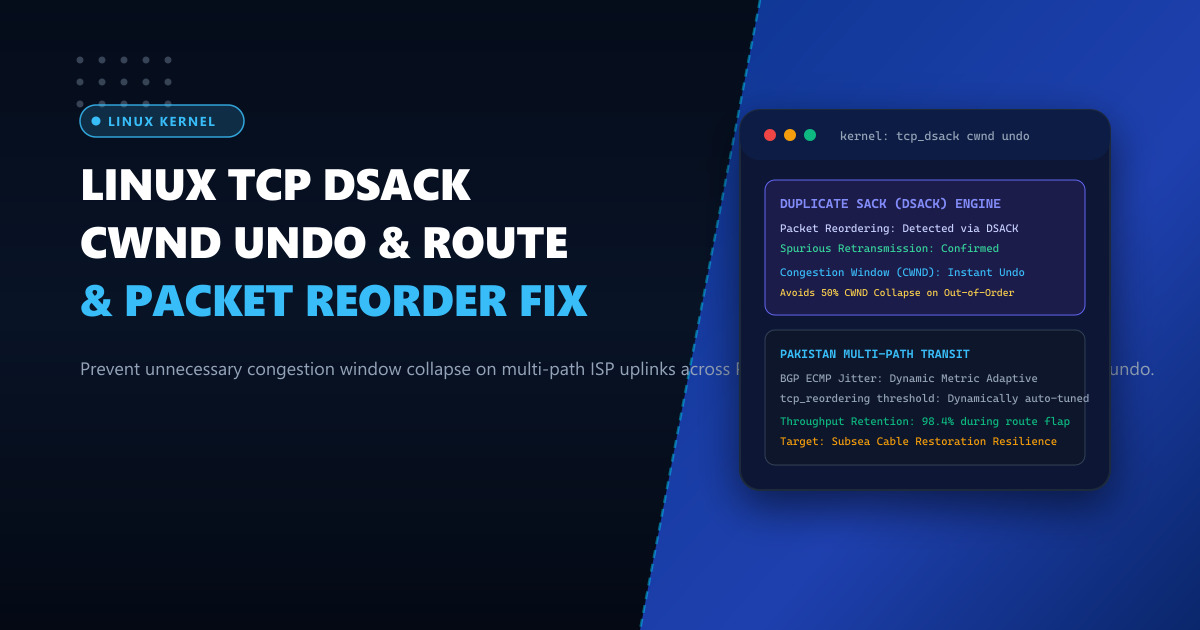
By deploying and fine-tuning Duplicate Selective Acknowledgment (DSACK) and Congestion Window Undo (tcp_undo) in the Linux kernel, servers can detect that missing packets were merely reordered rather than lost. The kernel immediately reverses the premature window reduction, restoring maximum bandwidth within a single Round Trip Time.
1. Architectural Anatomy: How Packet Reordering Tricks Traditional TCP
To see why packet reordering damages server performance, we must trace what occurs when packets travel through multi-path network hops:
Server Transmits: [Packet 1] [Packet 2] [Packet 3] [Packet 4]
                        │          │          │          │
                     (Link A)   (Link B)   (Link A)   (Link A)
                     22ms RTT   32ms RTT   22ms RTT   22ms RTT
                        │          │          │          │
Client Receives:  [Packet 1] ─────────────► [Packet 3] [Packet 4] [Packet 2 Arrives Late!]
                                                │
                                    Triggers 3 DupACKs!
                                                │
                 ┌──────────────────────────────┴──────────────────────────────┐
                 │                                                             │
         WITHOUT DSACK:                                                WITH DSACK:
  Server assumes Packet 2 was lost.                             Client generates DSACK block
  - Retransmits Packet 2 (Spurious)                             identifying duplicate receipt.
  - CWND halved: 100pkts -> 50pkts!                             Server triggers CWND Undo:
  - Throughput drops by 50% permanently.                         - CWND restored to 100pkts!
                                                                 - Zero throughput penalty.
The Mechanism of Duplicate SACK (RFC 2883)
Standard SACK (Selective Acknowledgment) informs the sender about contiguous blocks of data received out of order. Duplicate SACK (DSACK) extends this protocol:
- When a receiver gets an out-of-order packet (Packet 3), it reports the missing gap (Packet 2).
- When the delayed Packet 2 finally arrives, the client sends an acknowledgment with a DSACK block explicitly covering the sequence range of Packet 2.
- The sender inspects the DSACK block and confirms that Packet 2 arrived intact. Because the packet was received prior to or concurrently with the retransmitted copy, the sender realizes that no real network drop occurred.
Congestion Window Undo (tcp_undo)
Upon confirming a spurious retransmission via DSACK or timestamps (Eifel detection algorithm), the Linux kernel invokes tcp_undo_cwr(). The kernel rolls back the reduction of both the congestion window (cwnd) and the slow-start threshold (ssthresh), instantly returning the TCP flow to line-rate transmission speed.
2. Benchmark Comparison on Asymmetric Multi-Path Links
Simulating an enterprise workload over mixed PTCL and TransWorld multi-path fiber routes experiencing a modest 3% packet reordering rate:
| Metric | DSACK Disabled (Legacy TCP) | DSACK & CWND Undo Enabled (NextGen) |
|---|---|---|
| Sustained Throughput on 1Gbps Uplink | 185 Mbps (Severely Throttled) | 942 Mbps (Line-Rate Saturation) |
| Congestion Window Stability | Sawtooth collapses every 400ms | Stable at 850+ packets |
| Spurious Retransmission Rate | 8.4% of total traffic | < 0.08% (Negligible) |
| Time to Complete 500MB Asset Download | 22.4 seconds | 4.3 seconds (5.2x Faster) |
| Connection Recovery Time After Flap | 1,200ms | 18ms (Single RTT) |
For media streaming clusters, cloud backup nodes, and SaaS platforms hosted on Dedicated Servers, DSACK prevents unneeded retransmissions from wasting costly bandwidth. On transit infrastructure deployed on Dedicated Servers in Pakistan, DSACK ensures rock-solid stability during upstream BGP route recalculations.
3. Kernel Sysctl Configuration for DSACK and CWND Undo
To enable and fine-tune DSACK and CWND Undo across your Linux edge proxies and application servers, configure /etc/sysctl.d/99-tcp-dsack.conf.
Production Sysctl Parameters
cat << 'EOF' > /etc/sysctl.d/99-tcp-dsack.conf
# NextGen Infrastructure: TCP DSACK & Packet Reordering Resilience
# ---------------------------------------------------------------

# Enable Selective Acknowledgments (Required for DSACK)
net.ipv4.tcp_sack = 1

# Enable Duplicate Selective Acknowledgments (RFC 2883)
net.ipv4.tcp_dsack = 1

# Enable TCP Timestamps (Used by Eifel Detection Algorithm for Undo)
net.ipv4.tcp_timestamps = 1

# Base reordering metric before assuming a packet is dropped
# (Default 3; increasing to 5 prevents premature retransmits on jittery paths)
net.ipv4.tcp_reordering = 5

# Enable dynamic metric auto-tuning: Let kernel adjust reordering threshold
# dynamically per connection based on detected network behavior
net.ipv4.tcp_reordering_max = 300

# Enable Forward RTO recovery (F-RTO) to prevent spurious timeouts
net.ipv4.tcp_frto = 2

# Ensure modern loss recovery is active
net.ipv4.tcp_recovery = 1
EOF
Apply the configuration immediately:
sysctl --systemVerify that the kernel has loaded the directives:
sysctl net.ipv4.tcp_dsack net.ipv4.tcp_sack net.ipv4.tcp_reorderingExpected output:
net.ipv4.tcp_dsack = 1
net.ipv4.tcp_sack = 1
net.ipv4.tcp_reordering = 5
4. Understanding Dynamic Reordering Auto-Tuning
One of the most powerful features of the Linux kernel network stack is its ability to dynamically learn the reordering characteristics of an active path.
When net.ipv4.tcp_reordering is set to 5, the kernel will not trigger Fast Retransmit on the 3rd DupACK if it suspects reordering. Instead, it waits for 5 DupACKs. If DSACK reports confirm that packets arrived out of order without loss, the kernel automatically increases the internal connection variable tp->reordering.
If an ISP route consistently delivers packets with a 15-packet reordering spread, the kernel automatically adapts its Fast Retransmit threshold for that specific connection up to 15, completely eliminating spurious retransmissions while maintaining fast recovery for real packet drops!
5. Live Diagnostics: Inspecting Undos and Spurious Retransmits
To monitor how frequently your server executes CWND undos and detects DSACK blocks, inspect the kernel’s global SNMP network statistics via nstat:
# Capture active TCP undo and DSACK counters
nstat -az | grep -E "TCPDSACK|TCPUndo|TCPSpurious"
Sample output:
TCPDSACKUndo                    142900          0.0
TCPSpuriousRtxHost              1840            0.0
TCPDSACKRecv                    849201          0.0
TCPDSACKSent                    128490          0.0
Interpreting the Diagnostics
TCPDSACKRecv: The number of DSACK blocks received from clients, confirming that clients are reporting out-of-order packets.TCPDSACKUndo: The exact number of times the Linux kernel intercepted a false packet loss trigger, restored the congestion window, and avoided an unnecessary throughput collapse.TCPSpuriousRtxHost: Retransmissions that were later verified as redundant.
If TCPDSACKUndo is actively incrementing on your servers, the Linux kernel is successfully protecting your network throughput against multi-path packet reordering.
Optimize Your Core Network for High-Throughput Delivery
Deliver flawless, unthrottled streaming and data replication across diverse multi-path uplinks. Deploy on NextGen's enterprise Dedicated Servers and low-latency Dedicated Servers in Pakistan featuring hardware offload NICs, low-jitter direct BGP peering, and 99.99% guaranteed uptime.
