
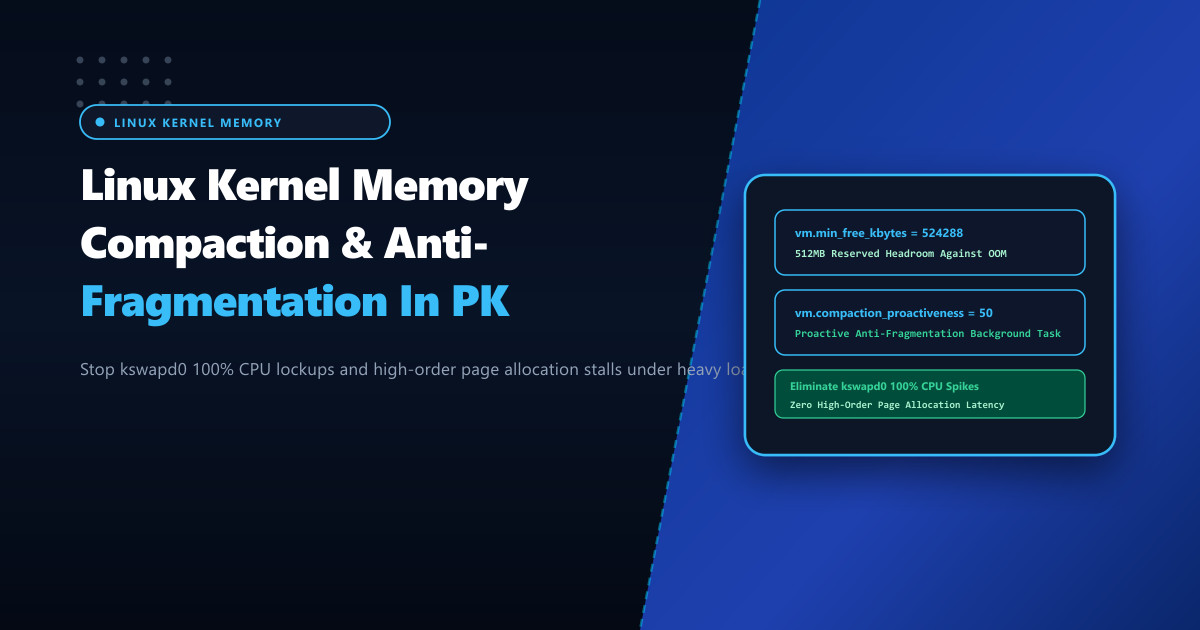
Under sustained multi-gigabyte memory loads—such as large database instances (MariaDB/PostgreSQL), in-memory caching tiers (Redis/Memcached), and high-concurrency virtualization hypervisors—Linux servers can experience sudden micro-freezes. System monitoring dashboards report CPU usage jumping to 100% across multiple cores, entirely consumed by the kernel daemon kswapd0, while active applications stall with log warnings like:
kernel: [184920.12] page allocation stalls for 1240ms, order: 3, mode: 0x14040c0
kernel: [184920.14] Node 0 Normal: 4500*4kB 1200*8kB 12*16kB 0*32kB 0*64kB 0*128kB 0*256kB 0*512kB 0*1024kB 0*2048kB
This phenomenon occurs when physical RAM becomes severely fragmented. Even when gigabytes of memory appear “free” or available in cache, the kernel is unable to locate contiguous physical memory blocks of high order (such as 2MB blocks for Transparent Huge Pages or 64KB blocks for network socket ring buffers).
Deploying high-density workloads on bare-metal Dedicated Servers provides the raw DDR4/DDR5 capacity needed, but system administrators must tune memory compaction and watermarks to permanently banish kswapd0 thrashing.
The Anatomy of Kernel Page Allocation Orders & Fragmentation
Linux divides physical memory into zones (DMA, DMA32, Normal) managed by the Buddy Allocator. Memory blocks are grouped in powers of two, known as “orders”:
- Order 0: 4 KB (1 page)
- Order 1: 8 KB (2 pages)
- Order 2: 16 KB (4 pages)
- Order 3: 32 KB (8 pages)
- Order 9: 2,048 KB / 2 MB (512 pages - standard HugePage size)
As files are created, cached, and discarded, memory space becomes fragmented like a checkerboard. When a network driver or database requests an Order-3 or Order-9 allocation and no contiguous block exists:
- Direct Reclaim: The requesting user process halts execution while synchronously scanning and freeing dirty file pages.
- Memory Compaction: The kernel moves unevictable pages around physical memory blocks to consolidate small free holes into contiguous spans.
- kswapd0 Lockup: If memory watermarks are improperly calibrated, the kernel background flusher runs continuously, burning 100% of CPU cycles in futile attempts to compact heavily fragmented memory.
Diagnosing Physical Memory Fragmentation via Buddyinfo
Inspect the health of memory orders across your system:
cat /proc/buddyinfoLook at the column progression from left (Order 0) to right (Order 10):
Node 0, zone Normal 18420 12400 6500 310 12 0 0 0 0 0 0If the higher-order columns (Orders 4 through 10) show zeros or single digits while low orders show tens of thousands, your physical RAM is severely fragmented. High-order page allocations will stall.
Kernel Sysctl Tuning for Proactive Anti-Fragmentation
Modern Linux kernels (5.x and 6.x) introduce advanced memory compaction knobs. Configure /etc/sysctl.d/99-memory-compaction.conf:
# /etc/sysctl.d/99-memory-compaction.conf - Anti-Fragmentation Tuning

# Ensure adequate reserved kernel memory headroom before direct reclaim kicks in
# Default is often too low (~64MB); scale to 512MB or 1GB on 64GB+ RAM nodes
vm.min_free_kbytes = 1048576

# Set watermark scale factor to trigger asynchronous background compaction early
# Default is 10 (0.1%); increase to 150 (1.5% of total memory)
vm.watermark_scale_factor = 150

# Enable proactive memory compaction in the background before allocation stalls occur
# (Available in Linux kernel 5.8+)
vm.compaction_proactiveness = 50

# Limit vfs cache pressure to prevent aggressive eviction of dentries and inodes
vm.vfs_cache_pressure = 50

# Lower swappiness on database nodes to avoid unnecessary NVMe swap thrashing
vm.swappiness = 10

# Configure Transparent Huge Pages to madvise mode
# Prevents synchronous global defragmentation stalls on arbitrary processes
Apply the configuration immediately:
sysctl -p /etc/sysctl.d/99-memory-compaction.confConfiguring Transparent Huge Pages (THP) to Madvise
Transparent Huge Pages (THP) allocated globally ([always]) frequently trigger allocation stalls because every dynamic process attempts to allocate 2MB chunks.
Switch THP to madvise so only optimized databases (like MariaDB or PostgreSQL) request huge pages explicitly:
# Check current THP status
cat /sys/kernel/mm/transparent_hugepage/enabled
cat /sys/kernel/mm/transparent_hugepage/defrag

# Configure madvise mode
echo madvise > /sys/kernel/mm/transparent_hugepage/enabled
echo defer+madvise > /sys/kernel/mm/transparent_hugepage/defrag
Make this setting permanent via systemd or grub kernel parameters (transparent_hugepage=madvise).
Triggering Manual On-Demand Memory Compaction
In maintenance automation or before heavy batch operations, trigger background kernel compaction manually:
# Instruct kernel to compact memory zones into high-order blocks
echo 1 > /proc/sys/vm/compact_memory

# Verify buddyinfo recovery
cat /proc/buddyinfo
Notice the immediate reappearance of contiguous blocks in Orders 6 through 9.
Running mission-critical enterprise workloads on Dedicated Servers in Pakistan ensures that database engines, virtual machines, and microservice meshes operate with low allocation latency and maximum system stability.
Optimize Server Stability with NextGen Dedicated Servers
Eliminate kernel memory stalls, CPU lockups, and I/O bottlenecks. Deploy scalable compute nodes with enterprise DDR5 ECC RAM and NVMe storage in Pakistan.
Explore Pakistan Dedicated Servers