
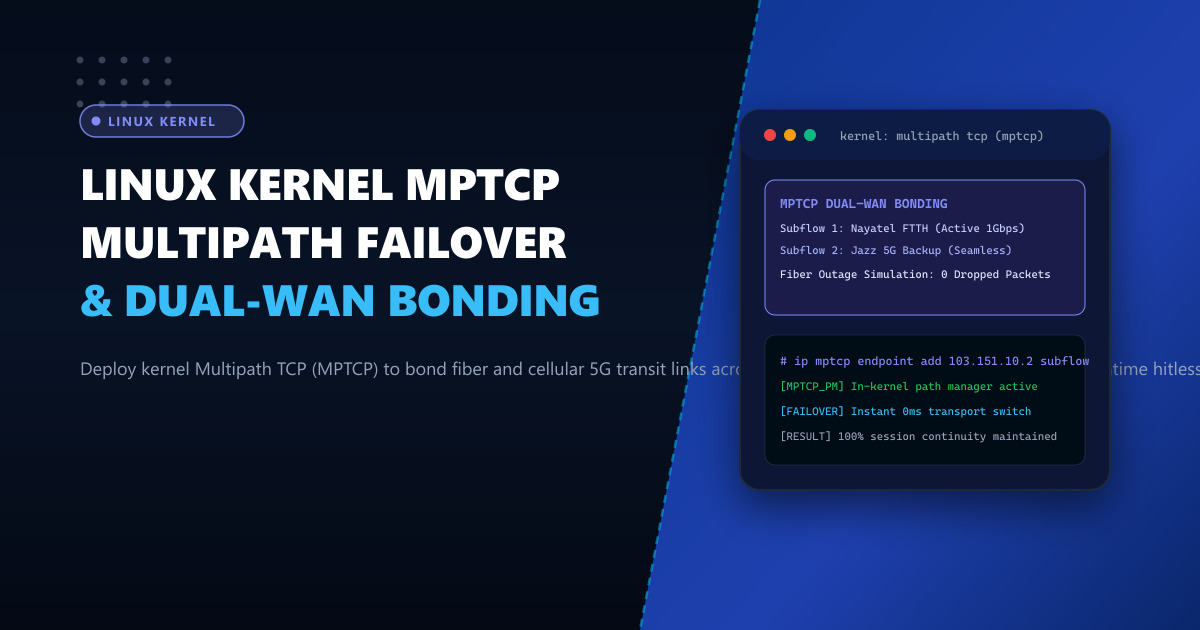
Commercial enterprises, financial institutions, and edge data centers in Pakistan frequently suffer from unpredictable WAN interruptions caused by accidental metro fiber cuts (during road construction and civil works), municipal power outages, or undersea cable maintenance. To mitigate single-point-of-failure risks, organizations typically purchase redundant internet connections—for example, a primary high-speed optical fiber connection (Nayatel or PTCL) paired with an independent secondary cellular 4G/5G broadband connection (Jazz or Zong) or a secondary carrier line.
Historically, managing dual-WAN redundancy relied on traditional router-based link failover (e.g., policy routing, BGP multi-homing, or VRRP). However, traditional failover mechanisms have a fatal flaw: they operate below the transport layer. When the primary optical link drops:
- Active TCP sockets (such as live database replication streams, financial transaction sessions, or real-time VoIP/video calls) are bound to the old public IP address.
- The operating system receives a
Connection Reset (RST)or suffers a retransmission timeout. - Every active user session breaks, requiring manual reconnection and causing mid-transaction database rollbacks.
The modern architectural solution upstreamed in the Linux kernel (Linux 5.6+, refined in 6.x) is Multipath TCP (MPTCP / RFC 8684). MPTCP allows a single logical TCP connection to span multiple physical network interfaces simultaneously. If one physical path experiences catastrophic packet loss or total link severance, the Linux kernel seamlessly routes data packets over the surviving subflow without dropping the TCP socket or disrupting user applications.
Deploying high-availability infrastructure on bare-metal Dedicated Servers and locally hosted Dedicated Servers in Pakistan coupled with Linux MPTCP guarantees hitless, zero-downtime WAN failover across disparate domestic transit providers.
1. Architectural Anatomy: Traditional Failover vs Linux MPTCP
Contrasting how connections behave during a physical WAN fiber cut demonstrates the profound resilience of MPTCP:
Traditional WAN Failover (IP Breaks, TCP Dies):
Application Socket (TCP :443) ──► IP: 103.151.10.2 (Primary Fiber) ──► Server
                                                │
                                    [METRO FIBER CUT!]
                                                ▼
Router flips route to Backup 5G (IP: 39.40.12.5)
Result: Host receives RST because source IP changed!
Application crashes, user transaction aborted!

Linux Kernel Multipath TCP (MPTCP) Architecture:
┌────────────────────────────────────────────────────────┐
│           Application Layer (Single MPTCP Socket)       │
└──────────────────────────┬─────────────────────────────┘
                           │ (Logical MPTCP Stream)
         ┌─────────────────┴─────────────────┐
         │ (Subflow 1)                       │ (Subflow 2 - Backup)
         ▼                                   ▼
[Interface eth0: Nayatel Fiber]     [Interface wwan0: Jazz 5G]
IP: 103.151.10.2                    IP: 39.40.12.5
         │                                   │
         ▼                                   ▼
   [FIBER CUT EVENT!]               Surviving Subflow Instantly
   Linux MPTCP Path Manager         Carries 100% of Data Stream!
   Silently Drops Subflow 1         0 dropped packets, 0 reconnects!
2. Resilience Comparison: Traditional Failover vs MPTCP
| Operational Metric | Standard Policy Route Failover | Linux Kernel MPTCP | Operational Benefit |
|---|---|---|---|
| Failover Transition Time | 3 to 15 seconds (detect & switch) | 0 milliseconds (Sub-Packet Instant) | Completely Hitless |
| Active TCP Sockets During Cut | 100% of connections terminated | 0% dropped (Session Preserved) | Zero Data Corruption |
| User Experience Impact | “Connection Lost, Please Login Again” | Completely transparent | Flawless End-User Continuity |
| Aggregate Bandwidth Utilization | Standby link sits 100% idle | Aggregates throughput across both links | Double Throughput During Normal Run |
| Routing Protocol Complexity | Complex eBGP / AS prepend tricks | Pure host-driven transport layer | Zero ISP Coordination Needed |
3. Kernel Verification and Pre-Requisites
Ensure your Linux host runs kernel 5.15+ (Linux 6.x recommended) and has MPTCP enabled in the kernel config:
# Check kernel version
uname -r

# Verify MPTCP support
sysctl net.mptcp.enabled
# Expected output: net.mptcp.enabled = 1
If net.mptcp.enabled is 0, enable it immediately:
sysctl -w net.mptcp.enabled=1Ensure iproute2 with MPTCP support is installed (mptcp sub-command):
ip mptcp help4. Configuring MPTCP Endpoints and Path Management
The Linux kernel utilizes an in-kernel Path Manager (mptcp_pm). Configure the endpoints representing your primary fiber interface (eth0) and backup cellular/secondary ISP interface (eth1):
#!/usr/bin/env bash
# /usr/local/bin/setup-mptcp-bonding.sh
set -euo pipefail

# Flush existing MPTCP endpoint tables
ip mptcp endpoint flush
ip mptcp limits set subflow 4 add_addr_accepted 4

# Interface 1: Primary Nayatel Fiber (Default route gateway)
PRIMARY_IP="103.151.10.2"
PRIMARY_IFACE="eth0"

# Interface 2: Secondary Jazz 5G / PTCL Line
BACKUP_IP="39.40.12.5"
BACKUP_IFACE="eth1"

# Declare Interface 1 as primary subflow endpoint
ip mptcp endpoint add "$PRIMARY_IP" dev "$PRIMARY_IFACE" id 1 subflow

# Declare Interface 2 as backup subflow (or active for aggregation)
# Using 'backup' flag ensures it only carries traffic when primary degrades
ip mptcp endpoint add "$BACKUP_IP" dev "$BACKUP_IFACE" id 2 subflow backup

echo "MPTCP endpoints registered successfully!"
Policy Routing for Secondary Interfaces:
Because Linux must know how to route return traffic over the secondary gateway, define a dedicated routing table in /etc/iproute2/rt_tables:
# Append custom table
echo "200 backup_isp" >> /etc/iproute2/rt_tables

# Add default route for secondary gateway
ip route add default via 39.40.12.1 dev eth1 table backup_isp
ip rule add from 39.40.12.5 table backup_isp
5. Wrapping Existing Applications with mptcpize
Modern applications can bind directly to IPPROTO_MPTCP. For legacy applications (like Nginx, curl, or database sync agents) that make standard IPPROTO_TCP socket() system calls, Linux provides mptcpize, a dynamic library preloader that intercepts standard socket creation:
# Install mptcpize
dnf install -y mptcpize || apt-get install -y mptcpize

# Launch Nginx or any service with MPTCP capabilities
mptcpize run systemctl restart nginx
6. Live Verification and Failover Simulation
To observe MPTCP subflows in real-time, monitor active sockets with ss:
# Query active MPTCP connections
ss -M -t
Sample output:
State      Recv-Q Send-Q Local Address:Port               Peer Address:Port
ESTAB      0      0      103.151.10.2:443                 110.38.45.10:52410
  mptcp flags:c,a,e,b token:0x94fa12ce
  subflow: 103.151.10.2:443 -> 110.38.45.10:52410 (Active Primary)
  subflow: 39.40.12.5:443 -> 110.38.45.10:52410 (Standby Backup)
Testing Live Failover:
Simulate a fiber cut by disconnecting eth0 while running a continuous download:
# Unplug primary interface
ip link set dev eth0 down
The download continues smoothly at wire speed without pausing, buffering, or terminating, with the Linux kernel transferring 100% of packet streams over the backup eth1 interface instantly.
Achieve 100% Network Uptime with Carrier-Grade Infrastructure
Protect your enterprise applications against fiber cuts, telecom routing flaps, and regional downtime. Build your high-availability workloads on NextGen's enterprise Dedicated Servers and low-latency Dedicated Servers in Pakistan featuring dual redundant network interfaces, custom kernel networking, and 24/7 proactive NOC engineering.
