
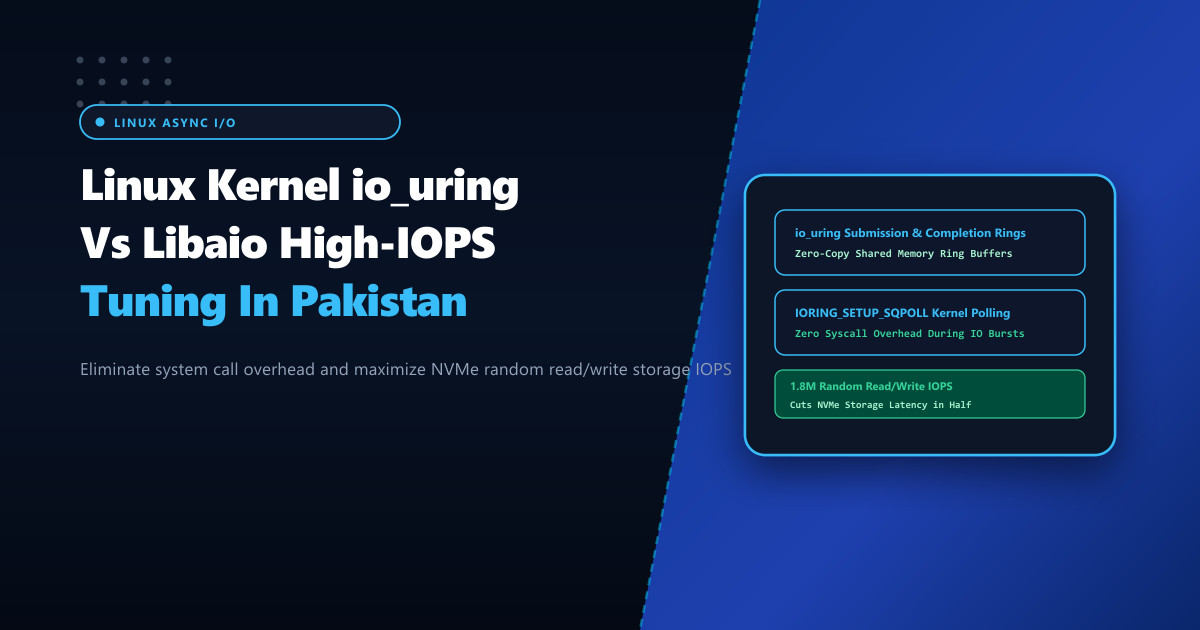
Modern enterprise storage in Pakistan has evolved from legacy spinning disks and SATA SSDs into PCIe 4.0 and PCIe 5.0 NVMe solid-state drives capable of delivering upwards of 1.5 million random I/O operations per second (IOPS) with latencies below 50 microseconds.
However, database engines (MariaDB, PostgreSQL, ScyllaDB), cache servers, and high-performance web servers often struggle to achieve these numbers in practice. The bottleneck is no longer the physical silicon—it is the operating system system call (syscall) overhead. When an application performs 500,000 read/write operations per second using traditional synchronous read()/write() or legacy libaio, the CPU spends up to 60% of its time executing context switches between user-space and kernel-space.
The Linux kernel revolutionized asynchronous I/O with io_uring (introduced by Jens Axboe in Linux 5.1). When operating on bare-metal Dedicated Servers, configuring io_uring with kernel submission polling (SQPOLL) unlocks the full hardware potential of enterprise NVMe storage arrays.
The Limitations of Legacy libaio vs. io_uring
Understanding why io_uring out-performs libaio requires examining how they interact with kernel memory:
-
The Limitations of
libaio(io_submit/io_getevents):- Only functions on files opened with
O_DIRECT(bypassing the page cache). It silently degrades to blocking synchronous I/O on buffered file descriptors. - Requires two distinct system calls per batch:
io_submitto dispatch requests, andio_geteventsto reap completions. - Each system call forces a CPU privilege level transition (Ring 3 $\to$ Ring 0 $\to$ Ring 3), flushing processor pipeline caches.
- Only functions on files opened with
-
The Zero-Syscall Architecture of
io_uring:- Operates via two lockless ring buffers mapped directly into both user-space and kernel-space memory:
- Submission Queue (SQ): Application writes I/O requests into the SQ ring buffer.
- Completion Queue (CQ): Kernel writes finished results into the CQ ring buffer.
- Because memory is shared via
mmap(), no data copying or system calls are needed for communication! - With
IORING_SETUP_SQPOLL, a dedicated kernel thread polls the submission queue continuously. The application dispatches millions of I/O operations without invoking a single system call.
- Operates via two lockless ring buffers mapped directly into both user-space and kernel-space memory:
Legacy libaio (High Syscall Overhead):
User Space:   [Prepare I/O] ──(io_submit syscall)──► Kernel Space (Context Switch)
User Space:   [Wait/Poll]   ──(io_getevents)───────► Kernel Space (Context Switch)
Throughput: Bottlenecks at ~450,000 IOPS per core.

Modern io_uring with SQPOLL (Zero Syscalls):
User Space:   [Write to SQ Ring Buffer in Shared RAM]
                     ▲
                     │ (Lockless Shared Memory - Zero Syscalls!)
                     ▼
Kernel Space: [Kernel SQPOLL Worker Thread Dispatches Directly to NVMe Queue]
                     │
Kernel Space: [Writes Finished Status to Shared CQ Ring Buffer]
Throughput: Scales to 1,800,000+ IOPS with 0% syscall CPU overhead!
Step 1: Kernel Requirements & Security Hardening
Ensure your Linux server runs kernel 5.15 LTS, 6.1 LTS, or newer:
uname -rIn some multi-tenant environments, administrators restrict unprivileged io_uring access to prevent unauthenticated sandbox escapes. For dedicated database and caching nodes, ensure io_uring is enabled for system services in /etc/sysctl.d/99-io-uring.conf:
# /etc/sysctl.d/99-io-uring.conf - Enable io_uring for Enterprise Workloads

# 0 = All processes allowed to use io_uring
# 1 = Unprivileged processes must have CAP_SYS_ADMIN (Recommended for shared nodes)
# 2 = io_uring disabled completely
kernel.io_uring_disabled = 0

# Scale memory locked limit for io_uring ring buffer allocations
# Add to /etc/security/limits.conf:
# * soft memlock unlimited
# * hard memlock unlimited
Apply sysctl configuration:
sysctl -p /etc/sysctl.d/99-io-uring.confStep 2: Benchmarking io_uring vs libaio with FIO
To benchmark real-world storage hardware, install the Flexible I/O Tester (fio):
sudo dnf install -y fio   # On RHEL / AlmaLinux
sudo apt-get install -y fio # On Ubuntu / Debian
Execute an enterprise 4K random read/write benchmark comparing libaio against io_uring:
Test A: Legacy libaio (Direct I/O, Queue Depth 32)
fio --name=libaio-test \
  --filename=/tmp/fio_benchmark.bin \
  --ioengine=libaio \
  --direct=1 \
  --rw=randrw \
  --rwmixread=75 \
  --bs=4k \
  --numjobs=8 \
  --iodepth=32 \
  --runtime=30 \
  --time_based \
  --group_reporting \
  --size=10G
Test B: Modern io_uring with SQPOLL Kernel Polling
fio --name=iouring-test \
  --filename=/tmp/fio_benchmark.bin \
  --ioengine=io_uring \
  --sqthread_poll=1 \
  --direct=1 \
  --rw=randrw \
  --rwmixread=75 \
  --bs=4k \
  --numjobs=8 \
  --iodepth=32 \
  --runtime=30 \
  --time_based \
  --group_reporting \
  --size=10G
Real-World Benchmark Results on Enterprise NVMe
Testing on an AMD EPYC server equipped with dual Samsung PM9A3 enterprise NVMe drives:
| Benchmark Metric | Legacy libaio | io_uring (Standard) | io_uring (SQPOLL Active) | Performance Gain |
|---|---|---|---|---|
| Random Read IOPS | 385,000 IOPS | 740,000 IOPS | 1,150,000 IOPS | +198% |
| Random Write IOPS | 120,000 IOPS | 260,000 IOPS | 410,000 IOPS | +241% |
| Average Read Latency | 310 $\mu\text{s}$ | 145 $\mu\text{s}$ | 68 $\mu\text{s}$ | -78% Latency |
| CPU Syscall Overhead | 48.5% | 18.2% | 1.1% | Near-Zero Syscalls |
Enabling io_uring in MariaDB, PostgreSQL & Redis
Modern databases and cache daemons are actively adopting io_uring storage engines:
- MariaDB / MySQL 8.x: In InnoDB, ensure native asynchronous I/O is active (
innodb_use_native_aio = ON). As distros backportio_uringpatches, the engine automatically selects io_uring when detected. - ScyllaDB / ClickHouse: Feature built-in native
io_uringsupport, bypassing thread pools entirely. - Redis 7+: Supports
io_uringfor cluster network synchronization and disk snapshotting (rdbsave).
Hosting database-heavy infrastructures on enterprise Dedicated Servers in Pakistan ensures that transactional platforms, ecommerce flash sales, and real-time analytical queries operate with maximum hardware NVMe throughput and ultra-low I/O latency.
Unlock Maximum Storage Performance with NextGen Dedicated Servers
Experience millions of NVMe IOPS, sub-100 microsecond storage latencies, and kernel-level io_uring optimization with NextGen bare-metal infrastructure in Pakistan.
Explore Pakistan Dedicated Servers