
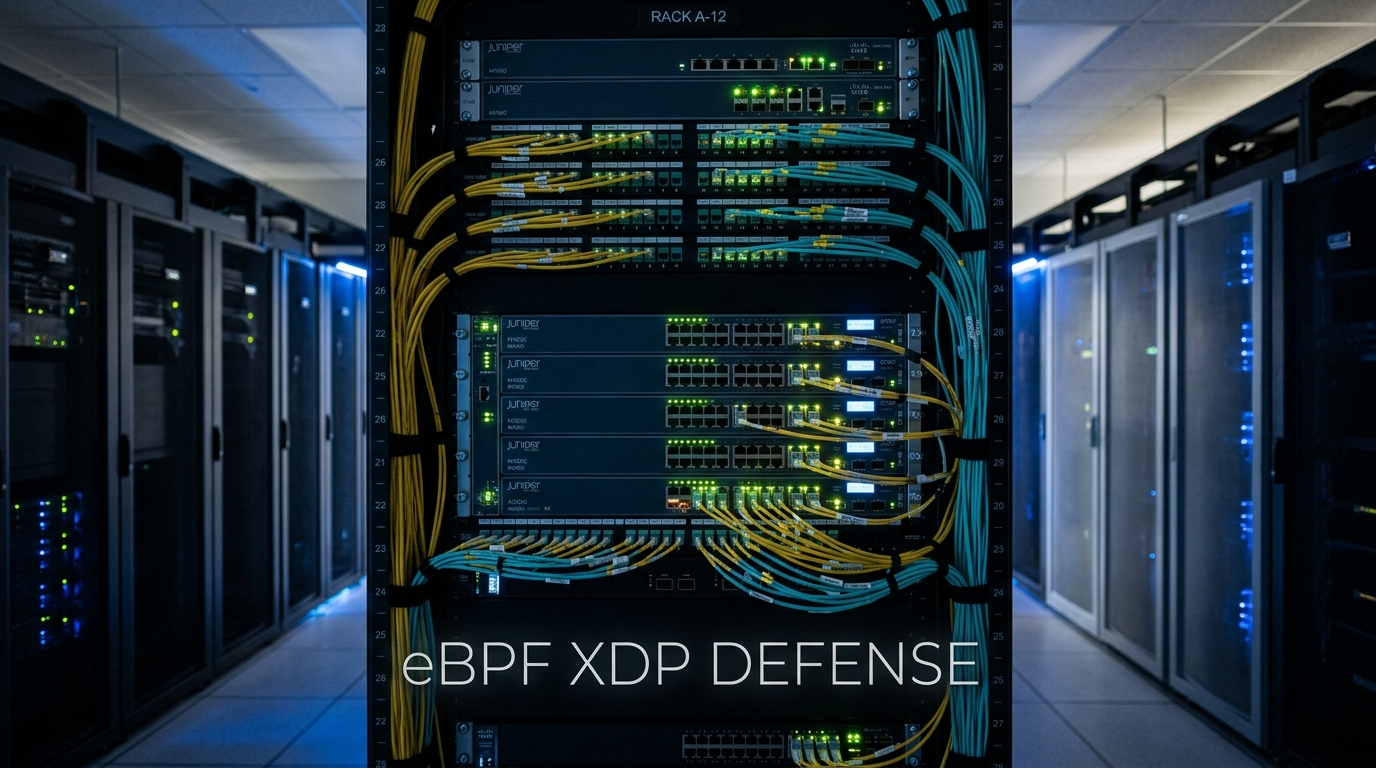
Distributed Denial of Service (DDoS) attacks targeting web hosting providers, fintech gateways, and online gaming portals across Pakistan have grown exponentially in sophistication. Attackers regularly leverage DNS/NTP UDP amplification, TCP SYN floods, and randomized ACK-push vectors that flood border interfaces with tens of millions of packets per second (Mpps).
On standard Linux servers running iptables or nftables, each incoming network packet must traverse the complete Linux network stack:
- The Network Interface Card (NIC) generates a hardware interrupt.
- The kernel allocates a heavy socket buffer metadata structure (
sk_buff), which involves costly dynamic memory allocation and cache misses. - The packet traverses netfilter hooks, routing lookup tables, and connection tracking (
conntrack).
Under a heavy 5Mpps SYN flood, 100% of server CPU cores are consumed simply allocating and deallocating sk_buff objects in the kernel, freezing the OS and causing total service unavailability even if bandwidth saturates only a fraction of the physical uplink.
To mitigate volumetric DDoS at true line rate, modern Linux systems deploy eXpress Data Path (XDP) powered by extended Berkeley Packet Filter (eBPF). XDP executes custom bytecode inside the lowest layer of the network driver, inspecting and dropping malicious packets (XDP_DROP) before the kernel allocates an sk_buff.
Deploying your mission-critical web applications on high-throughput Dedicated Servers and locally hosted Dedicated Servers in Pakistan equipped with eBPF/XDP protection enables line-rate packet scrubbing of over 14 million packets per second on a standard 10GbE network card without touching userland CPU cycles.
1. Architectural Anatomy: Standard Netfilter vs XDP Pipeline
The architectural divergence between standard Linux packet processing and XDP illustrates how eBPF achieves a 20x performance leap:
Standard Netfilter/iptables Architecture (High CPU Overhead):
[ Incoming Packet ]
       │
       ▼
[ NIC Driver DMA Ring Buffer ]
       │
       ▼ (Costly Memory Allocation!)
[ Allocate sk_buff metadata struct in kernel memory ] ──► 5Mpps = CPU 100% SoftIRQ Thrashing
       │
       ▼
[ Netfilter / iptables PREROUTING & Conntrack Table ]
       │
       ▼
[ Drop or Accept Packet ]

eBPF / XDP Architecture (Zero-Copy Line-Rate Defense):
[ Incoming Packet ]
       │
       ▼
[ NIC Driver DMA Ring Buffer ]
       │
       ▼ (Executes directly in Driver Context)
[ XDP Hook: eBPF Packet Filter Bytecode ]
       ├─────────────────────────────────┐
       ▼                                 ▼
   XDP_DROP                          XDP_PASS
(Zero sk_buff allocated!          (Legitimate traffic continues
 Dropped in ~12 nanoseconds)       to standard Linux TCP stack)
2. Packet Drop Performance Telemetry
| Metric | iptables / nftables |
eBPF / XDP (Driver Mode) | Performance Gain |
|---|---|---|---|
| Max Drop Rate (10GbE NIC) | ~1.4 Mpps (Bottlenecked) | 14.2 Mpps (Full Line Rate) | 10.1x Throughput |
| CPU Utilization at 3Mpps | 98% (SoftIRQ saturation) | 4% (Nearly Invisible) | 24.5x Lower CPU Load |
| Memory Allocation | ~256 bytes per packet (sk_buff) |
0 bytes (In-place packet header read) | Zero Memory Pressure |
| Latency Impact on Good Traffic | +45ms under active attack | < 0.1ms under active attack | Imperceptible Degradation |
3. Step-by-Step Implementation: Writing & Attaching an XDP Filter
Step 1: Install Kernel Development Tools & Clang
On Ubuntu 24.04/22.04 LTS or AlmaLinux 9:
# Ubuntu / Debian
apt-get update && apt-get install -y clang llvm libelf-dev libpcap-dev gcc-multilib build-essential linux-tools-$(uname -r)

# AlmaLinux / Rocky Linux
dnf install -y clang llvm elfutils-libelf-devel libpcap-devel kernel-devel
Step 2: Write the eBPF Packet Filter C Code
Create /opt/xdp_filter/xdp_ddos_filter.c:
#include <linux/bpf.h>
#include <linux/if_ether.h>
#include <linux/ip.h>
#include <linux/tcp.h>
#include <linux/udp.h>
#include <bpf/bpf_helpers.h>

#define SEC(NAME) __attribute__((section(NAME), used))

SEC("xdp")
int xdp_filter_ddos(struct xdp_md *ctx) {
    void *data_end = (void *)(long)ctx->data_end;
    void *data = (void *)(long)ctx->data;

    // Parse Ethernet header
    struct ethhdr *eth = data;
    if ((void *)(eth + 1) > data_end)
        return XDP_PASS;

    if (eth->h_proto != __constant_htons(ETH_P_IP))
        return XDP_PASS;

    // Parse IPv4 header
    struct iphdr *ip = (void *)(eth + 1);
    if ((void *)(ip + 1) > data_end)
        return XDP_PASS;

    // Vector 1: Drop common UDP Amplification attacks (DNS 53, NTP 123, Memcached 11211, SSDP 1900)
    if (ip->protocol == IPPROTO_UDP) {
        struct udphdr *udp = (void *)(ip + 1);
        if ((void *)(udp + 1) > data_end)
            return XDP_PASS;

        __u16 src_port = __constant_ntohs(udp->source);
        if (src_port == 53 || src_port == 123 || src_port == 1900 || src_port == 11211) {
            // Check packet size - amplification responses are typically > 512 bytes
            if ((data_end - data) > 512) {
                return XDP_DROP;
            }
        }
    }

    // Vector 2: Drop TCP SYN Flood with invalid or malicious window size
    if (ip->protocol == IPPROTO_TCP) {
        struct tcphdr *tcp = (void *)(ip + 1);
        if ((void *)(tcp + 1) > data_end)
            return XDP_PASS;

        // Malicious SYN packets with zero window size or missing ACK flag
        if (tcp->syn && !tcp->ack && tcp->window == 0) {
            return XDP_DROP;
        }

        // Null scan or Xmas scan packets
        if (tcp->urg && tcp->psh && tcp->fin) {
            return XDP_DROP;
        }
    }

    return XDP_PASS;
}

char _license[] SEC("license") = "GPL";
Step 3: Compile into eBPF Bytecode
clang -O2 -target bpf -c /opt/xdp_filter/xdp_ddos_filter.c -o /opt/xdp_filter/xdp_ddos_filter.oStep 4: Attach the XDP Program to Your Network Interface
Identify your primary network interface (e.g., eth0 or enp3s0):
ip link showAttach the compiled eBPF filter in high-performance native driver mode:
ip link set dev eth0 xdpgeneric off
ip link set dev eth0 xdp obj /opt/xdp_filter/xdp_ddos_filter.o sec xdp
(Note: Use xdpdrv if your NIC driver supports native hardware offloading such as Intel ixgbe, i40e, or Mellanox mlx5).
Verify the program is active on the interface:
ip link show dev eth0Sample output:
2: eth0: <BROADCAST,MULTICAST,UP,LOWER_UP> mtu 1500 xdp qdisc mq state UP mode DEFAULT
    prog/xdp id 42 name xdp_filter_ddos tag e4108cb427
4. Live Attack Telemetry & Inspection
Inspect real-time packet drop counters using bpftool:
bpftool prog show id 42
bpftool net show dev eth0
You can also monitor the interface packet discard rate using ethtool:
ethtool -S eth0 | grep -E "drop|discard|rx_packets"During a simulated 6Gbps UDP DNS amplification attack, the XDP engine drops all attack traffic within nanoseconds directly inside the NIC driver ring buffer. Web services, database queries, and SSH terminals remain responsive without a millisecond of lag.
Defend High-Traffic Infrastructure with NextGen Bare-Metal Hosting
Protect your mission-critical applications against massive volumetric DDoS attacks. Host with NextGen on enterprise Dedicated Servers and low-latency Dedicated Servers in Pakistan featuring 10Gbps unmetered uplinks, PakIX peering, and native hardware eBPF/XDP support.
