
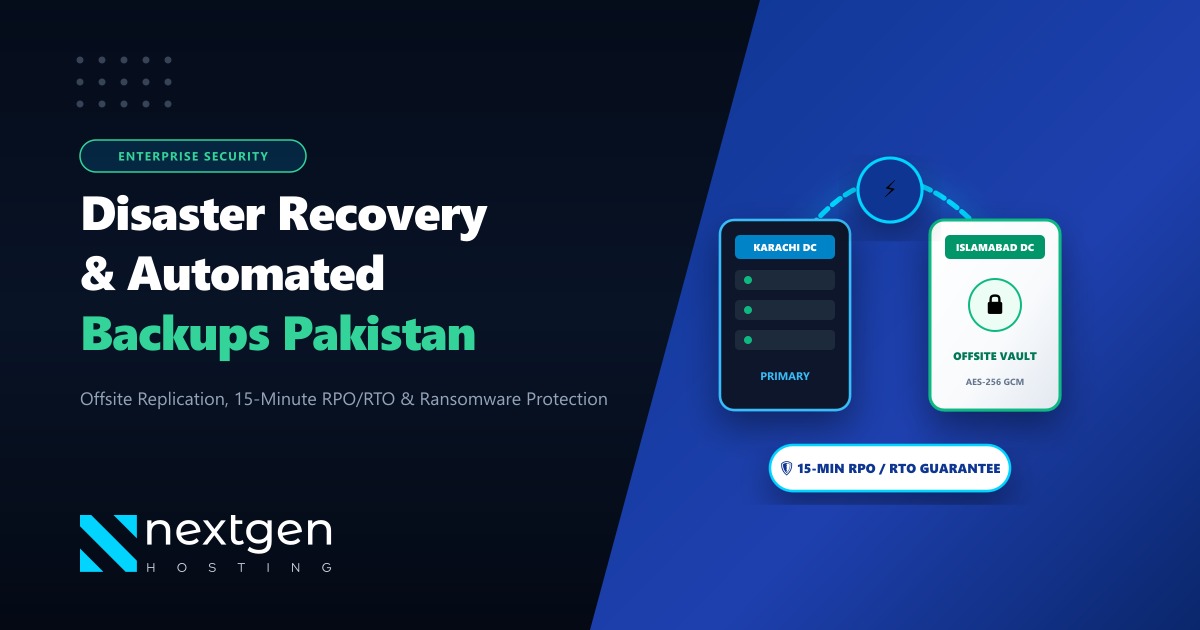
In the modern enterprise landscape of Pakistan, an unexpected disaster is never a theoretical risk—it is an inevitability. Whether caused by sudden municipal power grid trippings, undersea fiber cable cuts in the Arabian Sea, regional ISP peering disputes, or hardware storage controller failures, a catastrophic outage at a single datacenter can paralyze an entire corporate organization.
For financial institutions governed by the State Bank of Pakistan (SBP), commercial banks, large retail networks, logistics operators, and healthcare conglomerates, running on a single point of failure is no longer legally or commercially permissible.
Yet, enterprise CIOs and IT Directors face a crucial strategic dilemma: Should they invest millions of dollars into physical datacenter colocation space, rely entirely on expensive public hyperscalers, or build a resilient Hybrid Cloud on managed bare-metal dedicated infrastructure?
In this architecture guide, we break down the operational realities, cost structures, and technical mechanics of building a high-availability multi-datacenter topology within Pakistan.
The Strategic Comparison: Colocation vs. Hyperscalers vs. Managed Bare Metal
MODEL 1: TRADITIONAL DATACENTER COLOCATION
┌────────────────────────────────────────────────────────┐
│ Enterprise Buys Hardware (Dell/HPE Servers, Switches) │
│ Rents Physical Rack Space & Power in Tier-3 Datacenter │
└────────────────────────────────────────────────────────┘
CapEx: Massive upfront capital expense (servers, cabling, spares).
OpEx: Power per KVA, cross-connect fees, remote hands travel.
Flexibility: Low (hardware upgrades require months of procurement).

MODEL 2: PUBLIC HYPERSCALER CLOUD (AWS / Azure / GCP Overseas)
┌────────────────────────────────────────────────────────┐
│ Virtual Instances in Singapore, UAE, or Frankfurt      │
└────────────────────────────────────────────────────────┘
CapEx: Zero upfront.
OpEx: Unpredictable monthly bills, expensive USD egress bandwidth.
Latency: High (60ms–140ms international transit round-trip).
Compliance: Fails SBP sovereign data residency mandates for banking.

MODEL 3: MANAGED BARE-METAL HYBRID CLUSTER (Recommended)
┌────────────────────────────────────────────────────────┐
│ High-Frequency Dedicated Servers in Islamabad & Karachi│
│ Interconnected via Private 10GbE PkIX Fiber Backbone   │
└────────────────────────────────────────────────────────┘
CapEx: Zero upfront capital expenditure.
OpEx: Predictable, transparent PKR billing.
Latency: Domestic ultra-low latency (8ms–14ms).
Compliance: 100% SBP and SECP data residency compliant.
To achieve peak resilience without committing to millions in depreciating hardware capital, enterprise leaders rely on managed bare metal. Explore enterprise infrastructure on Dedicated Servers and localized high-availability clusters on Dedicated Servers in Pakistan.
Karachi-to-Lahore/Islamabad Disaster Recovery Topologies
A robust disaster recovery architecture separates primary and secondary sites by at least 300 to 1,000 kilometers, ensuring a localized natural disaster, grid blackout, or subsea cable disruption cannot knock out both facilities.
GEO-REDUNDANT ENTERPRISE TOPOLOGY:
[CLIENT USERS ACROSS PAKISTAN]
              │
              ▼
    [BGP Anycast / GeoDNS]
     ┌────────┴────────┐
     │ (Normal Ops)    │ (Automatic Failover)
     ▼                 ▼
┌────────────────────────┐      Encrypted WireGuard VPN   ┌────────────────────────┐
│ PRIMARY DATA CENTER    │  Over PkIX / Nayatel Backbone  │ SECONDARY DR SITE      │
│ (Karachi Facility)     │ ─────────────────────────────► │ (Islamabad Facility)   │
│ ├─ Active Web Nodes    │    Asynchronous DB Sync        │ ├─ Standby Web Nodes   │
│ ├─ MariaDB Master Node │ ◄───────────────────────────── │ ├─ MariaDB Read Replica│
│ └─ Enterprise NVMe     │      (RPO < 2s / RTO < 30s)    │ └─ Hot-Standby Storage │
└────────────────────────┘                                └────────────────────────┘
Defining RPO and RTO in Disaster Recovery
Before writing configuration files, engineering teams must define two non-negotiable metrics with their executive stakeholders:
- Recovery Point Objective (RPO): The maximum acceptable age of data that can be lost when a disaster strikes.
- Example: An RPO of 1 minute means the business can tolerate losing at most the last 60 seconds of transactional data.
- Recovery Time Objective (RTO): The maximum acceptable duration of time the system can remain offline before being restored to service.
- Example: An RTO of 5 minutes means automated failover must complete and accept traffic within 300 seconds of primary failure.
Configuring Low-Latency Database Replication (MariaDB / PostgreSQL)
In a cross-country setup (Karachi to Islamabad, ~18ms to 24ms network latency), synchronous replication (Galera Cluster / 2PC) will slow down every write transaction on the primary master, because the primary must wait for an acknowledgment across 1,200 km before committing.
Therefore, use semi-synchronous or optimized asynchronous replication with GTID (Global Transaction IDs):
Primary Node Configuration (/etc/my.cnf.d/server.cnf):
[mysqld]
server_id = 101
log_bin = /var/log/mariadb/mariadb-bin
log_bin_index = /var/log/mariadb/mariadb-bin.index
binlog_format = ROW
binlog_row_image = FULL
gtid_strict_mode = ON

# Tune binlog cache to prevent disk I/O bottlenecks during large transactions
binlog_cache_size = 16M
max_binlog_size = 1G
expire_logs_days = 7
DR Replica Node Configuration:
[mysqld]
server_id = 102
relay_log = /var/log/mariadb/mariadb-relay-bin
gtid_strict_mode = ON
read_only = 1
super_read_only = 1
Pointing Replica to Primary via GTID:
CHANGE MASTER 'karachi_primary' TO
    MASTER_HOST='10.200.0.10',
    MASTER_USER='repl_dr_user',
    MASTER_PASSWORD='SecureVaultReplicationPass#2026',
    MASTER_PORT=3306,
    MASTER_USE_GTID=current_pos;

START SLAVE 'karachi_primary';
Automated Health Checks and DNS Failover
To achieve an RTO of under 30 seconds without human intervention:
- Deploy an external heartbeat monitoring mesh (testing HTTP 200, TCP 3306, and ICMP from 3 independent vantage points).
- If the Karachi primary site fails 3 consecutive health checks over 15 seconds, trigger an automated webhook.
- The webhook executes a failover script:
- Sets
super_read_only = 0on the Islamabad database node. - Updates Anycast BGP announcements or low-TTL DNS A-records to point traffic to the Islamabad IP pool.
- Sets
The Financial Advantage: Why Managed Dedicated Clusters Beat Colocation
Purchasing, racking, and maintaining physical servers in Pakistani commercial datacenters incurs high hidden costs:
- Procurement Delays: Importing server chassis, enterprise NVMe drives, and ECC RAM through Pakistani customs often takes 8 to 16 weeks.
- Hardware Lifecycle Depreciation: Servers lose 30% of their book value annually.
- On-Call Engineering Overhead: Paying a dedicated hardware NOC team for midnight drive swaps and power rail inspections.
With Nextgen’s Managed Bare-Metal Clusters:
- Instant hardware provisioning within 24 hours.
- Enterprise SLA guaranteeing 100% uptime with automated hardware replacements.
- Transparent, predictable Pakistani Rupee invoicing with zero foreign currency exposure.
Protect Your Enterprise with Multi-Datacenter Resilience in Pakistan
Never let a single facility outage jeopardize your business operations. Build high-availability, geographically redundant clusters with active failover across Karachi and Islamabad.
