
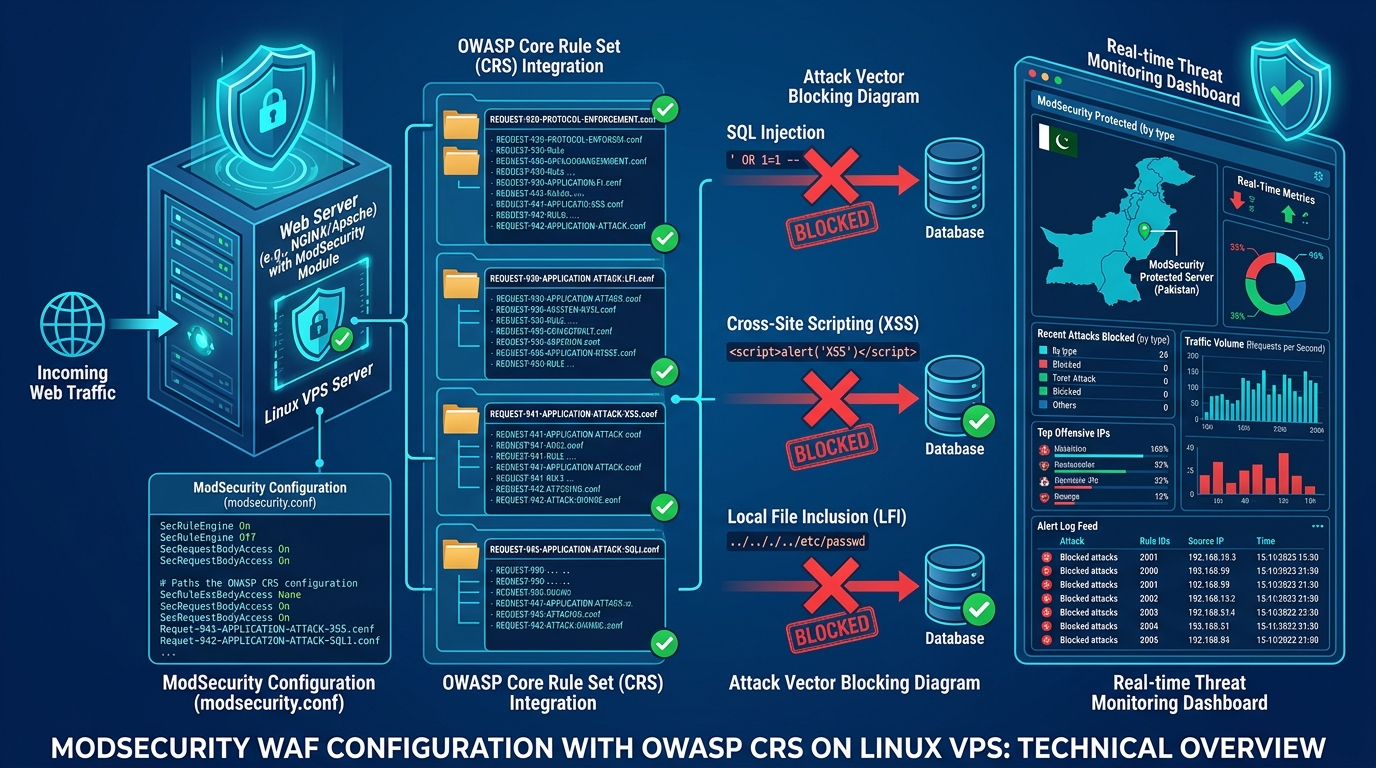
Mastering ModSecurity: Troubleshooting Complex False Positives in cPanel & WordPress
ModSecurity is a powerful Web Application Firewall (WAF) that acts as the first line of defense for your cPanel server. While it excels at blocking malicious traffic like SQL injections, Cross-Site Scripting (XSS), and zero-day exploits, its aggressive rule sets (such as OWASP Core Rule Set) often lead to false positives.
A false positive occurs when legitimate traffic—such as an administrator saving a complex WordPress post, an API endpoint receiving JSON payloads, or a payment gateway sending a webhook—is incorrectly flagged and blocked by the WAF.
In this highly technical guide, we’ll explore advanced diagnostic techniques to pinpoint the exact ModSecurity rules causing issues and implement surgical exclusions without compromising your server’s security posture.
1. The Anatomy of a ModSecurity Block
When ModSecurity blocks a request, it typically results in a 403 Forbidden or 406 Not Acceptable HTTP response. Behind the scenes, ModSecurity logs the detailed reason for this block.
To begin troubleshooting, you must locate the audit logs. In a standard cPanel/WHM environment, these logs are found at:
- Apache Error Log:
/usr/local/apache/logs/error_log(Provides a brief summary of the block). - ModSecurity Audit Log:
/usr/local/apache/logs/modsec_audit.log(Provides the complete request and response payloads, plus the matched rules).
Reading the Audit Log
A typical ModSecurity audit log entry is divided into sections (A through Z).
- Section A: The audit log header (Timestamp, Unique ID, Source IP, Source Port, Destination IP, Destination Port).
- Section B: The request headers.
- Section C: The request body (often where the false positive trigger lies).
- Section H: The audit log trailer, containing the critical
Message:directive which outlines the matched rule.
Example Log Snippet (Section H):
Message: Access denied with code 403 (phase 2). Pattern match "(?i:(?:\\b(?:(?:s(?:t(?:d(?:dev(_pop|_samp)?)?|r(?:_to_date|cmp))|u(?:b(?:str(?:ing(_index)?)?|date)|m)|e(?:c(?:_to_time|ond)|ssion_user)|y(?:s(?:tem_user|date)|md)|ha(?:1|2)?|oundex|chema|ign|in)|m(?:in(?:ute)?|a(?:ke_set|x)|onth(?:name)?|i(?:crosecond|d)|d5)| ..." at ARGS:post_content. [file "/etc/apache2/conf.d/modsec_vendor_configs/OWASP3/rules/REQUEST-942-APPLICATION-ATTACK-SQLI.conf"] [line "1123"] [id "942190"] [msg "Detects MSSQL code execution and information gathering attempts"] [severity "CRITICAL"] [tag "application-multi"] [tag "language-multi"] [tag "platform-multi"] [tag "attack-sqli"] [tag "paranoia-level/1"] [tag "OWASP_CRS/WEB_ATTACK/SQL_INJECTION"] [tag "WASCTC/WASC-19"] [tag "OWASP_TOP_10/A1"] [tag "OWASP_AppSensor/CIE1"] [tag "PCI/6.5.2"]Key Takeaways from the Log:
- ID (
942190): The specific rule ID that was triggered. - File: The configuration file containing the rule (
REQUEST-942-APPLICATION-ATTACK-SQLI.conf). - Target (
ARGS:post_content): The specific parameter in the request that triggered the rule (in this case, the body of a WordPress post).
2. Diagnosing WordPress-Specific False Positives
WordPress environments are notorious for triggering ModSecurity rules due to the complex HTML, JS, and sometimes PHP snippets saved within posts, theme settings, or page builders (like Elementor or Divi).
Common Scenarios:
- Saving a Page Builder Template: Triggers XSS rules (e.g., 941xxx series) because the payload contains raw HTML and JavaScript meant to be rendered on the frontend.
- Updating Plugins/Themes via WP-Admin: Triggers Remote File Inclusion (RFI) or Command Injection rules due to the file paths and commands executed during the update process.
- WooCommerce Webhooks: Triggers anomaly scoring or protocol violation rules if the JSON payload isn’t formatted exactly as ModSecurity expects.
Utilizing WHM ModSecurity Tools
cPanel provides a graphical interface that simplifies log analysis. Navigate to WHM > Security Center > ModSecurity Tools.
- Hits List: This interface lists recent ModSecurity triggers. You can filter by domain, IP address, or Rule ID.
- Reporting: Clicking “More” on a specific hit reveals the detailed Section H log, making it easy to identify the Rule ID and Target.
3. Implementing Surgical Exclusions (The Right Way)
The most common mistake administrators make is disabling ModSecurity entirely for a domain or globally disabling a rule across the entire server. This creates significant security vulnerabilities.
The correct approach is targeted whitelisting. You want to disable the specific rule only for the specific URI and specific parameter causing the issue.
Method 1: Using WHM (cPanel UI)
While WHM’s “ModSecurity Tools” allows you to disable rules, it often disables them globally. For targeted exclusions, you need to use Apache configuration includes.
Method 2: Manual Configuration via Apache Includes (Recommended)
To create a surgical exclusion, we use the SecRuleRemoveById, SecRuleUpdateTargetById, or SecRuleRemoveByTag directives within an Apache <LocationMatch> block.
In cPanel, custom Apache configurations should be placed in the appropriate Include directory. For a specific virtual host, you would typically use:
/etc/apache2/conf.d/userdata/std/2_4/username/domain.com/modsec_whitelist.conf (for HTTP)
/etc/apache2/conf.d/userdata/ssl/2_4/username/domain.com/modsec_whitelist.conf (for HTTPS)
Example 1: Whitelisting a Rule for a Specific WordPress Path
If Rule ID 942190 is blocking an administrator from saving posts in wp-admin/post.php:
<LocationMatch "/wp-admin/post.php">
    SecRuleRemoveById 942190
</LocationMatch>
Example 2: Whitelisting a Specific Parameter (Advanced)
Instead of disabling the rule entirely for the URI, you can disable it only for the specific parameter (e.g., post_content) being inspected. This is much safer.
<LocationMatch "/wp-admin/post.php">
    SecRuleUpdateTargetById 942190 !ARGS:post_content
</LocationMatch>
This configuration tells ModSecurity: “Run Rule 942190 on this URI, but do NOT inspect the post_content POST argument.”
Example 3: Whitelisting an API Endpoint by IP Address
If a trusted third-party service (e.g., a payment provider’s IP 203.0.113.50) is being blocked by anomaly scoring rules when hitting a webhook endpoint:
<LocationMatch "/wp-json/wc/v3/webhook">
    SecRule REMOTE_ADDR "@ipMatch 203.0.113.50" "id:10001,phase:1,nolog,allow,ctl:ruleEngine=Off"
</LocationMatch>
This custom rule creates an ID (10001) that turns off the rule engine completely for the specific URI, but only if the request originates from the trusted IP.
Applying the Changes
After creating or modifying the .conf file, you must rebuild the Apache configuration and restart the service:
/scripts/rebuildhttpdconf
/scripts/restartsrv_httpd
4. Tuning the OWASP Core Rule Set (CRS)
If you are using the OWASP CRS via cPanel’s vendor feature, you might encounter issues with the Anomaly Scoring Mode.
In anomaly scoring mode, individual rules don’t block requests directly. Instead, they add to a cumulative “anomaly score.” If the score exceeds a predefined threshold (e.g., 5 for inbound), the request is blocked.
If you are seeing legitimate traffic blocked by “Inbound Anomaly Score Exceeded” (often Rule ID 949110), you have two options:
- Identify the Contributing Rules: Look at the audit log to see which rules contributed to the score (e.g., rule 920xxx added 3 points, rule 942xxx added 5 points). Whitelist those underlying rules using the
SecRuleUpdateTargetByIdmethod mentioned above. - Adjust the Threshold (Proceed with Caution): If you find the default threshold of 5 is too strict for your application, you can increase it. However, this lowers the overall security posture globally.
Conclusion
Troubleshooting ModSecurity in cPanel requires patience, meticulous log analysis, and an understanding of how WAF rules interact with complex applications like WordPress. By moving away from “global disable” mentalities and embracing surgical, parameter-level exclusions, you can maintain a robust security perimeter without disrupting legitimate business operations.
For reliable hosting environments where these configurations are expertly managed for you, consider exploring advanced Nextgen VPS solutions.
Need Enterprise-Grade Performance?
If your workload demands maximum processing power and zero resource-sharing, explore our bare-metal Dedicated Servers and Dedicated Servers in Pakistan. We offer ultra-low latency, unmetered bandwidth, and enterprise-grade hardware to scale your operations seamlessly.
